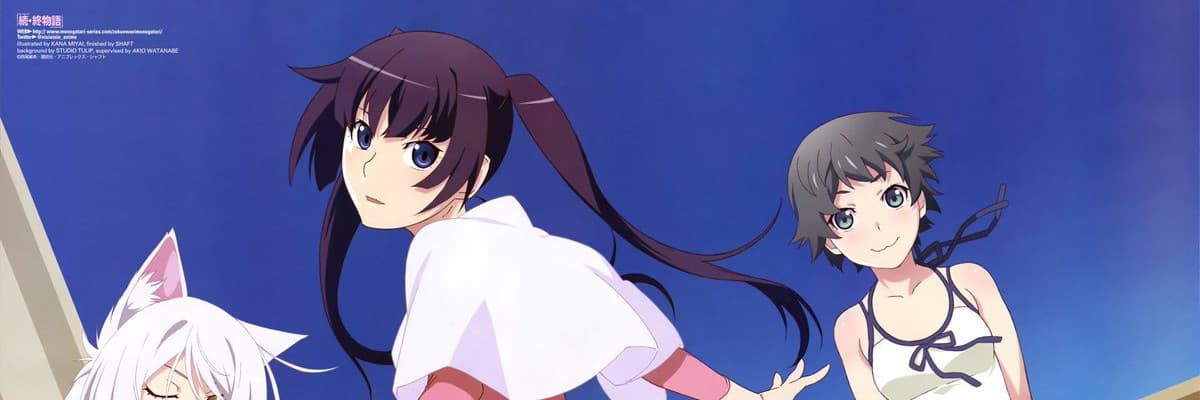
Well, here we are. The continuation of the end. The epilogue. Zoku Owarimonogatari is the final instalment of the story of the Monogatari Series. A mirror story, a twisted reflection of the story that we have just witnessed.
I’m a big fan of the mirror world gimmick. The drama of someone being suddenly different is a fun way for a story to explore the characters from a different angle. With such complex characters to mess around with, this series can do some really clever stuff. But Zoku Owarimonogatari does more than just that. The series has taken the gimmick and redefined it, using the very concept to explore how the characters look at themselves.
So, at its heart, this series is more than just about seeing the mirrored versions of the characters. While the central mystery at first appears to be how did Araragi end up in this mirror world, the real question becomes why. Why are these people mirrored as they are?
A mirror, as Gaen Tooe tells us, lets us see our back. The mirror lets us see the hidden parts of ourselves, the parts we can can only see in a reflection.
So, in the mirror world, the characters are reflected, flipped and mirrored to show a different side of themselves. The mirror world shows how people are on the inside. Hanekawa appears as Black Hanekawa because that’s who she has long carried on the inside. Mayoi is now 21 years old, the reflection of a girl who has continued to grow internally despite her age freezing externally. And Tsukihi remains unchanged because she is as she appears.
And what is the point of showing how people are on the inside? Perhaps it lets Araragi peer deeper into the realities of his own world. We look in a mirror to be able to see and study ourselves. Here, the mirror is being held against his reality, allowing him to properly look at it.
Yet, it’s more complicated that that. Araragi doesn’t find himself pulled into a mirror world, but rather the mirror world finds itself pulled into Araragi’s. The reflections aren’t the mere backsides of the characters. This series isn’t more than just a fun gimmick at the end of the story.
Because the reflections aren’t just the hidden sides of these people. They’re their regrets. The last 20% that is about to be forgotten. Mayoi is 21 because she regrets not being able to grow up. Shinobu is a human because she held regret for not being that noble woman anymore. These are regrets that the characters have lived with and forgotten.
And as Araragi has just graduated, he too is about to move on from the school and his classmates, leaving behind these regrets. This series is about them. It’s posits that while you cannot and need not change them, do not forget them.
All the mirrored people Araragi meets and interacts in this series allow him to see the last 20% that he could not see before. In this, the series is doing more than just tying up loose ends. Narratively, I think this was done in Owarimonogatari Second Season. Instead it’s rounding out everyone. Poetically polishing them that last 20%.
We don’t see Senjougahara in the mirror world. For Araragi there was nothing her regretted with her. And I’m sure we meet Gaen Tooe because Gaen Izuko regretted how she dealt with her older sister. We see and meet everyone for a reason, and it’s all with the purpose of showing us that these people are complex even when everything seems to be neatly resolved.
Speaking of Gaen, though… The brilliance of this series and of the achronological storytelling really shined in this bathing scene. The rainy devil was of course a counterpart of Gaen Tooe, in the same way that Ougi is for Araragi.
And her talking about it in this conversation punctuates Hanamonogatari. She repeats the opening comments she made in the series. She argued that the rainy devils left hand cannot be a poison or a medicine, that it can only be a corpse. In this sense, we can read another layer into who Numachi Rouka really is. And what the monkey’s paw role really was. (This series would also explain why Ougi appears as a boy in Hanamonogatari).
And being able to hear Tooe talk about her sister finally shed light onto my final question of the show. Why does Gaen Izuko know everything? Because there is nothing she doesn’t want to know. This is good enough for me. Knowledge was a very important thing in this series, and Gaen Tooe had the final perspective: it doesn’t matter. What’s important is understanding, and that strikes the heart of what this series is about.
We need to understand our regrets. Because we can be right or wrong, left or right about what we know. But we need to understand it, even if we cannot change it. The final lesson for Araragi.
Frankly, I cannot believe this is it. Well, I can, after this series. Owarimonogatari Second Season was such a remarkable way to conclude the story. I was nervous about Zoku Owarimonogatari. I didn’t want to finish with a sour taste in my mouth. But it wasn’t. I didn’t see where you could keep going with a story that was over, but it’s this cherry on top.
This last 20% that Nisioisin and Shaft have made to the story, reflecting on it all, acknowledging the imperfection and regrets of an incredible cast of characters. It’s a statement that makes the ‘happily every after’ of the final season more complicated, yet does not undermine it. These peoples lives continue after the graduation, living out the consequences of imperfect choices with their regrets. But that’s ok. With these regrets we can still live complete and happy lives. Left foot or right foot don’t matter. Just take a leap forward.
58.5 out of 60 users liked this review