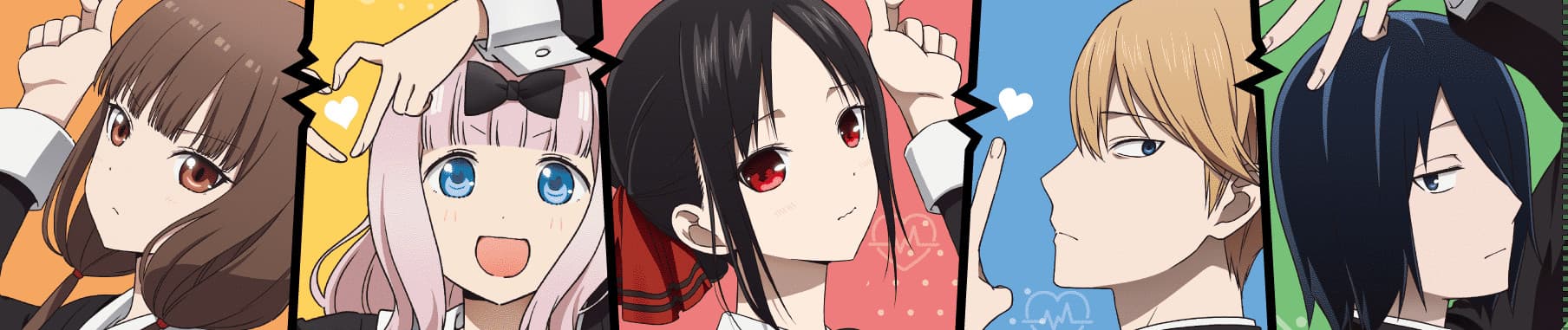
When you pick up an anime to watch, what draws you towards the shows that you select? Is it gripping drama, crafted plot and climax, riveting conclusion and resolution? Is it meaningful characters, excellent dialogue, and insightful ethos? Or maybe it’s uproarious comedy, tumultuous conflict, and tear-jerking heartfelt scenes? If you’re reading this review, it’s probably because you’ve either watched or plan to watch Love is War, and maybe you’ve ether experienced or desire to experience any of the things listed above. And rightly so - this show covers a broad variety of grounds, not just in topical content but also in genre and motif.
I think that my opinion about the show is most properly introduced with a quick recount of how I arrived at this point. I’m not normally one to watch shows while they are being released, but Love is War has been a surprising exception for me during each of the three seasons so far. I saw S1 in an anime club when I was still in college, coming off a emotional journey through sad KEY works and looking for something comedic to boost my spirits. When S2 advented, I turned again to our warring scholars fairly close to the series’ release, an unusual exception from my general path of waiting years or even decades between release and viewing. And throughout S3 I’ve stuck closest of all, having just finished the series right on the tails of the last episode. I feel surprisingly invested in this series, perhaps an indicator of how seriously I take slice-of-life shows, and I am now eager to put my thoughts into words.
Generally, I start these reviews by breaking up the shows’ content into basic categories, and I’ll do the same here, with the exception that I want to start this review by praising what I feel to be the shows’ greatest strengths. I actually think that S3 moves a step beyond its predecessor in S2, which definitely surpassed the artistic content of S1, particularly with respect to some of the dramatized scenes. Vocal and visual design are intricately intertwined in this show - when the narrator starts talking, and as soon as he starts putting the machinations of our protagonists’ minds into spoken word, the art moves with it. The trivialities of the everyday life, and the interactions between the warring players - all of it is blown into grotesque heights, with the weight of the characters’ worlds resting on a single word or gesture. I think that S1 tested the efficacy of this notion, S2 built on it and S3 really pulled it into the limelight. I can say with certainty that the dramatized artwork contributes significantly to the power of this series’ narrative style.
Speaking of narrative style, I’ve gushed about the presence of the Narrator in earlier reviews, and I’ll do so again here. The narrator is quietly but arguably the most important and powerful character in the entire series. Each skit is set with his powerful voice, and the machinations of all the characters’ minds are vocalized in his deep and authoritative statements. I’d say it’s here that Love is War makes itself most distinct from the glut of romantic comedies saturating the modern anime landscape - as the viewer, you have a psuedomniscient view into the characters’ thoughts, wishes and feelings. I’m not asserting that the Narrator tells you everything there is to know - far from it - but he will tell you enough to keep the comedic element alive, and I love A-1 pictures for it. Actually I just love Aoyama Yutaka in general.
Wait - speaking of things that I love - did I mention I love Suzuki Masayuki in general? I praised the S1 OP as being one of its strongest elements, and while I feel that S2 slipped back a peg in terms of OP/ED strength, S3 roars back with an absolutely amazing opening made by the man himself. In a way, I think that the S3 OP takes itself less seriously in the same way that S1 OP asserted its own ridiculousness, and in general I feel that the sound design of this song is more poignant and tastefully linked to the visuals. I also appreciated the S3 ED probably the most out of the 3 so far, with Suzuki Airi putting on an excellent performance. I wouldn’t say that Love is War is an anime you watch entirely for the music, but it doesn’t disappoint me here.
All right, I’ve given a quick gloss on the style and music, and while I usually don’t dedicate a ton of time to this topic, I want to turn quickly to the art. I’ll say - it’s actually quite good. It does lean on CGI at times, which can be controversial, but I appreciate most of the style, coloring and detail used throughout this show. The one exception is the final arc, in particular the final episode, which isn’t great - it’s absolutely fantastic. Sure, I understand that A-1 was probably saving their best for last, but I absolutely adored the art direction in Episode 13. I obviously can’t say much without spoiling the ending, but just that little piece alone moved my regard of the show’s art up a notch in my book. The remainder of the show, while nothing outstanding, is surely a step-up from the uninspired motifs of S1, and more builds on the fanatical story-telling purposes of S2. I don’t think you’ll be distracted by inconsistency, with the CGI being the only place where I could see frustration potentially arising.
So I’ve talked about the narration, the music, and the art. Let’s turn now to my favorite part of any review: the plot and characters. Now let me make one thing abundantly clear: Love Is War is a romcom and a drama. But I think I’d do it a disservice if I failed to recount how I reached this conclusion, so I’ll provide a quick summary of my conclusions when analyzing S1 and S2. The majority of S1 focuses mainly on the show’s comedic elements, and without speaking specifically about those right here, sticks fairly close to comedy throughout most episodes. However, nearer to the end, it delves a little bit deeper into drama. What do I mean by that? Specifically, not all the topics brought up, the conversations had, the thoughts visualized, exist for a laugh and a farce. The writers introduce topics for the sake of dramatizing the events of the story, most often the relationships between the characters. And I’m not saying that tongue-in-cheek here. It’s incredibly obvious that the entire point of the show - all three series - is to poke comedic fun at the battle of wits between Shirogane and Shinomiya and the romantic tension behind it. When all that’s shown resolves into comedy, everything’s as normal. But sometimes, what’s shown is left at the drama. Maybe we get a glimpse into Shirogane’s family pressures or Shinomiya’s upbringing. It’s not there immediately for the comedy, it’s probably for the drama.
And here’s where my first major concern with this series begins. Some romantic comedies do it more than others, but you’d be hard-pressed to find one that doesn’t integrate some sort of drama at some point in the story. Maybe it’s in the chapters leading up to a confession, maybe it’s in a backstory that draws the characters closer together, maybe it’s something they mutually experience not for the laughs but for the heartache. And by no means am I saying this is a bad thing! Shows can cross genres without losing a sense of who they truly are, if and only if they remain fast to what gives them their identity. In S1, I felt that that the writers switched focus off comedy and towards genre in the final few episodes, weaning off the battle of wits and onto a story of separate-but-similar longsuffering. I didn’t love this then, and I entered S2 hoping for a return to the series’ comedic roots. Instead, I was met with an attempt to integrate comedy and drama together, right from the start, and across several arcs where I felt that both suffered because of it. I said this before, but when the narrator stops talking, Love is War stopped exhibiting its magic for me. The details behind this are covered more thoroughly in my S2 review, but let’s cast that aside for now to look at the new light that S3 brings. And what better way to do that than by looking at the characters?
I’ll begin with probably my favorite, a character that I feels suffered the most with the lackluster drama development in S2. Certainly, Ishigami’s character was developed substantially in S3, but I felt that the authorship behind his story was simply incongruent with the rest of the show. He was dedicated one somewhat insulated episode then, but in S3 is thankfully given not an episode or an arc but a character arc, one that is developed more subtly and with more purpose in S3. In S2 I decried that his episode was concluded by Shirogane’s heroics, and I’m very happy to report that in S3, Ishigami’s story is his own. Now I don’t think it’s a particular complex one - after all, this is a romcom - but it’s a lot more meaningful and shows significantly more respect to the character to show him change and grow over time, rather than come to a banal conclusion at the end of a single episode. I’d also argue that Ishigami changes for the better this season, even throughout some of the more comedic sections. Simply put - he follows a basic character arc where he learns to trust in others but more importantly himself. Although I couldn’t call it incredibly strong from a analysis standpoint, Yuu’s arc is touching in its own way, and is probably the strongest character-related aspect of this season for me.
Things fall fast when looking at his studious and straightedged counterpart, however. From her introduction, I’d never seen Iino’s need to exist. Does that sound like an oversimplification? Sure does. But let’s take a good look at what purposes she serves. From what’s most accurately described as straw opponent in S2 to a anhedonic in S3, Iino can pretty much be replaced by a series of contrarian maxims. Yes, I know that her character serves a very basic purpose of being a foil to Ishigami, but this purpose is already well-met by Shinomiya’s character. In S2, her arc is resolved by Shirogane’s brilliance and Shinomiya’s craftyness, and ever since she remains along for the ride. I don’t see her grow in the same way that Ishigami does, and I don’t even see the vestiges of what could be called a character arc. I don’t hate Miko - she reminds me of myself more than anyone else in this show - but if she doesn’t add anything to the story, why does she need to exist?
A click on my page will rapidly reveal some of my favorites - shows, staff, and characters. It’s not super often I turn to one of my favorites when describing another anime, but I’ve been dying to make the comparison here and I think it’s about time. One of my favorite characters of all time is Hiiragi Tsukasa, the sugary side of the twins from Lucky Star. In contrast with the author’s namesake, her twin sister Kagami, Tsukasa absolutely embodies one-dimensionality. And I do not say that lightly. She is the sigle most superficial character that I’ve ever run across in any piece of media. She is the very definition of “head empty, no thoughts.” Why in the world do I like her? It’s because of what she represents - Lucky Star is not a romance, but it is a comedy, and it is also a satire. Tsukasa’s unidimensionality satirizes the flat character trope so prevalent in modern media and anime in specific, simply but taking a flat character to its logical extremes. Tsukasa had simple thoughts, simple feelings, simple reactions. She is the brilliant result of something at it’s very farthest from the median. So why would I spend so long talking about a purple-haired girl who first appeared in a show from 2007? It’s because she is the perfect conduit for me to talk about the next character.
Fujiwara has always been a difficult character for me. I noted this in my S2 review, but she is, in some ways, the perfect character for a comedic anime. Flat characters provide a touchstone - something predictable and consistent. You know how they will act given certain stimuli, and the anticipation of this action can in itself be comedic. My biggest gripe with Fujiwara in S1 and S2 was the repetition of her antics - predictable response to different circumstance can be comedic, but exact replication of the same circumstances, with only tiny details changed? That becomes boring pretty quickly. There’s only so many times that “Fujiwara teaches clueless Shirogane how to do something” is interesting, and what’s perhaps funny the first time ceases to be funny the next. Earlier, I decried the fact that Iino has no visible character arc. Chika has almost no character development at all. She does not change or grow. She harbors equally destructive and negative views of her male counterparts at the end of S3 as she did at the beginning of S1. I don’t get why the writers keep pulling her into conversations that are supposed to have meaning, just to have them instantly slip off the single vertex that is her character. But most importantly, unlike Hiiragi, she’s not a satire. This show does not seek to be self-aware or find irony within itself - nor does it need to - so why, why, would you ever think that a character so hopelessly flat could be interesting? She isn’t used as a touchstone, but doesn’t work as a character with depth either.
All right, let’s address the final two. In my S1 review I identified Shirogane as my favorite character, a title that he since lost to Ishigami in S3. He was a character I could both like and respect, thanks to his sincere care for his small family and simple but meaningful desire for the rest of the council’s happiness. I did, however, struggle with the limited amount that his character actually developed in S2 and yet again in S3. Sure, this time he shows true determination. He moves beyond merely trying and actually leans, in some ways, on his friends and family for help. And thank goodness, he doesn’t patronize some of his peers by being portrayed as a brilliant savior who can resolve all their problems, instead permitting others to grapple with their own struggles and dreams. But we get less into his head in S3 than before, and the narrator’s voice drops off when revealing his machinations. Shirogane becomes less human, less identifiable to me in S3, and in doing so, the sharpness of the dramatic development in his story loses its edge. Do I still like Shirogane? Yes. I think he does grow, even if less obviously so, in S3, and I credit the writers for integrating his drama better into the comedy than in previous seasons. But do I think we would have been better-off with a few more glimpses into his head, either for the laughs or for the tears? Yes, probably so.
Sometimes I leave the hardest for last, and again I have done so. Shinomiya Kaguya is someone I neither liked nor respected all throughout S1 and S2. She is someone who is absolutely consumed by self-interest. Unlike Shirogane, who actually seems to care for the student council, for her, they exist only as pawns to an end. Although arguably less verbably abusive than Fujiwara, Shinomiya is a harsh person with the only explanation for such being a difficult upbringing in an unusual household. She does things only for self-aggrandizement, something that is confirmed positively in S3 but was obvious throughout S1 and S2. However, and I actually say this with great joy - she somehow manages to be probably the best-treated character throughout this third season, and someone who fares the best under the comedy-drama tension. Moreso than Miyuki, she rises to a difficult task at hand. She genuinely challenges her superficiality, acknowledging late (but thankfully at all) that she likes her crush not only for his dashing looks but also for his character and sensibilities. It’s hard for me to give a ton of credit to someone who relentlessly criticizes those who love her most, but the development is there, and for that I’ll give A-1 some credit.
This is supposed to be a review free of spoilers (to the best of my ability) so I can’t divulge too much detail about the plot. But take what I’ve stated about the characters as my personal assertion that this season is a step up from S2. Sure, the writers maintain the sometimes odd comedy-drama tension, but this season thankfully concentrates most of the drama toward the end, leaving me to appreciate the purely-comedic sketches in the first bits just as much as I appreciated them in S1. And furthermore, with all the character development struggle the show goes through, the final episode (two episodes, really), is honestly pretty good, particularly with the visuals and music. If you liked S1 I think you’ll like this one too, if you were turned away by S2 I can weakly recommend this one as well. For me - Love is War has given me a better appreciation about what I like in an anime: the art, the writing, the characters, and how each of them can be used or misused to tell a story.
67.5 out of 121 users liked this review
