Okay, this will be very off the cuff and probably sloppy.
For several months now I have deluded myself into thinking I wrote a review for Char's Counterattack. You can imagine my shock now when I checked my reviews list, simply to reread it and see if I touched upon any interesting ideas, and saw that I had actually been thinking about my review of Zeta Gundam.
I have in fact, reviewed more non-Gundam Tomino works than actual Tomino Gundam works. This was a very odd idea to consider because I have been attempting, for months now, to also write a Double Zeta review (which will never see the light of day). This self-delusion ultimately epitomizes some core ideas of the film, Kidou Senshi Gundam: Gyakushuu no Char, or as it is also known, Mobile Suit Gundam: Char's Counterattack.
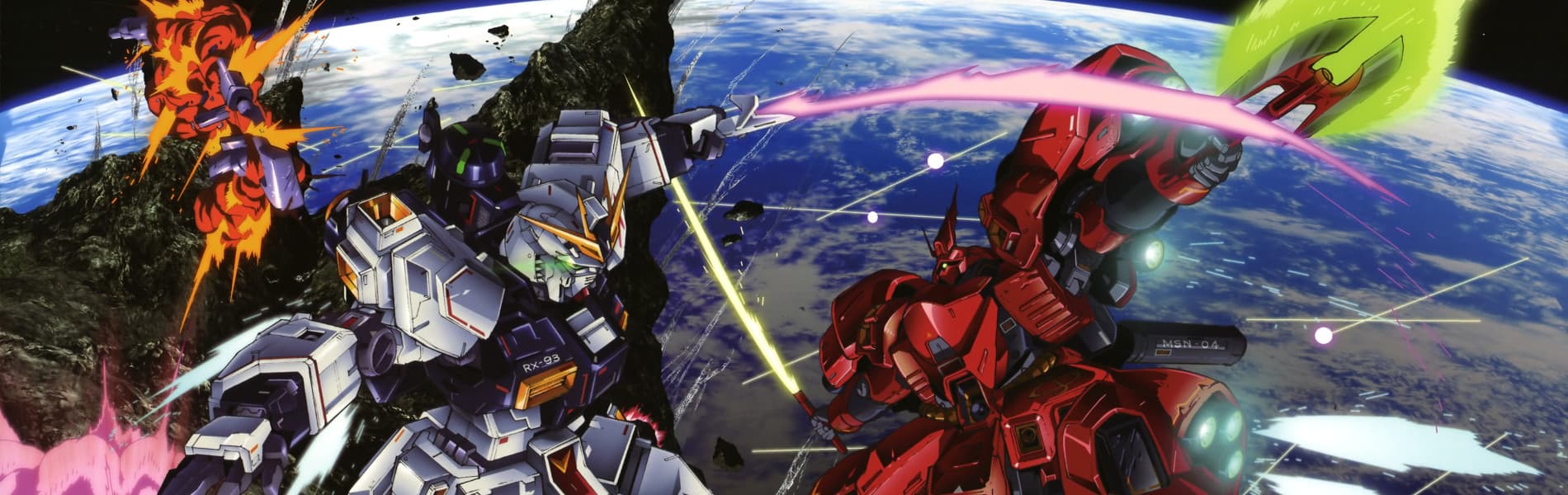
This film is both a very controversial and very beloved film. It is the ultimate climax of one of the most iconic rivalries in anime, capping off several years of storytelling and 139 episodes of TV anime, the Earth itself is once again at the mercy of a renewed Zeon empire, this time led by the elusive Char Aznable, and Amuro Ray alongside allies from prior entries must work to defend the Earth from this threat.
But, that very description can also be read as a lie by most people. Many see Char's actions coming off of Zeta as nonsensical, the only relevant returning characters outside the main rivalry and Bright, Mirai, and a spirit of Lalah Sune. Every other character has seemingly moved on, and are not relevant to this conflict, and that can be a gut-punch following on from Zeta or even Double Zeta. One may ask themselves, "Where's Kai?" "Where's Fraw?" "Where's Kamille, Fa, Judau, Sayla, and everyone else?" It feels very cheap, to have followed all these various characters, seen them grow, delve into despair, and come out on top, just for them to seemingly be tossed aside in the conclusion, but that also feels like the point of Char's Counterattack.
Aside from Bright's family, the only returning characters are just Amuro and Char, and this feels intentional. Everyone else has moved on, has grown up and had a good life, Bright and Mirai are used to show this. These two characters we have known for years are happily married, have children, and have been caught up in this conflict. Bright fights for the sake of a future for his family, he is truly grown up. He's not the kid that only knew how to beat someone out of their personal problems like he was in 0079, and he's not in the role Amuro was in during Zeta, getting jealous at a child upstaging him. Contrast him with the Amuro I just mentioned, as well as the Char of this film.
Char is, to put it very bluntly, a very pathetic man at this stage in his life. He's petty and has been unable to truly grow for several years. He has been hiding his true self throughout the entire series, continually donning the Char Aznable name, and when that name becomes too much he quickly dons another. The conclusion of Zeta saw him reuniting with Haman, and when forced to confront her he chooses to run away, leaving her to take center stage and have to be dealt with by a new group of kids forced into an unnecessary war. His character in the film feels like the truest next step from that stage. In 0079, he hid himself to execute a petty revenge while abandoning his sister, leaving her to grow without him. In Zeta, he tries to raise up the next generation, but runs away when actions he took as Char Aznable come back to bite him.
Now, we reach Char's Counterattack, the final chapter of his story, where he only does what people expect of him. Of course, the heir to the Principality of Zeon would want to "put the Earth to sleep". The environmental catastrophe here is obvious, and despite the maybe well intentioned place the original Zeon ideals came from, what Char wants to do is cause a calamity that would wipe out a large chunk of humanity and make Earth uninhabitable. When he recruits Quess, he takes on the role she wants, which is a father figure of sorts, but he fails to or just can't have her be a replacement for Lalah Sune, and that's where his true self lies, and why I called him pathetic.
Char's final words of the film, which are also his final words in the series (chronologically), are often made fun of, and for good reason. It's the truest encapsulation of his character, he lays everything bare in his final moments with Amuro, probably unintentionally. He has been fixated on the conclusion of 0079, the tragedy of Lalah, the one woman he ever physically got close to beyond mere sexual desire like we see in this film. This is why I find any attempts at romance with Char in outside media to ultimately be a mistake, and why I think Char's Deleted Affair is complete tripe (among other reasons). Lalah was the one woman he connected with, but he never truly connected with her. Lalah did love him, but the one she spiritually connected with was ultimately Amuro, through their newtype connection. Perhaps Amuro's spiritual connection with Lalah is what allows him to truly mature following her death, unlike Char. It's a very interpretive film so long as you ignore meaningless side content.
To talk briefly on said meaningless side content, I'd like to highlight Beltorchika's Children, the novel version of a rewritten draft for Char's Counterattack. It is ultimately mostly the same piece, though it allows to me to highlight an important factor about the ending as well as Amuro's character. In the novel, Amuro is in love with the titular Beltorchika, and she is even pregnant with his child. I find this to be an interesting contrast with Char, but ultimately unnecessary, especially in regards to the ending. This is beyond even just the simple fact that I prefer "Lalah? Your mother?" as Amuro's final line, and into thematic territory. In the film version, Amuro gives up his life for the sake of humanity, and I think Tomino also saw this as the truest completion of Amuro's character journey. He didn't need a child to carry on his life in a spiritual sense, he didn't need to directly love someone, Amuro himself has just become a man that truly loves humanity and believes that they can change, having developed from that boy in 0079 that kept everyone at a distance, who only really showed base desires towards attractive women like Sayla (please don't read too deep into my phrasing of this), he was never really friends with anyone on the White Base, you can tell Kai has his friend group that doesn't include Amuro. But, through his relationship with Lalah, his growing companionship and love for the White Base crew, and his experiences after the events of the series all helped shape him to be someone who has a base love for humanity. While Char is eternally trapped in that moment from 14 years ago.
In short, I don't find the timeskips of Gundam to be a mistake. I don't find the seemingly schizophrenic character writing of Char to be a mistake either. We see vignettes, brief periods in the lives of these characters, we see their flaws, their development, how they grow, how they fall, and ultimately we see their contrasting conclusions, a desire to destroy humanity vs a desire to let humanity grow and change. Who better to be the push in protecting a humanity that can change, than a man who has changed more than anyone else.
If you want to stop reading, the review is over in that paragraph, this is just an extended though that I couldn't fit in elsewhere as it contradicts a part of this review. I don't hold firm in what I said about Char not truly believing in the cause of this film, how I said he just does it because it's what people want of him. There are valid connections between this film and Tomino's other work, Space Runaway Ideon. Like I said, if you don't care, you don't have to read this. Tomino's final antagonist of Ideon is Doba, the father of the female lead and the man who "Shoulders the karma of the Buff Clan". Multiple characters have doubts about if he truly cares for the Buff Clan and wonder if he's just doing this to simply wage a war against the impossibly strong titan, and to take its power. Similarly, Char has a line in this film where he states that "Someone has to shoulder the evils of humanity." Perhaps he sees it as his responsibility to do this, like when Amuro made him a "sacrifice" in Zeta. He might see himself as the man who shoulders the karma of the Spacenoids, and is just trying to do what he believes is best in an ultimately evil way. Char, similarly to Doba, even has a ghost show up to confirm that he is "Innocent" (though the ghost Doba sees is far more direct, saying "You really do care about the Buff Clan".).
Overall, Char's Counterattack is probably the most interesting Gundam entry, up there with Victory for me. It leaves a lot for the viewer to chew on, while offering few answers, ultimately being a character piece showing this epic rivalry come to a head. Sorry if this review was a bit (see; a lot) nonsensical at times, I've just been wanting to talk about anime in a longform way again for a long time.
88 out of 93 users liked this review
