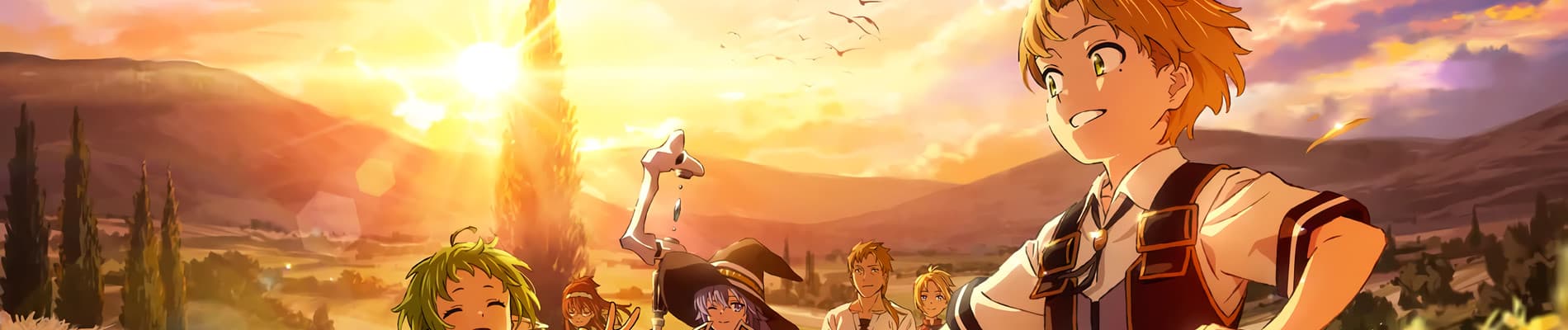
Maybe I can do it. Maybe even I... Maybe even a jobless, reclusive bum like me can get a do-over at life and can get serious about living.
As soon as I heard that line, it hooked me! As I started to question myself, am I about to watch this reclusive bum living a second chance at life, trying to live a life worthy of living? Well... the answer was obvious.
It begins after our protagonist got kicked out of the house by his siblings while masturbating to a porno. Being bullied and scorned from his past life, as scummy as he is, even so, he found the resolve, attempting to do something heroic—his life ended in a tragic accident—by truck-kun, no less. Later was reincarnated as Rudeus Greyrat, a beginning to new life, as a baby to two loving parents, with memories and knowledge of his previous life preserved.
That was... something.
I am still dipping my toes into the "isekai" genre. But when I heard of the word "isekai", I thought to myself—why are they not using the genre to its full potential? Only later, did "Mushoku Tensei" come into my existence that did everything that "isekai" as a genre I thought it should be. A second chance a life. What will you be doing if given that chance? To be better? Worst? Or the same? With having "a second chance at life" as one of the themes comes the delicate subjects to be touched. It sparks controversy. While he has good traits, Rudeus is a deeply flawed character—he is insecure, pessimistic, degenerate and lest we forget, his problematic pedophilic behaviour—yet that's what I found him intriguing. It's unbelievable! One of the things a writer shouldn't take a risk on is by making the protagonist unlikeable. And yet they somehow made it work! One's journey is only meaningful if his past was full of regrets.You wouldn't believe me if I were to say Rudeus is a kind and caring person.
"Wh-what!? Why are we wasting time here!? Where is the demon lord!?"
"NO."
Well, at least not yet. It's not that kind of story. It's a journey. Maybe we will get there. Maybe we wouldn't. Who knows.
The show understands its pacing. It doesn't rush. We spent 3/4 of the story in Part 1 following Rudeus from his infancy state to a childhood state, learning about the world, the magic and meeting new people. Spending his time being a recluse in his past life, he resolves to make the worth of something of this new life and tries to overcome the traumatic experience that he was carrying. Living this new life, he needs to find self-worth in himself—to learn to love somebody, he would need to start with himself. Can he return the love that showered him upon this new life? As we learn more about Rudeus, we also learn about the world and the characters he met along the way make every moment in this state thoroughly enjoyable despite the time it took. The story keeps you engaged in a way you wouldn't expect—if I were to describe it, it was a unique exploration of a human story set in a fantasy setting—it was an unexpected direction for a fantasy story, but it was definitely a welcome one.
Although it wasn't part of the focus of the overarching plot, I thought the delicate subjects in the show were handled tastefully with proper narrative reasoning, albeit not perfect. I applaud them for not sugarcoating it. The sexual depiction was also one of the delicate subjects touched in the show, yet I feel no semblance of annoyance towards it. Somehow they made it feels natural. In fact, I find it perfectly plays a part in the narrative of this world. It's there. It exists. I'd praise "Mushoku Tensei" for its world—the world is alive, exists and constantly moving outside of our main character.
One of the strengths that lie within this show is the immersion. Rudeus is a fascinating and fantastic character, there was so much to dissect out of Rudeus—it was a fun analysis study if you were like me, but put that aside, the characters in "Mushoku Tensei" were absolutely fantastic. The characters in this show feel like human beings—flawed, great character acting and natural dialogues that elevate it even more. It made you care for these characters—these characters' growth felt natural—well, like an actual human. A character doesn't have to be complex to be great, but depth does. The beginning story of "Mushoku Tensei" doesn't rely on the rich lore of its world to make it fascinating but on its characters, which I can't help but applaud for its approach.
The animation and visual was fantastic and delightful. I appreciated the touch of film grain and a slight camera shake that made the scenes look more cinematic. They did a good job, framing the scenes beautifully, capturing the world of "Mushoku Tensei"—it pulls you into this rich fantasy world, they understand. With care, the design was nothing less than fantastic, everything fit perfectly into the world—none of it felt awkward or out of place. The immersion of this show is just outstanding.
When I first looked up the staff of this show, I noticed a composer Yoshiaki Fujisawa known for his work from "Land of the Lustrous" will be doing the soundtracks for this show, I was excited. But admittedly, I was slightly disappointed as it wasn't on par with his other work, "Land of the Lustrous."—otherwise, it was still fantastical and fitting for the show. The soundtracks themselves are memorable if I were to say so myself—it has its own identity, and it's unique. On the other hand, Yuiko Oohara did an incredible for the opening and ending songs—the songs are filled with emotions and lyrics that reflect the story—analyzing them was fun. I loved every single one of them.
"Mushoku Tensei" is a fantastic show. If the future seasons get the same treatment—you can only expect greatness from this story. There is so much to look forward to in this rich world of "Mushoku Tensei".
133 out of 150 users liked this review