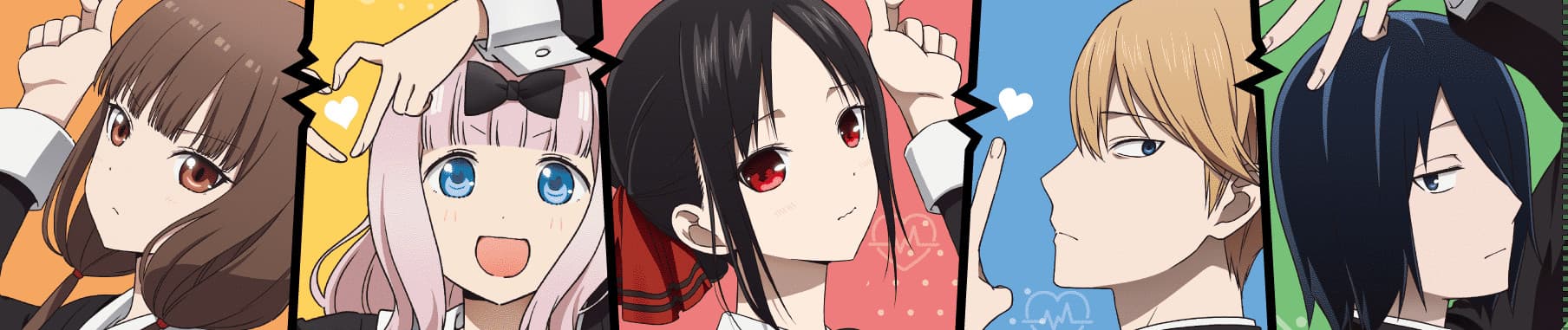
There’s a couple of things that make good shows good. Good characters, strong plot, engaging climax, and satisfying resolution. But perhaps one of the most-overlooked aspects of a good show is the way it fits within its genre. Indeed, the best shows become definitive within their genres, to the point at which you think of the show itself when you think about the category of shows it defines. After watching Kaguya-Sama, it’s become very clear to me that this show is one that will define its category, both now and in years to come. That’s a bold statement from a show that comes from a genre so well-established, yes, slice-of-life, romance, and comedy are three already well-explored in the world of anime, each featuring its own definitive works. But the true beauty in this show comes in the way it integrates these seemingly-disparate genres into something that’s truly incredible, striking, and dare I say - beautiful. For a show that’s explicitly about love, there’s just so much to love about this show, and I won’t hesitate to share my infatuation with it, with you.
So let’s get started. But before we get started, let’s take a little closer look at what I discussed earlier. I made the claim that slice-of-life, romance and comedy are already well-established in their genres. What I mean by this is that each genre is one that features a few outstanding, seminal works. Slice-of-life? Immediately the incredibly powerful yet personal story of San-Gatsu no Lion jumps to my mind. It’s an incredible discovery of the life of a young man and his adopted family, and a heartwarming glimpse into his life and its tribulations. Romance? Instantly Toradora puts itself in the forefront of my thoughts, its story of an uneasy alliance turning into an unexpected yet incredibly poignant love story that cuts so much deeper than a simplistic tale of attraction. And what about comedy? How can I avoid thinking about Nichijou, a show with comedy so fantastically ridiculous that it still inspires laughter and admiration years after its release. And those are just examples of shows that I’ve personally seen - I cannot claim to know all of the seminal works in their respective genres. But what I do know is that they stand out, they characterize the genre, they make the genre what it truly is.
Where does Kaguya-Sama fit into this? In my mind, it’s very important to realize what exactly the show claims to be. Firstly, I don’t think it’s a stretch to say it’s a slice of life, providing a really good look into the personal lives of Miyuki and Kaguya and Chika and Yu and Miko and all of their schoolmates, their families and their friends, their daily lives and their interests and passions. And here’s the thing - it’s an incredibly good slice of life. Yet it’s not just a slice of life, but a romance, one that foregoes simplistic tropes to tell a story of connection not between the titular character and the other protagonist, but also between several others sharing a similar walk. But at the same time, it’s an incredibly good comedy too. Perhaps the humor isn’t for everyone, but I personally found the premise - an epic tale of pride and wits, the balance between conflicting personalities and the tremendous narration that ties it all together - positively hilarious, and something that struck me as unique as it is effective.
I don’t want to put this off any longer, so I’ll preface this review by saying I highly, highly recommend this show, even for the distinctive reason that I find it comparable or even surpassing seminal works in each of these three aforementioned respective genres. Individually, Kaguya-Sama is an extremely good slice-of-life. It’s an extremely good romance. It’s an extremely good comedy. But I don’t just highly recommend this show because it’s so good in each individual genre, I recommend it because it forms a seminal work of genre-integration. In a sense, I would say that Kaguya-Sama forms almost its own genre, its own category of show that somehow manages to integrate different elements into something so incredibly cohesive and natural that you almost don’t notice the pure magic happening until the final episode has passed.
Like I mentioned in my first review, I generally look at anime in the context of multiple categories - art, music, plot and characters. I’ll touch on each of these categories in turn, but I think it’s worth saying that there’s something very peculiar, very unusual, very special about the way that each of these categories is implemented. Now I know I’m posting this under the S3 review, but I think the context from S1 and S2 is also important to take into consideration here. I argue that each of these four aforementioned categories is more than distinctive on its own turn. In contrast, each one is specifically and masterfully crafted to deepen the poignancy of the others. What do I mean by this? Let’s take a look at the art, for example. The art is directed in a way that builds the plot. Kaguya-Sama’s art shows you what’s going on. It draws out, in pictures and animations, what’s going on in the characters’ heads. It promotes characterization by demonstrating thoughts visually. And it coordinates with the music to build tension, show conflict, and draw conclusions. In lesser shows, each of these categories are distinct. Separated. Each lives within its own little bucket of good and bad. But in Kaguya-Sama, they’re integrated. Blended. Each one exists to build the strength of those around it. I’ll get more into this later, but it’s absolutely clear to me that this show is astoundly-well integrated.
I know I just talked about how well combined each of the categories are, but I’ll temporarily separate them to talk about each one in turn here. The art of Kaguya-Sama has always been exceptionally strong. S1 introduced the use of color, light and shadow to describe the passionate battles between Kaguya and Miyuki, demonstrating their interpersonal struggles not just in the words they spoke but in the visuals we see. S2 and S3, moreover, absolutely expand on this theme and go so much further to demonstrate exactly what’s going on. From a more surface-level, Kaguya-Sama is just beautifully animated. Scenes are fluid and seamless, characters are consistently drawn and meaningfully designed. The same care given to a scene depicting total ware is given to a simple shot of the student council walking across their boardroom. A-1 pictures does not cut corners on mundane scenes and blow budgets on the bigger moments. Every scene, almost without exception, is drawn and animated carefully and with a passion requisite to an incredible finished product.
I’m not totally sure if this falls within the category of art direction, but it’s really amazing to me just how distinctly S3 fits within the categories of its artistic direction. Like I alluded to earlier, the art helps to tell the story. It’s incredibly clear that characters are drawn not just to put them on a scene, but with purpose. Even little background movements, gestures and expressions are animated with care and precision. And without getting too much into spoilers, the final few episodes of S3 are without a doubt some of, if not the very best, animated and drawn episodes from any anime that I’ve ever been exposed to. Please, if you do nothing else, find some time to reach the final few episodes of this show. Even if the comedy and drama isn’t for you, I think it will be very hard not to appreciate the sheer beauty of the animation and art at the conclusion of this show.
I’ve gushed about the plot too much. Let’s talk a bit about the music. Just to clarify, when I discuss music, I’m not just speaking about the openings and endings, although those certainly are here as well, but the entire soundtrack. And let’s talk about that latter bit first - the soundtrack is absolutely amazing. There are some shows that you know almost entirely for the soundtrack, and were it not for the rest of the show being so amazing, I think Kaguya-Sama’s score would be one of those shows. It’s amazingly fitting for a show that’s about the battle of the wits. The music sets the action and the conflict. It rises in tension as Miyuki and Kaguya begin their battles, and it sets off the sharpness of the conflict between the two genius protagonists. But it isn’t just strong and flashy, it’s also quiet and subtle. The soundtrack pulls you slowly and powerfully into the quiet drama that surrounds this show. It makes you feel the sorrow of unrequited love, the excitement of a reciprocated feeling, the uncertainty of just not knowing the answer. I’ve talked perhaps too much about Shirogane and Shinomiya in this series, but I’d say that the soundtrack perhaps has the most poignant effect on some of the other leads, in particular Chika, Miko and Yu - you will feel their stories through the force of the current beneath. I’m not a musician, but I will tell you I was enthralled with Kaguya-Sama’s soundtrack, and yet again, particularly in the final few episodes of this season.
But I had mentioned before that the music isn’t just the Opening and Ending, yet those are two very important aspects of this show’s score. I’m going to talk about those next, but first I want to rewind the clock just a bit. When you first jump into S1 of Kaguya-Sama, your ears are met with perhaps the catchiest, most suave piece of melody that we’ve received in recent memory. The S1 OP, sung by none other than Masayuki Suzuki himself, defines an era. When I think about this show, I think about this OP. But unlike other shows, with OP quality taking leaps and tumbles as the seasons wear on, Suzuki’s openings for S2 and S3 are equally as strong. In my mind, Kaguya-Sama is Love Dramatic, it is Daddy Daddy Do, it is Giri Giri. Again, I’m no musician, and it’s difficult for me to quantify what makes these songs so good, but I will assure you that nothing captures the tension and triumphs of a show like this quite like those openings. And the endings are equally incredible, with Sentimental Crisis, Blown by the Wind and My Heart Does Not Know What to Do perfectly capturing the romantic side of the romcom that Kaguya-Sama is. The OPs pull you into the show and prepare you for the wars ahead, the EDs ease you back out and through the romantic suspense beneath. Please listen to this show’s music - I think you’ll truly love it.
So that’s the art and the music. But so many anime have amazing art and music. I’d argue it’s the plot that starts to set Kaguya-Sama apart from other shows in its genres. If you’ve heard about this show, or even read through the first segment of this review, you’ll know that this show is based around two characters who want to be confessed to, but don’t want to confess to each other. It’s a very simple concept, and one that you may think is too simple to form three seasons of a show around. But I think the truth is a little bit deeper. Kaguya-Sama might be about a common trope of mutual confession, but it does so by integrating characters who make the trope interesting. But how does this work? And what gives this show the depth that I’ve alluded to before?
I think the answer lies in the genres I discussed at the beginning of this review. Let’s look at slice-of-life first. Slice-of-life is an interesting genre because it, more than other types of shows, lends us the least escape from the world that we currently live in. What do I mean by that? I mean to say that the slice-of-life seen in Kaguya-Sama, among other shows, makes me remember myself in situations similar to those in which I watch the fictional characters in front of me find themselves in. Kaguya-Sama isn’t just a romance - it’s a show that’s fundamentally about connecting with other people. And not all of these connections are natural. Not all of them are easy. And they all come at a cost. Watching this show brought me strongly back to the struggles that I experienced in similar social and educational situations not long ago. While somehow remaining funny and romantic, Kaguya-Sama is a shockingly accurate depiction of the bizarre social dynamics of a high school life. And not just the easy parts - the drama within social circles, the pain of working while being a full-time student, the absolute stress and trauma caused by academic and family pressure to succeed. It’s a little hard for me to assign complete realness to a comedy show, but even simple situations such as Miyuki’s struggle while considering college applications and his lack of sleep when staying up to help his family, resonate deeply within me. A lot of SoL shows pretty much forgo a lot of real-life pressures to focus on particular aspects of life, and while there’s nothing wrong with that, something about Kaguya-Sama’s respect for these topics fill me with a sense of positive admiration.
Next let’s look a little closer at the romance. I wouldn’t call Kaguya-Sama a predominantly romantic show, but I think the focus on “Ultra-Romantic” is strong in this season and it deserves special attention in this review. Romance is a genre that’s easy to get wrong and hard to get right. It’s one thing to tell a story of connection between two unlikely subjects, but it’s yet another thing to tell about how this connection comes to be. What do I mean by that? I think the romantic side of this show is strengthened incredibly due to the way in which it portrays the way each character grows. In S1, the attraction between Kaguya and Miyuki is theoretical, almost academic in nature. They respect each others’ brains, fortitude and cunning. But in many ways, the attraction is almost one of mutual pride. Each one wants to prove that the other desires themselves, and neither one wants to be first to admit it. A lot of the attraction is one of near-destruction. Each figure sees an incredible victory in a single, small admission, and incredible defeat if they make such admission first.
But that kind of sensation begins to waver, shift and evolve as the seasons wear on, finally coming to a sharp front in S3. Both protagonists come to a striking sense of understanding - they are forced to identify exactly what they find attractive about the other, and both characters start to realize that these qualities are much deeper and more meaningful than their intelligence or craftyness. In my mind, the romantic power of this show is found in the way that the main characters challenge why they’re fascinated by each other. In this way, Kaguya-Sama is not a show about superficial connection but deep, meaningful resonance that draws one to the other and forces them to take risks, experience pain, and reach beyond their comfort zone.
That being said, I think I would be remiss not to discuss some of the romantic subplots that also make this show truly amazing. Without going too deep into the spoiler-territory here, Yu’s subplot comprises its own category of powerful connection, perhaps not as flashy or overt as that between Shirogane and Shinomiya, but one that for some of us hits closer to home. His redemption of a truly painful situation, one that left him as a veritable outcast at no true fault of his own, and his ability to find a cogent bond rather than giving up on himself - is something that I as the viewer find both heartening and emotional. Again, I’ll avoid spoilers as best as I can here, but A-1 Pictures’ ability to draw such meaning out of a character first introduced through comedic gags, speaks to the power of this show’s story.
The final genre I want to discuss in this subtopic of telling an interesting story is that of comedy. I’ve found that comedy in anime generally comes in a few different fashions - ironic comedy and situational comedy. The first category occurs when the outcome is so different from expected that the result is hilarious in its absurdity. Maybe a character responds to a situation in the exact opposite fashion as expected, or maybe someone draws a conclusion completely antithetical to what the viewer expects. The second category happens when the outcome is completely unexpected, to the point at which you cannot anticipate how something will transpire before it comes to pass. I mentioned Nichijou earlier in this review, and I think it’s fairly prevalent how that show makes expert use of each of these two categories - not only do the characters find themselves in completely ironic situations, so many of the situations are so fantastical, so unexpected, so outrageous that they can’t be anything short of hilarious. I’d argue that Kagua-Sama makes very good use of both sorts of comedy, integrated in a way that a lot of other shows do not.
What do I mean by this? Let’s look at the ironic comedy first. This sort of irony is in which the outcome is different than expected. I’d say that this show makes excellent use of setting up a situation so it looks like there’d be a particular outcome, and then completely subverts the viewer’s expectations. One excellent example of this is seen in the interactions between members of the student council when they play games most often conceived by Chika Fujiwara - the tension grows as you increasingly expect the game to have a dramatic outcome that somehow forces either Shimoyma or Shirogane to reveal their love to one another, but is unexpectedly resolved in a fashion that nobody expected - maybe it’s an ace up one’s sleeve, an uncalled for interruption by another member of the council, or any number of unanticipated outcomes. The true unexpectedness of the ironic comedy in Kaguya-Sama made it, in my mind, one of the most hilarious shows I’ve seen in a good while. I do want to clarify that this sort of comedy simply isn’t for everyone. Not everyone will find this comedic in the same way that I do, and that’s perfectly fine! But I’d encourage you to give it a go - I personally found it a truly enjoyable experience.
The second sort of comedy is the situational type that I referred to earlier. I think that merely using the word “situational” does not adequately describe what Kaguya-Sama really demonstrates throughout all three seasons, but it’s a good starting point to discuss this type of comedic effect. This show creates comedy out of putting the characters in situations where their unique personalities bounce off of each other in humorous ways. A good example of this is our friends Iino and Ishigami, who are constantly placed in circumstances where their two opposing viewpoints come into tension. In this way, the situational comedy of this show helps to further the characterization of its players - it leverages the fact that these two characters are foils of each other. Earlier, I talked about how the slice-of-life, romance and comedy genres included in this show are extremely well-integrated, and this is one such example. The use of situational comedy helps to further build the characterization which in turn helps push the SoL and romantic plots. It’s brilliantly done and extremely satisfying to watch play out.
I’m not quite done talking about the plot yet, but I think I’m not going to be able to go much further without talking about the characters. And here, I actually think I want to discuss a lot of them one-by-one. Kaguya-Sama is filled with a surprisingly-large cast of different figures, each of which cannot be reduced to a few lines in an anime review. Furthermore, I think that understanding each character individually really helps the viewer make sense of the relationships between them, and better appreciate the plot that tracks how these relationships grow and evolve.
So in the interest of doing so, I want to turn first to one of my favorites, Yu Ishigami. Yu is a character who is oh-so-easy to oversimplify, particularly in the context of only the first two seasons. He’s portrayed as a bit of a social outcast, someone who appears to prefer playing video games to interacting with his peers. Moreover, he’s also suggested to be someone who we simply don’t know much about, with characters like Chika and Miko mistrustful of his dubious beliefs earlier in the series. However, Yu encompasses a great deal of depth that cannot be understood without a closer look at his backstory. Without going into spoiler-territory, it’s clear to me that S3 does an incredible job giving Yu the developmental space that he needs to make his true passions and desires clear. At first, we were just given a facade, the dark and antisocial side of Yu that rejects interacting with others. Now, we’re given a reason for his behavior, a look into some of the social and moral quandaries that he faced before arriving at his situation.
However, I’d say the best part of Yu’s character development in S3 is what I see as a redemptive arc in his relationships and behavior. He holds an unusual but strikingly beautiful relationship with Kaguya, who betrays her perhaps-obscured but secretly ardent desire for his success and well-being, despite the pains that it may put him through. His friendship with Miyuki is simple in execution but not in design, with both characters leaning on each other to overcome their difficulties. And perhaps most of all, his interactions with Chika and Miko reveal a real reversal of the initial dispositions that each side had with one another. Sure, Yu hasn’t overcome all of his negative preconceptions and he certainly hasn’t come to fulfillment with all his life’s relationships, but the sheer amount of courage and action he takes in this season is inspiring and speaks to the strength of his character.
Another character who evolves and grows significantly throughout the course of S3 is Miko Iino herself, a straightedge and uptight rule-enforcer who starts to show a little bit of her inner desires, thoughts and goals. Perhaps more than any other character, Miko is believable. Her behavior reminds me of the way that I acted in the past, and her interactions with others, particularly when revealing people who’ve disregarded the rules, is both convicting and comedic. However, I’d say that the most compelling part about her character is the way that her inner conflict is teased out throughout the course of S3. Miko’s desire for approval, her internal struggle to perform despite the odds, is something that cut right to my core. I mentioned earlier that she reminds me of how I’ve acted in the past, but more importantly she reminds me of how I felt in the past and how those feelings continue to influence my mental and emotional state to this day. I can’t simplify Miko’s character into one of rule-adherence alone, when the plot and character development pushes other aspects of her personality and behavior, and gives us a glimpse into her mind. Again, I can’t go too much into detail without betraying spoilers, but it’s very clear to me that her character was developed with a multifaceted result.
I think I’m going to leave the main two for last, so next I’ll turn to Chika Fujiwara, who is as different from her fellow council members as could possibly be. It’s easy to oversimplify Chika into a role of mere comedic relief, and I think this is a very common trap for reviewers to fall into when regarding her character. How does a character grow and change if her role is primarily to assist the ironic and situational comedy we discussed earlier? I think the solution to this question is to first realize that she isn’t merely a comedic relief. Chika, perhaps more than any other character, deeply cares about the well-being of her friends and peers. I think her consistent assistance of Miyuki, who struggles to immediately pick up on new skills, is an incredible example of this. Her lessons - singing, dancing, rapping, making balloon animals - aren’t merely just comedic gags. I’d argue it’s a trap to fall into the notion that they exist entirely for the comedy. They’re an incredible, active example of the way that Chika actively works to maintain her friend’s dignity and encourage his development of new skills. And it’s not just the president - it’s each of the members of the student council. Who does Kaguya call? Chika. Who does Miko complain to? Chika. Who tempers and challenges Yu? Chika.
Moreover, I think the depth of Chika’s character is revealed when you take a closer look at how she behaves as part of the student council. Not to their detraction, but it’s pretty clear to me that Kaguya and Miyuki often hold varying motives for actions that they take and games that they play. They think primarily in the context of revealing the other’s motives or intentions. But Chika, on the other hand, is just there to have fun and build bonds between the council. In a lot of ways, she pulls the other four out of their internal struggle, allowing them repose from the turmoil that wracks their minds. Whether intentional or not, Chika is the personal relief as much as she is the comedic relief. And her character is significant as soon as you think about what the show would look like if you took her away - almost unthinkable. And she’s not static either: I think S3 makes it increasingly clear just how much she cares for every one of her friends, and the lengths that she’ll go in order to resolve the mysteries that bother them.
I kind of did this intentionally. I really wanted to leave Kaguya Shinomiya and Miyuki Shirogane till the very end, and to kick their discussion off, I’d like to talk about Kaguya first. Kaguya is a character, that perhaps more than anyone else, changes significantly over the course of three seasons. In S1, it’s very easy to write off her character as one of incredible intelligence, wit and perhaps just a bit of pride. She was not someone to cross, and she was someone with a solution to every single problem that she faced. Perhaps not all things would be resolved in her favor, but her absolute control over so many situations was as impressive as it was hilarious. However, throughout S2 it became clear to me that her character shifted as she built relationships with others, in particular Yu and Chika, and revealed both to the viewers and to herself the absolute fervency with which she holds the well-being of those she cares about. S3, moreover, continues to build on this motif. We’ve been well-revealed to the familial and social pressure that Kaguya faces as part of her heritage, but her reaction to those pressures does not become part of her character until this season enters.
Kaguya, perhaps moreso than any other character in this show, is one of consistent conviction to a changing end. What do I mean by that? Without going too deep into spoilers here, I’ll touch briefly on an example - her interactions with Ai Hayasaka, Kaguya’s maid. In earlier seasons, the interaction between the two were one of request and acknowledgement. Kaguya asked, Hayasaka did her job. But in S3, it becomes incredibly clear to me just how much Kaguya cares about the well-being of someone who is shown to be her friend and sister. There’s no financial or social benefit to Kaguya treating Hayasaka as her equal, or caring about her feelings or well-being. But Kaguya does so anyway, at first with some slips and mistakes, and finally with true love and conviction. Her character remains convicted in her desire and goals, but her end changes. She learns to truly love those closest to her in the way that she desires to be loved, and this development is a heart-warming and striking thing to behold.
Looking even deeper, it’s incredibly clear to me in S3 just how much Kaguya changes in her behavior towards repayment. We get an incredible flashback that shows how she used to help others in the hope that her favors may be repaid some day in hope of social payback. This flashback is juxtaposed with her selfless behavior in S3, which reveals how she helps others because of her care for them, without any sense of being repaid. Her ruthless and dogged encouragement of Yu to improve his test scores is not something that comes back to benefit her, it is entirely based on her desire to improve his self-worth and his disposition to confess to his own love interest. S3 makes it incredibly obvious that she helps others because she wants to, not because she thinks she will benefit.
Finally, Kaguya makes incredible personal development in her personal disposition towards things that matter. In the first few seasons, it’s not incredibly obvious what attracts her towards Miyuki. Perhaps it’s his smarts or his looks, but the true reason isn’t incredibly clear. And I think the answer isn’t too far off - it might not even be clear to Kaguya why she likes him. However, in S3, we see this change. She clearly admits, to herself and to us, that she is attracted to his inner qualities. His care for others. His desire to succeed. His dogged work ethic. Her ultra-romantic desire is justified in qualities that she identifies, not superficial pride in showing him up. In a way, it’s the subversion of the war that makes Kaguya-Sama ultra-romantic, and it’s this unique take on this genre that make this aspect of her character development so fun to watch.
Finally, I can’t help but take a look at Miyuki, a character who has come so far from the initial skits and sketches of S1. Miyuki has always been a strong character. Someone who works incredibly hard, cares for those around him, and looks to always do the right thing. Although those aspects of his character don’t change in S3, they become more nuanced. Like Kaguya, Miyuki is posed with the question - why does he like her? And he comes to an incredible realization. He loves her for her action. Her bold ability to step out when he’s paralyzed with fear or indecision. And it’s this realization that drives Miyuki to change over the course of this season. He’s struck with the absolute conviction that he must prove to her - and honestly, to himself and to us as viewers - that he is worthy of her love. We can argue about the veracity of this statement but I think it’s hard to be impressed by his resolve.
I think the most obvious way that this comes out in the course of this season is the way that his innate character traits remain while this conviction comes to the forefront. His recollections of how he sacrificed his own time and sanity to support his family and little sister - even at the cost of his questionable wardrobe - is hilarious and heart-warming. It’s clear to me that the same traits that made him potato hard-working, determined and successful that Kaguya finds so attractive do not falter here. He’s determined to make the festival a success, although comedically not with the exact results he was hoping for during the planning phase - and direct it to reflect positively upon his council and his peers. He enables, permitting even Miko and Yu to contribute to the festival in their own unique ways, and plays upon their strengths to bring about triumph.
But the single thing that impresses me the most about Shirogane’s character development in S3 is what I alluded to earlier - his conviction. In S1 and S2, his resolve faltered at critical times. Perhaps this is most obvious in his battles with Shinomiya, but it’s also clear in the way he interacted with her on a normal basis. Their relationship did not have the opportunities to grow in the ways he wanted to, because of his lack of conviction and resolve. Although we see some shadows and moments of this in S3, it’s clear to me that the conviction is on an entirely new level. He is not satisfied with leaving his life at the status quo. He is absolutely and completely determined that he can and will make a change for his future. More than anything else, Miyuki revels in the fact that some opportunities cannot be revisited once they are past. What was once an impenetrable wall in the first few seasons becomes sumountable by his changing character. And, to put it bluntly - it’s inspiring.
I hope I’ve made it abundantly clear that the characters developed throughout the course of Kaguya-Sama S3 make the show what it is. Their relationships, growing and changing as the season comes to its climax and resolution, immensely help to further its vibrancy as a slice-of-life, its potency as a romance, and its hilarity as a comedy. I really do not think I can summarize the power of these characters in a few paragraphs, nor do I think you can fully understand them just by reading. Please, if you find yourself interested, go ahead and watch this show for yourself. Experience the growth and nuance that comes with living alongside these characters as they pull out their true passions and desires.
I want to attempt to pull this review to a close, and to do that, I want to go back to where I started. Some shows are incredibly good because of what they do for their respective genres. The decisions made, the characters developed, the plot points crafted - all those help to form the way future works in the genre are built. Kaguya-Sama would be an incredible work if it was not genre-defining, but I argue it fits the bill of all three that I personally classify it under - and perhaps more that I have overlooked.
As a slice-of-life, it provides a striking example of something that so many of us viewers have experienced in the past, or experience on a daily basis. When you peel back the fantastical artwork in the comedic scenes, and the romantic overtones, it’s a very realistic look at social life, balancing different personalities in the course of making friends and building relationships. As a romance, it defies superficiality by not merely portraying romantic tension as physical attraction or simplistic allure. It shows deep, meaningful connection between two characters who are simultaneously enamored with, yet a little afraid of, each other. It demonstrates how each one honestly identifies the meaningful qualities that form their appeal, and tells a story of a love that tugs on my heartstrings. And as a comedy, its incredible narrative style and extremely balanced use of ironic and situational comedy forms something that I couldn’t help but just laugh at. It is something that’s funny in a different way than so many other shows I’ve seen, and funny in a way that makes me want to come back for more. Kaguya-Sama is a seminal work in each of these genres, and even being a landmark in any single genre would be enough for me to recommend it. Being a seminal work in each genre, and an exemplary sample of integration between genres makes me just stop and plead: please watch this show.
Thanks for reading.
86 out of 92 users liked this review
