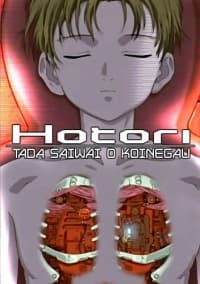
Most of my favorite anime consists of stuff that's either obscure or not very well known, or only well known in certain circles. While I've grown up watching anime, it wasn't until 2005 when I learned that anime was originally made in Japan, and I hadn't quite developed my preferences nor made a point of watching anime all the way through until about 2010, when I was in high school. That being said, I lurk on Anime News Network pretty much on a daily basis, and long ago, there used to be this really good weekly column series called Buried Treasure, where Justin Sevakis would talk about an obscure anime, its history, his opinions on it, and its overall availability. Some were good, others weren't, but I remember always looking forward to those articles as I always found them very interesting. I actually found a lot of my favorite anime through Buried Treasure, and I'm sad the column was shut down. I do remember the very first Buried Treasure article I saw, which was this one, talking about a short, little known anime short film called Hotori: Tada Saiwai no Koinegau, which translates to The Simple Hope for Joy, but I saw a subtitled version that translated it as I Only Want Happiness, but I'm just going to call it Hotori for the sake of brevity. The film came out in 2005, airing on Animax and based on a story that was the third winner of the Animax Grand Prix, a contest held by the channel of the same name to see which stories they could adapt to animation in some form. I remember watching Hotori after reading about it and liking it, though I forgot about it for years. This year, I rewatched it, and honestly? I think it still holds up surprisingly well, as much so as it did when I watched it as a kid.
In the year 2034, technology has advanced to the point where humanoid robots can act like actual human beings with memories implanted into them. In a facility known as the personality plant, a robot named Suzu is being prepared to become a replacement son to a family whose child, Ryou, died from a disease, and a nurse monitors his progress every day as he receives new memories and learns all about the complexities of being human, such as understanding emotions and human interaction. While out playing, Suzu encounters a young girl, Hotori, who he finds out is slowly dying from an Alzheimer's-like disease that's making her forget her memories. The two of them become friends and bond over their opposite situations, and slowly, Suzu begins to grapple with his own feelings and doubts about being a replacement for a dead child. But when Hotori's symptoms get stronger, she makes a frightening request: She wants Suzu to shoot her with a gun she found in a greenhouse, as she doesn't want to die having forgotten all that was important to her.
One thing I definitely noticed about Hotori upon rewatching it is that while the film was made in 2005, it really doesn't look like it. It has the look and feel of hand-painted cel anime from the late 90s, complete with slightly foggy backgrounds and the muted color palette. I say this as a compliment though, as the animation itself is pretty okay. Nothing groundbreaking for a digipaint anime from 2005, and by Sunrise standards its budget isn't the highest, but it does its job fairly well. Though if I had one complaint, it's that the eyes on the child characters are a little too big, almost making them look like aliens. It's not as bad as, say, the terrible Ijime OVA, but the big eyes do give the kids this really uncanny look to them. The music fares better though, with every usage of violins, pianos, saxophones, harps, cellos, and acoustic guitars fitting like a glove. I could probably give the soundtrack two words: Restrained and contemplative, never going overboard with trying to make you feel for the kids and their respective plights.
Really, restrained and contemplative are pretty good words to describe Hotori as a whole. The movie is slow and gently paced, and the main conflict is sad, but fairly down-to-earth, with no real antagonist in sight. Since the film has a small cast of characters, and runs for about 40 minutes, it doesn't have a lot of time to develop them fully, which is fine. Characters like Suzu's nurse Usui and Hotori's father and brother serve their roles well, and their personalities and problems are down-to-earth and relatable, even with the sci-fi angle the movie is going for. Suzu and Hotori, the two leads, receive the most screentime and development, and the film makes great use of them, total opposites of one another, but still managing to make them interesting and relatable, showing their weaknesses and strengths and having them subtly change, from Suzu learning more about feelings and emotions to Hotori being scared of losing her memories and all that makes her herself. It also helps that the movie is pretty heavy on "show, don't tell," relying more on body language and facial expressions to convey what the characters are feeling than relying heavily on dialogue and exposition dumping, and the gentle, low-key atmosphere of the film only elevates it, and everything else, beautifully. Even if the characters aren't the most three-dimensional and layered, they don't really feel like stock archetypes, though I wish we could have seen more of Ryou's parents and saw how they came to like Suzu as he is rather than just a replacement for their dead son.
Now, I'm sure people are going to take issue with the fact that a child wants her similarly-aged friend to help her commit suicide, and I can understand why. As far as I can tell, Hotori tackles the subject fairly sensitively and delicately, without relying too heavily on pointless melodrama, milking it for pathos, or treating it lightly. And don't worry, the film isn't as depressing as I'm making it sound, as it also has a pretty nice ending that neatly resolves Suzu and Hotori's arcs. That being said, there are a lot of questions Hotori leaves unanswered as a result of going for that ending, but there are other questions it doesn't really try to answer as well: Since Suzu is a robot, is he going to stay a child forever, or will he grow up physically in some capacity? I can understand wanting to leave some things to the audience's imagination, but...food for thought.
To quote Mr. Sevakis' article above, Hotori ~The Simple Hope for Joy~ is a pensive little jewel that reminds us of the joys of simply living, of accumulating memories. It walks a delicate line, maintaining a solid balance between the joy and the sad in life. It's quietly unforgettable. It's a shame there isn't more of it, but I'm glad Hotori is what it is, and I couldn't ask any more from it.
6 out of 6 users liked this review