Future Boy Conan
a review by Kuma187
a review by Kuma187
The 60s and 70s were certainly memorable times for those who were alive back then: with the still vivid memories of WWII and the wider and faster spread of information thanks to the democratisation of the radio and television, people became more and more aware of the troublesome issues that were plaguing their world, in particular the constant scare of annihilation due to the Cold War, the division of Korea after the Korean War that would go on until this day, the Vietnam War, which lasted for 2 decades and would leave its scars in the psyche of many, and whose terrible images of villages and people being doused with napalm shook the hearts of the civilians, and more.
It was only natural that the hippie movement would be born in the 50s and spread around the world from the 60s, as a way of counterbalancing the displays of cruelty. Despite enjoying a period of unprecedented economic growth, people grew more and more upset as they chose to break away from the regime of old, and Japan wasn't an exception.
It's in this particular environment that director Hayao Miyazaki, born in 41, grew up, and he was certainly not insensitive to the influence of the humanistic ideologies, which led him, avid reader of world literature, to travel to several countries in company of Takahata in order to get the rights to make animated adaptation of various classics, which would be known as the World Masterpiece Theater series. After 5 years on the project, Miyazaki is finally given the ability to direct his first animated work in 1978: Mirai Shounen Conan.
Adaptation of the novel The Incredible Tide by Alexander Key, the anime tells the story of a world that is healing, 2 decades after a major conflict broke it apart. You can already see some Nausicäa in this premise with its post-apocalyptic setting where Nature reigns supreme and its unrestrained antiwar thematic.
The protagonist, Conan, is a young boy living on Remnant Island with his grand father. One day, as he's settling it with a big shark, he meets an unconscious girl on the beach, whom he decides to help and take care of. While I've grown bored and annoyed by the "boy meets girl" formula in anime (and basically most other media as well) due to how overly sentimentalist and cliché of a story this type of premise can give birth to, Mirai Shounen Conan stays dynamic at basically all times, and the rare moments it gives in to contemplation for an extended period of time, it's for a very good reason.
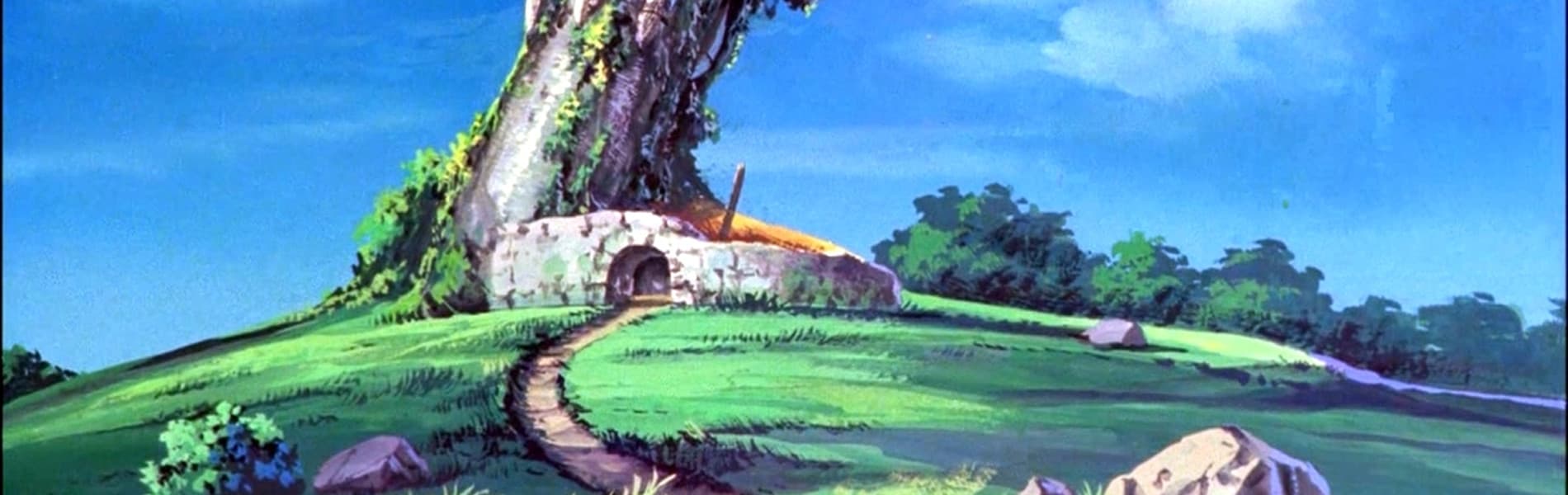
There are many things to praise in this anime. First of all, let's talk about the graphical aspect. Anime in the 70s certainly wasn't the same as it became later and in fact, Conan is closer to being a cartoon than anything else: it offers constantly fluid animation drawn expertly, and wears its environmentalism on its sleeve through simple yet warm and good-looking landscapes. There are quite a lot of labial sync issues but that is basically par for the course at the time
The story, while very serious and talking about death, child labor, slavery, natural disasters, dictatorship, military, etc. is never too serious and manages to strike a fine line between being mature enough to draw you in and goofy and colorful enough to provide relief from all the events. In that regard, it's closer to Laputa compared to the more gritty and heavier Nausicäa. This is an anime for a younger audience and it doesn't hide it. In fact, this nuanced discourse can be seen in the way that, although the anime does show a clear hatred for militarism with the way it depicts soldiers as literal NPCs who lose all individual characteristics when they don the uniform and the helmet, it also doesn't chastise people for choosing to arm themselves, which is enjoyable.
But mostly, what really transpires in Conan, it's the feeling of adventure. You head into the unknown just as Conan does and the story, while really tame for the first few episodes, quickly takes on very big proportions as of episode 5 all the way until the climactic last event, displaying "Humanity" for all good and bad it can be. Events, be they rather insignificant or absolutely game-changing, keep happening while never smothering the viewer under a fast pacing, which keeps the story as fresh as the wind blowing through the sails of Captain Dyce.
Of course the anime isn't without its drawbacks: episode 3 offers a goofy but also unnecessarily prolonged "birth of friendship" between Conan and Jimsy, which could have certainly been shortened. Also, there's no denying the anime is victim of a pretty strong case of characters wearing some very THICK plot armor. If you can live with that like I did, good for you, but be warned: you will see Stromtroopers-levels of awful aiming. Concerning the characters, I just wish they had also done something "more" somehow. In fact, there are only 2 characters who undergo any substantial development throughout the series.
Really, it's a shame this series is not better known and Miyazaki's name is basically synonymous with the word 'Ghibli', because this anime is definitely worth watching, and not only for the historical aspect of being the predecessor to Miyazaki's most well-known stories, but also because it's an extremely solid work on its own right, telling a great story about humanity, greed, war and Nature.
12.5 out of 13 users liked this review
