
GOD'S IN HIS HEAVEN, ALL'S RIGHT WITH THE WORLD.
Neon Genesis Evangelion is an anime that's been firmly embedded into both the internet and pop culture. I was always aware of it, especially online, as the fans of the show often rep it however they can. Through profile pictures, shitposts, or just normal discussion, it's hard to not know what Evangelion is.
But now that I've watched the show, I believe that I didn't fully grasp what the show was. I knew some basics, and went in with a few thoughts in mind. Mainly, I was most curious about the mechs in this show, which are actually it's name sake. I know gundam as a genre uses their mechs symbolically, if the show calls for it. I've been told gundams can range from being a larger metaphor for war, to simply just being a replacement for normal tools of war such as tanks.
The first thing that jumped out to me, thematically, was maturity. The pilots in this show are all freshmen in high school, an age that's often fraught with confusion over identity, sexuality, and one's place in the world. The protagonist, Shinji Ikari, is suffering from all three. Shinji at the start lacks a bit of a back bone, often labeled as a wimp or other adjacent terms by those around him. Not only is piloting the EVAs a very taxing job mentally, Shinji was abandoned by his father at a young age, and now serves under him as an EVA pilot. From this we learn Shinji's defining character trait; he follows orders almost without question.
Shinji is deeply afraid of disappointing others, while also being hungry for validation. Shinji almost can't support himself without others, which leads me into the surrounding cast.
Evangelion has an excellent set of protagonists, as well as a supporting cast. There are three women who play a major role in Shinji's life once he becomes an EVA pilot; Misato Katsuragi, Rei Ayanami, and Asuka Langley Soryu.
Misato is a commander at NERV, the organization that built and controls the Evangelions, while both Rei and Asuka are pilots alongside Shinji. These main four are at the center of Neon Genesis Evangelion, and the themes always tie directly back to them.
Lets return to Shinji's fears for a second. Shinji does not have much love come from himself, in all honesty one could say he hates himself. And he is not alone in this. Asuka, much like Shinji, is desperate for validation. Unlike him, she at least has her pride in being a pilot to stand on. But when Shinji begins to pass her in skill, along with memories that she had repressed returning to her, she completely shatters. The source of her pride gone, she's nothing. She runs away, even attempting to starve herself as her self-hatred runs deeper and deeper.
Misato and Rei, in contrast, appear to be a bit more stable than Shinji and Asuka at first. Misato is confident, bright, and flirtatious. The return of her old ex in the form of Ryoji Kaji at first appears to be just a romantic b-plot, but actually becomes a major part in fully stripping away Misato's warm exterior. Rei, instead, stands directly in contrast to Shinji and Asuka. She has a close relationship with Shinji's father, and comes off as almost emotionless and effortlessly confident. While Shinji's jealousy of her being liked by his father fades as he grows closer and more attracted to Rei, Asuka's hatred only deepens by the series' conclusion. But Rei, due to her existence as a clone, she finds some emotions completely alien. It is through her friendship with Shinji that she begins to open up, begins to remember things from past versions of herself, and truly feel vulnerable.
Vulnerability is a major aspect of this show. Many of the characters run away from it, some not even understanding it. This is represented in many ways, a major one being nudity and sexuality. As a heterosexual man, I feel like I can not fully speak on whether or not the show is respectful to it's female characters in this regard. But I do think it does play a major part in it's themes, especially since our focal character is Shinji.
 /cdn.vox-cdn.com/uploads/chorus_asset/file/16446712/tumblr_nzss2qZIyT1suxi1yo1_1280.jpg)
Well to put it bluntly, Shinji is a teenage boy surrounded by attractive women. Shinji is often picked on by Asuka for not adhering to her more western views on masculinity, and Shinji's sexual immaturity becomes more apparent throughout the show. He's shy, easily flustered, and doesn't particularly know how to express that side of himself. This stands in complete contrast to a character like Misato, who is confident in her body and her sexuality. But it's revealed that sex for her is simply a distraction, a way for her to distance herself from her underlying issues, despite her impulsiveness leading her directly to what she's running from.
Shinji does seem to mature a bit, though. In the final episodes, with the introduction of Kaworu Nagisa, we see him flirt with Shinji. He actually seems to appreciate this, in his own typically flustered and shy way of course. This comes to a head when during one of their final conversations together, Kaworu says this;
Kaworu later reveals himself as the final angel, and is ultimately killed by Shinji because of that. When confronted by Misato, Shinji admits something truly heartbreaking;
Firstly, there is drama surrounding these lines. The original word used in japanese is "好き," or "suki." This word is often translated to "like" in english, but can either mean like or love. Japanese romantic comedies often use this as a joke. The source of the drama is that the new dub on Netflix, the one I watched, replaces the original dub's use of the word "love" with "like." Although arguments can be made, I think this is just another case of the new dub wanting to be as close to the translations as possible. I personally see no explicit homophobia in this change, but do not discourage those that do. As a straight man, it is not really my place to decide.
But back to the line... It broke my heart the first time I heard Shinji say that. Men are so often not given affection, and one can imagine how hard it must be for someone like Shinji to hear that, just to have it stripped away in the blink of an eye. All of these characters, so afraid of vulnerability but so desperate for comfort, are trapped in this unforgiving world. It's tragic.
Well, they're beautifully animated for one. The whole show is, but some of the fights with the angels are just downright stunning. Asuka's first fight in Unit Two, having the EVA have to jump from battleship to battleship before diving underneath to properly defeat it. Or the first time Unit One went berserk. Ooh, or the joint fight that Shinji and Asuka did that was synced to classical music! That one was excellent. My biggest gripes with the animation overall, though, is that the EVAs lack continuity in size and that some scenes hold on a single shot for a bit too long. The first isn't as easily noticed until actively sought out or pointed out, and the second is a minor complaint that was a commonplace aspect of anime of Evangelion's generation.
As I am writing this, I have yet to watch End of Evangelion. I wanted to review the series on it's own merit, and that means it's final episodes by themselves. These episodes are when the series truly shows it hand when it comes to themes. We do a run through of almost therapy-like sessions with each of the main cast. We learn of their trauma, their anxieties, their fears, their insecurities, and their wants. All of this, of course, is from the lens of Shinji and the Human Instrumentality Project. This is the goal of secret organization SEELE, and admittedly it's a bit confusing.
I do like the ending, don't get me wrong. It's messages of anti-suicide and pro-go-outside are extremely important, and this is aided by it's blunt yet abstract presentation. Shinji learns that what makes him who he is is not only how he perceives himself, but the parts of him that are in others. Through this, Shinji realizes the joy in being with others. Even if it means being hurt, even if it means being vulnerable, Shinji wants another chance to find joy again. And thus, Shinji is congratulated by the cast, an iconic scene. I am aware that this ending is more fleshed out in End of Evangelion, but I think the show misses a lot of context that would have made me enjoy this ending more the first time I saw it in episode 26.
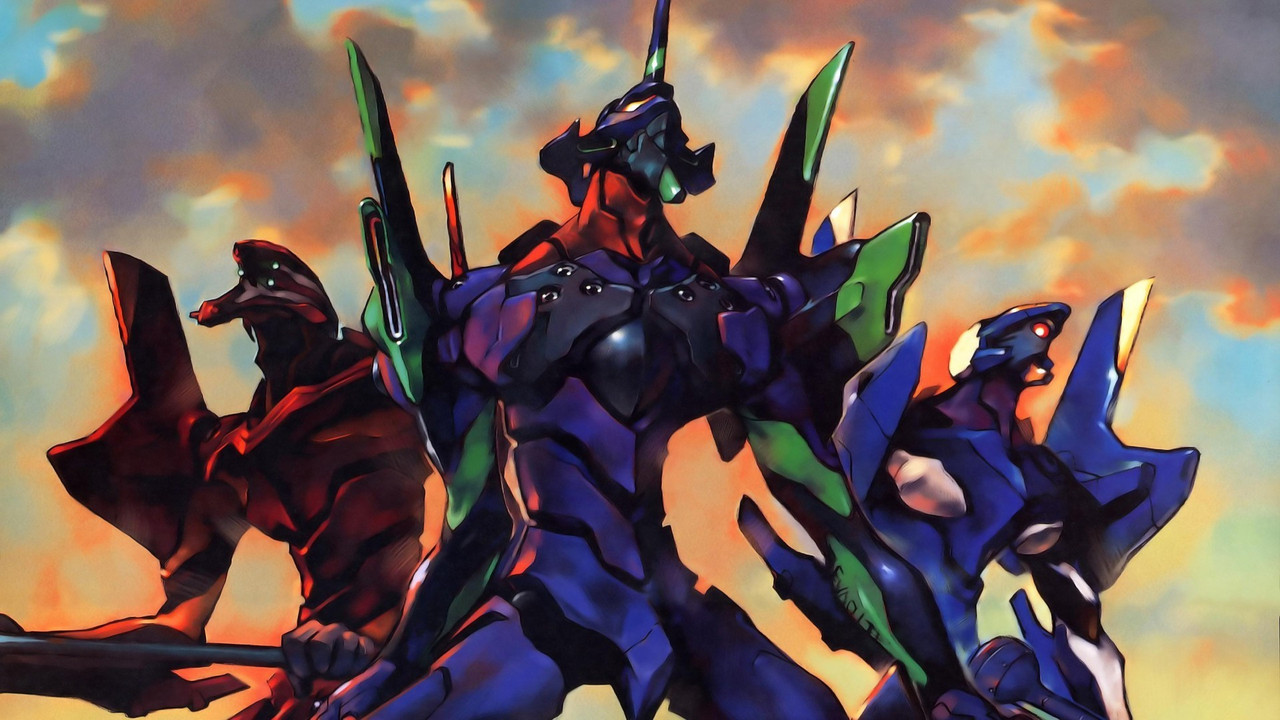
EVAs are symbols, and symbols take on many meanings.
They could represent puberty or growing up, as I mentioned earlier in this review. We have teenage pilots controlling these adult bodies, and experiencing adult themes, which calls back to their past trauma. They also may represent parents. Shinji's father heads the Evangelion program at NERV, and it seems that Shinji's mother is alive inside Unit One itself. Even the technology, like the plug that powers the EVAs being called an umbilical cord, links back to this metaphor. These two are the most apparent, and the ones that should be looked out for during a rewatch.
Beyond that, the EVAs are born of Adam, the first angel, and the cause of the world's desolation. In this way, they could represent humanity's salvation. Taking their enemy and using it to defeat it, bending it to their will. In turn, they could represent sin. Human will stretching too far, and being punished for trying to play God. The EVAs are a nasty reflection of the angels; they destroy their enemies brutally without thought or reason, same as their enemy does to them.
But my main take-away is this; the Evangelions represent connection and humanity. From the start of the series, a pilot's sync rate is highlighted as what makes separates a good pilot from a great one. The entire show revolves around friendships, relationships, familial bonds, and connections. The EVAs are powered by it; if a pilot isn't connected with it's EVA, it's completely motionless. Almost as if it wasn't alive. By the end of the series, we see how important it is for humans to connect with one another. Being vulnerable is scary, but we may not ever find true satisfaction or joy if we shut others out.
Neon Genesis Evangelion is a modern day epic. There's a reason it's been so everlasting since it's release. Whether that's the story, the animation, it's excellent soundtrack, or simply because of cool robots--Evangelion wraps it's complex and mature themes into an abstract masterpiece.