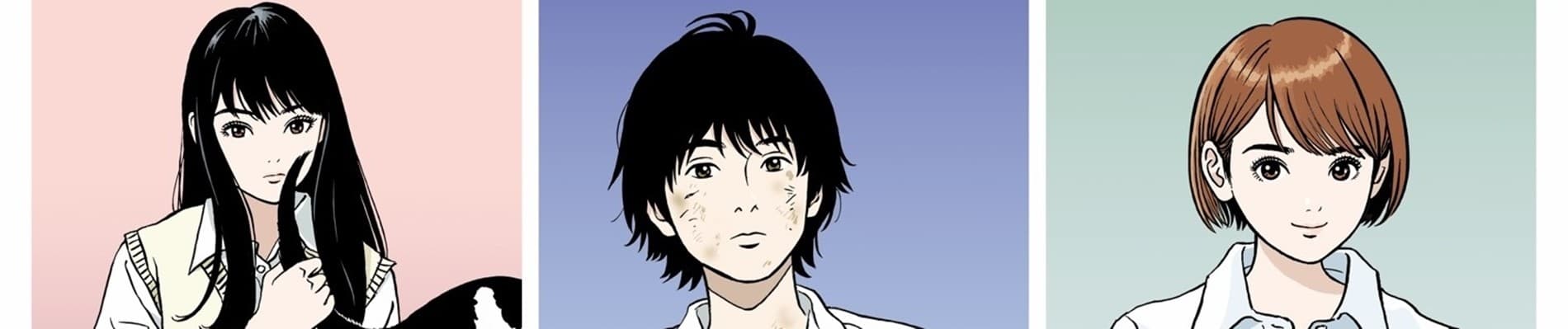
ARE YOU A SUNFLOWER OR A DANDELION?
~~~
After having just finished the rewatch of Sonny Boy I wanted to share my thoughts on a series that at the end of the first vision I had loved but which, at the end of the second, I can consider the anime that most entertained me among all the ones I have seen. A logic-less anime, which explains almost nothing but invites the viewer to give their interpretation of the events, the developments of the characters, and the metaphors that Natsume puts into play.

__
PLOT
__
Sonny Boy's plot is simultaneously the simplest and most original part of the work. The underlying plot that links all the events simply tells of how a group of boys and girls was the victim of a drift, a space-time journey that sent them to a parallel dimension. The students aim is to survive, understand the situation and look for a way to return to the real world.
The peculiarity of the series is that in fact, the episodes that are really useful for the plot are only 1-2-5-6. The rest deal with developing the characters, telling their pasts, but above all doing both by exploiting a very original narrative that consists in placing numerous metaphors and symbolisms. While I would prefer to talk about the characters in their section, I want to spend a few words here to talk about the way I have seen this series.
~~~

The anime is characterized by many very particular situations that contain metaphors and social criticism. The most characteristic thing is that all this is not decided by anyone and is not confirmed anywhere. All these similarities are the result of purely personal interpretations that I have made episode by episode. Natsume, except in a few cases which I will talk about at the end, does not suggest an absolute truth behind a particular scene. A sentence from a character that for me can mean "A", for another person with another mentality it means B. The anime is nothing more than a box full of puzzle pieces but the peculiarity is that the puzzle will eventually have a different shape depending on who composes it.
This is the best thing about this show, the fact that it led me with a lot of interest to analyze and interpret it, to personally discover what it meant and it doesn't matter if in the end what I think it means is wrong or different from the opinion of another person. Below I want to give a summary of the interpretations I had during the episodes, which I recommend to read only to those who have completed the anime to avoid spoilers.
PURELY PERSONAL INTERPRETATIONS (SPOILERS)EPISODE 3
Spoiler, click to viewclick to hide
Episode 3 (The frozen boys) made me think of a metaphor for social isolation. The Island removes from the world people who do not want to be part of society. From that moment on, they will live doing what they want, away from the judgments of the people; but theirs will be only apparent happiness because they are hidden in a dark and lonely world.
EPISODE 4
Spoiler, click to viewclick to hide
Episode 4 (The monkeys) gave me the idea of wanting to be a sort of metaphor for the eternal confrontation between subjectivity and objectivity. Monkey Blue, the hero of the people and symbol of hope, makes a mistake that the referee could forgive as it is of little consequence and that it would risk erasing people's hope and dreams. The referee, in love with baseball for its cruel impartiality, does not compromise at the cost of destroying the feelings of the people. Furious at the decision, the fans in the stadium attack and kill him, in a murder that sees emotion, subjectivity and dreams prevail over impartiality, justice, and objectivity.
AKI'S CHARACTER
Spoiler, click to viewclick to hide
Aki's character (who the students reported as being very different from who she was in the real world) appears to be something of an ambassador of God, a completely drained person who has now become a blind servant of God. Her decisions and choices are nothing more than a reflection of those of the principal.
MAIN STORYLINE
Spoiler, click to viewclick to hide
The drift storyline (which appeared mainly during episode 6) feels like a kind of challenge for students who are thrown into a hostile world (society) without any adult support, in a world where they have to fend for themselves or they will succumb.
EPISODE 7
Spoiler, click to viewclick to hide
Episode 7 (The tower) references the Tower of Babel, the infinite tower that leads to Paradise. The workers (symbol of the worker ant, to connect us to a similar metaphor about Rajdhani's ants from the same episode) bring the blocks down without question, although it is against all logical sense. They are also told that there is a place to observe shooting stars. Nagara's friend points out that even just looking for them is the right thing. The stars represent the dream that, although unrealizable, allows people to face their monotonous and empty life, in the hope of reaching a better future. A similar purpose is also that of Paradise. People do not question its existence or its purpose, but working to be able to "build hope" allows them to be happy and to carry on, even for hundreds of years. The only thing man seeks is happiness and if the only way to get it (not even surely) is to lead a certain type of life or make a certain type of choices then man will lead that life and make those choices because the only thing that matters is the ultimate goal he wants to achieve (even if at the end it's a disappointment). The significance of the overthrow of the Tower seems to be precisely that of opposing society if governed by stupid rules. By doing this Nagara manages to reach the top of the Tower where hope is kept.
EPISODE 8
Spoiler, click to viewclick to hide
Episode 8 (about Yamabiko's past) was without a doubt my favorite one. The main theme is war and the relationship between God and man. Yamabiko (who symbolizes man) is devoted to Kodama (who symbolizes God) and agrees to every request of her, he does not oppose any idea or opinion of her for fear of losing her. Precisely for this reason, he turns into a dog, a symbol of fidelity but also of blind trust without being able to oppose his master. "War" is a man who does not care about the feelings of others, who has brought tumors (which symbolize human suffering) but he is not the only cause because man, by making the right choices, would have been able to avoid the epidemic. Guerra then shows Kodama his medals which symbolize the deaths that war has caused in the world.
EPISODE 9
Spoiler, click to viewclick to hide
Episode 9 (about Mizuho's past and the conflict between the brothers) seems to have as its main theme maternal love (of cats towards Mizuho) and discrimination (2 equal people who have been fighting each other for millennia for a stupid aesthetic difference. This conflict has also profoundly changed their personality even though they were the same person initially). Furthermore, after having won the conflict against himself (characterized by this symbol of wanting to mature and seek a true purpose) with the help of third parties, the winner throws himself into despair as he has lost his only reason for living and he has lost it in the most cowardly way possible.
_______
~~~
CHARACTERS
In addition to having entertained me a lot with his messages and his symbolisms, Sonny Boy has another incredible strength, its cast. A series of boys and girls, with the most disparate personalities, who undertake a very human and very satisfying growth path.
Nagara, initially insecure and distant, first forms solid bonds with Mizuho and Nozomi with whom he behaves with serenity and naturalness. His power is a representation of his initial characterization, a power that allows him to escape from responsibilities. Then he grows up to be able to take life head-on, be much more convinced, and firmly oppose injustices.
Nozomi, a cheerful and sociable girl, is the train that drives Nagara's early development. Her power symbolizes her ambitious personality. She concludes the story proud of having done what she thought was right to do.
Mizuho, initially childish and capricious, also possesses a power that represents her. A girl who wants things done her way possesses the ability to get whatever she wants and she exploits it initially out of whim and revenge on those who tormented her.
Asakaze, impulsive and arrogant, develops inversely in the Worlds compared to the others. He demonstrates to the end that he considers himself a nullity and that his power is the only reason why he can be helpful. A person who is easy to take advantage of, who is exploited by God to achieve his purposes as he is a blind servant too.
My favorite character of the series, however, remains Rajdhani, a brilliant and very lively boy, who has the personality to be loved by anyone and to always support friends in times of difficulty. I love the way he leads the group, an unshakable point of support, and the way he tells his stories is one of the most impactful things about this anime.
In general, the whole cast proves to have grown a lot throughout the story and the roles of the characters change in a very satisfying way during the narrative. Especially Asakaze, the cast proves to be composed of humans (not stereotypical anime characters) with flaws, weaknesses, dreams, and hopes. Their choices do not follow a predefined path but are influenced by their fears and their (sometimes) stupid beliefs. I think having a human cast is the best compliment you can give to an anime (and to a TV Show in general).

____
ART / ANIMATIONS
The particularity of the show is elevated even more by perfectly fitting designs for the genre and an animation that makes everything more fascinating and unique. The drawing style is a style that is very reminiscent of Yuasa's (Tatami Galaxy, Devilman Crybaby) and for the psychological genre it is a style that I always consider very suitable. To this is added the spectacularity in terms of animations, direction, and colors of many scenes that leave truly breathtaking. From this point of view certainly the best anime Madhouse has done in the last 4-5 years.

___
MUSIC
__
One of the most original anime I've seen from a musical point of view. This is because not only does it have wonderful music that further contributes to fueling the atmosphere, but it is possible to see a large part of the scenes totally without music. In this case, the author wants to let the power of the scene itself thrill and strike the viewer instead of "forcing" the reaction through the songs.
Furthermore, the series has no opening and is closed only by an ending that always closes the episode at the right time.

______
CONCLUSIONS
__
In closing, I tend to point out how much this anime has managed to make me so fond of the way it has had of telling this story. Each 20-minute episode lasted me an hour, spent reflecting, analyzing, and hypothesizing. I realize that this is a process that can only be done if the anime has taken you a lot, so I want to advise everyone who wants to watch/rewatch it to try this experience (only if the anime inspires you enough to miss out on time like this) because I assure you that it is absolutely worth it. I think the reason it has very disparate ratings is just that.
I further specify that all the interpretations I have made are purely personal and, reading an interview with the author in which he explained what he had in mind to represent in a couple of cases, I even found myself having conflicting opinions with the same author. Does this mean I was wrong? Probably yes but that's not the thing I want to give importance to. The important thing is that a 12-episode anime lasted as long as a 40-episode one and it felt like it had 3 episodes.
P.S. I am not a native English speaker, so I apologize for any mistakes~~~