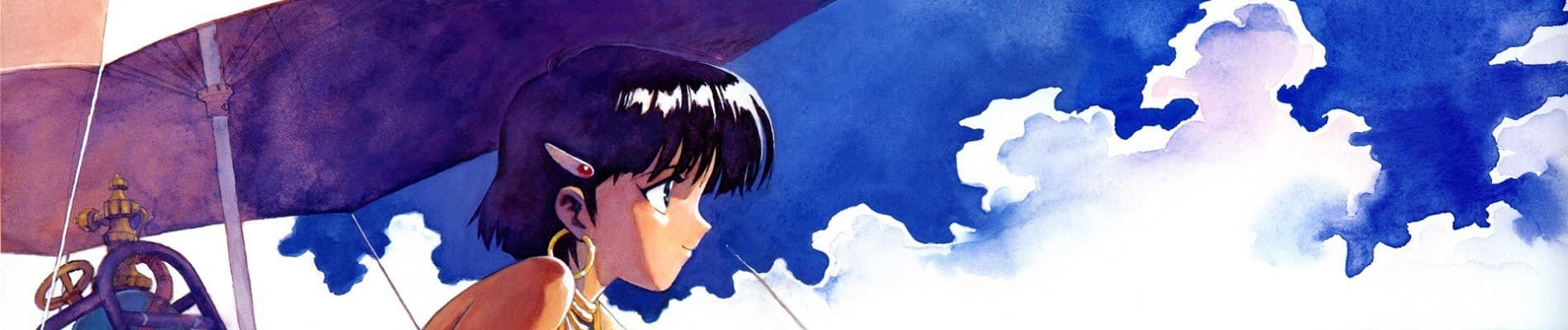
I have not watched much old anime. It’s an oversight I know I need to correct; there’s plenty of great stuff to be found in anime’s long history, and I’d be doing myself a disservice if my only experience with this medium’s past came in the form of Miyazaki movies (as fantastic as those movies may be). But I tend to drag my heels on it because, well, me and old anime don’t always get along. As many excellent shows and movies as I’ve seen in the years before the new millennium, a lot of stuff from back then has just not aged well. At least not for me. Maybe it’s a disconnect with the visual and thematic aesthetics of the time compared to how modern anime looks and feels. Maybe it’s the difference of growing up in a post-Evangelion world and finding it hard to return to anime that were made before that franchise’s overwhelming influence. Or maybe some of this stuff just straight-up sucked and we were too young or inexperienced with the medium to realize. I want to like old anime, and I’m sure there’s plenty of stuff I’ll love that I just haven’t found yet, but a lot of the time, engaging with anime’s history means running into barriers that I’m not always able to overcome. And sadly, that’s exactly what happened with Nadia: The Secret of Blue Water.
If nothing else, the circumstances of Nadia’s creation are fascinating enough to engage with on their own. Originally a pitch from Hayao Miyazaki himself, it was eventually picked up to be directed by Hideaki Anno, a man who’s creative sensibilities couldn’t be farther from Miyazaki’s if he tried. The show’s tumultuous production was so destructive to Anno’s mental health that he stayed away from directing another project for years. And when he finally returned to the director’s chair, he channeled those mental health struggles into his new project, resulting in the absolute game-changer that was Neon Genesis Evangelion. So in a weird way, Nadia and its creation is responsible for the shape of the modern anime landscape. Anime as we know it wouldn’t exist without Evangelion, and Evangelion wouldn’t exist without the executives at Gainax forcing Nadia’s creators to shoehorn in an entirely new story arc mid-production because the ratings were so good. So, uh, I guess the legendarily terrible Island Arc wasn’t a total waste after all? I dunno, silver linings and all that.
But I’m getting ahead of myself. The premise is, fittingly enough, classic Miyazaki, by which I mean it’s basically just Castle in the Sky again. You’ve got a mysterious girl with a magical pendant who teams up with an ordinary boy to find a lost civilization the pendant is important to, that civilization is a metaphor for the sin of hubris and the need for humans to live in harmony with nature instead of trying to subdue it, the bad guys are a fascist-coded cult seeking to monopolize the old civilization’s power for themselves and rule the world, and there’s a secondary bad guy team of bumbling Team Rocket-esque criminals who eventually end of on the side of the good guys (The Grandis Gang is the best part of this show and I appreciated every moment they were on screen). There are some differences, of course- the setting is the late 19th century instead of a post-apocalyptic pastoral paradise, the ancient civilization is buried under the waves instead of hidden above the clouds- but the broad strokes are basically identical. But hey, Miyazaki’s never been shy about recycling ideas before, and if the execution of these ideas here had been as great as Laputa, that’s what really matters.
Except, of course, this isn’t a Miyazaki show. It’s a Hideaki Anno show. And the clash between the very Miyazaki premise and the very Anno execution of that premise is easily the biggest reason to watch Nadia. It’s fascinating watching this all-ages fantasy adventure take sudden turns into death and darkness. It’s fascinating watching Miyazaki’s trademark whimsy and lush portrait of reality filtered through Anno’s fascination with jagged edges and even more jagged characters. Violence is intense and shocking. Body horror, though rare, is genuinely gruesome. The depictions of ancient cultures are steeped in cryptidian menace and existential mystique. Nadia herself is a far more jaded protagonist than Miyazaki’s ever written, a girl who pushes the world away out of fear it’ll just hurt her to engage with other people again. There’s even a lot of the experimental direction that would come to define Evangelion’s final stretch of accidental art-house brilliance. It never stops being a whimsical adventure first and foremost, but Nadia: The Secret of Blue Water is far more willing to engage with the darker, edgier side of its adventure than Castle in the Sky ever did. If you enjoy tracking the careers and styles of specific artists, this show will be like catnip to you.
Unfortunately, I can’t just enjoy Nadia on the basis of its eclectic blend of storytelling sensibilities. I have to judge it as a show. And even putting aside the infamous Island Arc (Don’t worry, we’ll get to that mess in a moment), this is a deeply flawed product of its time. And sadly, Nadia herself is one of its biggest issues. Or rather, the issue is in how she’s treated. Despite her name being in the title, Nadia barely gets to do anything besides mope, get captured, get rescued, and be ferried along by plot forces that tell her she’s The Most Important Thing™ ever. It’s the same problem last year’s Fena: Pirate Princess had, where the protagonist is supposedly the most special amazing important person ever, but it all manifests as the plot pushing her around rather than her getting to take charge of her own story. Now, Nadia’s emotional growth as a person is central to the show, so it’s not like it completely ignores her. Her journey of learning to accept other people and let go of her past feeds directly into the show’s thesis on humanity, and how we all need to support each other as one people instead of isolating ourselves through arrogance or fear. But it would still be nice if she actually got to DO something on that journey instead of the plot mostly unfolding without her influence.
And sadly, that’s far from the only way this show lets its female characters down. There’s the expected fanservice, of course, all of it very groan-worthy whether it’s “accidental” pervert moments or the men just straight up leering at the girls around them. But what’s even worse is… okay, look, remember back in Gunbuster how that one girl fell in love with her much older coach out of nowhere? Remember how gross and completely nonsensical it was? Yeah, I’m starting to think Anno had a bit of an Electra complex in his early days as a creator. Quite literally in this case, because Electra is literally the name of one of the characters in this show, and her big emotional breakdown comes from being in love the man who basically raised her as an adoptive father, only to succumb to jealousy when she thought his biological daughter was stealing his attention. No, I am not making this up. This is literally in-universe how Electra describes her feelings. And then they eventually have a kid together! Yes, really! And believe it or not, that’s not even the only time this show pulls an Usagi Drop on you! Christ almighty, at least when Evangelion went full Freudian psychosexual drama with Misato and Ritsuko, it was fucked up on purpose.
As for the Island Arc… yeah, it’s exactly as horrendous as you’ve heard. It’s a pointless diversion that only exists to kill time because the studio ordered more episodes, all the characters are Flanderized to their most annoying selves, the story’s tone takes a bizarre diversion into Looney Tunes territory, the animation takes a serious nosedive because there wasn’t enough time to make the episodes on such short notice (on the bright side, the majority of Nadia does still hold up and look great), and it basically butchers everything this show had going for it. For all my issues with The Secret of Blue Water, I can at least respect its sense of adventure and commitment to its complex themes. But the Island Arc isn’t just bad on its own, it feels like a deliberate insult to the show it’s supposedly a part of. In particular, it shits all over Nadia with some of the worst character assassination I think I’ve ever seen, and it turns her romance with co-protagonist inventor boy Jean into an absolutely agonizing slog of pointless conflict and convenient progress-backtracking that makes Zero no Tsukaima look like Kaguya-sama. Whoever was responsible for how this arc turned out, it feels like they just hated Nadia, and they used their time in charge as an excuse to play out their weird misogynistic fantasies of putting her in her place. It’s honestly more degrading than any of the fanservice moments.
And since there’s actually some big important plot developments in the middle of the Island Arc, you can’t just skip it like your average Naruto or Bleach filler arc. You either have to track down a fan edit of this arc that cuts out all but the most important bits, suffer through it in its entirety, or just skip all but the most relevant episodes and be content missing the connective tissue that would otherwise tell you how certain characters got to where they are. It’s a no-win scenario no matter how you slice it. I could honestly spend an entirely separate review just breaking down all the ways the Island Arc sucks, that’s how bad it gets. But at that point I wouldn’t really be reviewing Nadia: The Secret of Blue Water anymore. If there’s one consolation, it’s that outside that handful of important plot beats, everything in this arc matters so little that its terribleness doesn’t impact the rest of the show. You might as well be watching an entirely different show with entirely different priorities, and when things finally get back on track for the final five episodes, you can slip right back into Nadia Proper as if nothing ever happened, the characters still untainted by whatever madness took hold of them for the past twelve episodes. Not that it really dulls the pain of having to sit through them in the first place, but still. Again: silver linings.
I realize I’ve been negative for a lot of this review, and I wish that weren’t the case. Because there were things I really liked about Nadia! I liked the overall animation and art design! I liked its willingness to engage with death as a thematic concept and give it some real gravitas! I liked the Grandis Gang’s antics! I liked how weird and out-there it was willing to get with its pulp sci-fi! I even really liked the English dub! Yeah, it took some getting used to, and Jean’s voice actor really shouldn’t have been forced to do that terrible French accent, but it’s got so much charm! It’s not hard to see why this show became a classic; even despite its obvious inspirations, it’s got so much originality, so much passion. It’s the kind of singular work that you just know nothing else will ever quite duplicate again, and I respect it for that. But time has not been kind to Nadia. Watching this show over three decades later, its warts have only grown more cancerous, its flaws more unavoidable, its missteps less forgivable. There’s plenty of good to be found in here, but on the whole, too much of Nadia: The Secret of Blue Water feels like it’s better off being left in the past.
8 out of 12 users liked this review
