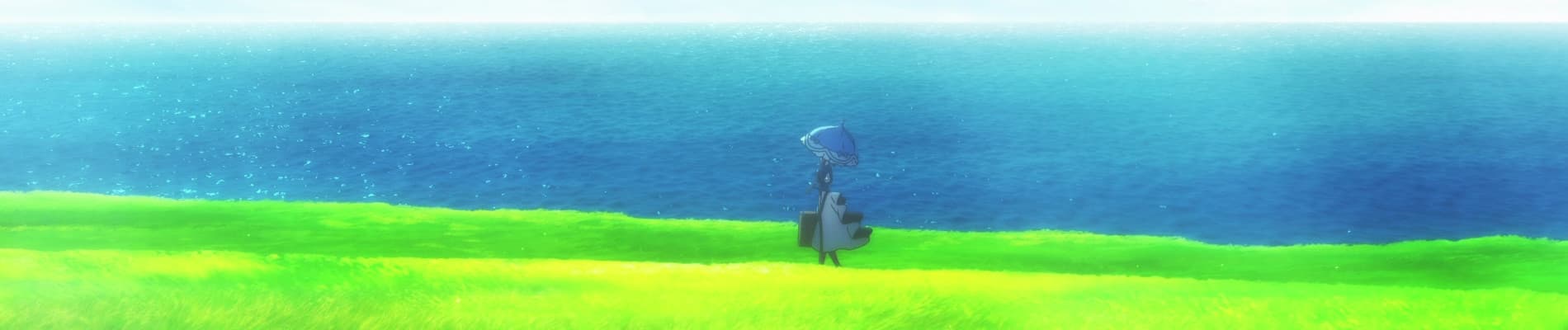


Writing lets your feelings reach people from any distance, whether it be physical, emotional, or even temporal. It lets you say things you don't want overheard, things you want to be reread over and over again, things that are much too terrifying or embarrassing to say in person, things that must be said anyway. Letters are as personal as writing can be, but writing for an audience of one comes with its own unique set of challenges. Violet Evergarden is the story of a girl who helps people do just that as she tries to make sense of all the love, longing, hope, and perseverance in the world around her.

I read a novel called Wired Love in one of my university classes a while back. Written in 1880, it focuses on the lives of female telegraph operators who transcribe letters into Morse Code and send them over the wires while listening for responses and transcribing those with equal precision. Knowing the setting has some historical basis and making that connection from my own experiences made me appreciate it that much more. While the technology might not quite line up, the focus in both cases is on single women in a career that's all about communication and their dedication to that career in spite of the attitudes of the time.
With that premise, each episode brilliantly explores the many forms love can take. Leaving the army at the end of a four-year war, Violet starts her new life ghostwriting letters in the hopes of learning the meaning of "I love you". It's rough going for Violet at first, and her initial lack of empathy and ignorance of social cues can be a bit painful to watch. But through fulfilling her clients' requests and with the support of her friends and co-workers, she grows more capable in her career – allowing each episode to focus more on the client's request as needed – and she gets closer and closer to understanding one "I love you" in particular.
While other anime series might have a marked improvement in lighting or animation from the TV series to the movies, Violet Evergarden is so visually impressive from the outset that the movies simply pick up where it leaves off. From sunlight streaming through windows to stars in an open sky, from the slightest changes in someone's expression to two armies meeting in battle, KyoAni does it all and does it spectacularly.
There's a recurring shot of Violet taking off her gloves and someone seeing her mechanical arms for the first time – while they're a literal and metaphorical gap in human connection from her upbringing and her war wounds, they allow the people she meets to notice that gap at a glance. The beauty in those scenes comes from imagining what they might be thinking based on their reaction, their initial impression of her, and everything we know about them up to that point. It's a reminder to them that every person you meet has their own scars and their own battles to fight, and I fall for it every time.

Watching Violet Evergarden reaffirmed my desire to write for others and for myself and ignited a spark of creative passion I didn't know I was missing. I hope the series forever remains as dear to me as it was on the day I decided to write this.