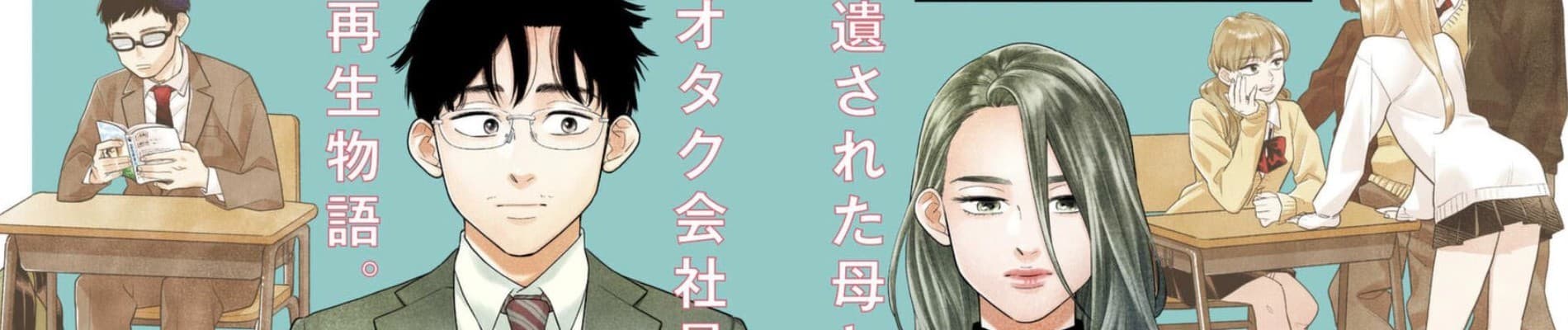

It Looks Like My Son Has Been Reincarnated into Another World approaches isekai meta-writing from a genuinely unique angle. Which may be a statement met with skepticism, considering how much of a dead horse meta-writing in the isekai genre is at this point. Although the series partakes in usual isekai trope mockery, it interestingly observes isekai without the fantasy scaffold. Rather, it takes a psychological, out-of-the-box approach.
Lengthy title may lead one to believe, but the story's centerpiece is the ambiguity of the two protagonists' relationship. Ambiguity often lends itself as a powerful engine for character dynamics (See Evangelion, Oregairu, Monogatari, Haruhi Suzumiya), requiring the audience to analyze the smallest of shits to flesh out possible semantics (an apt definition of unpopular ships). Although manzai-style banter is often frequent between the timid Dobura and deadpan, blunt Mio, the story occasionally reminds and clarifies the disturbing base of the two's relationship; her son's death leading an mentally imbalanced Mio to voraciously consume her son's light-novel collection and seeking out Dobara's help in belief that isekai'ing will bring her son back. Situated in-between Mio's cultish fervor in isekai and Dobara's pity in her, there's no room for something so clear-cut as friendship in the current stage of the story.

Whereas otaku culture has often been reduced to dreary meta-jokes and self-deprecation in many titles, the series likens itself to Welcome to the N.H.K. and Watamote, sticking its landing with the darker side of the coin. It Looks Like My Son grafts escapism as the common link in the protagonists' dynamic, doubling as refreshing otaku culture commentary. Although Mio mitigates her image of an otaku, her obsession with isekai light-novels as a means of escapism and coping from her son's death captures the essence of otaku. Running away from home, presumably temporarily living off her husband's sent money and dedicating most of her time to anything isekai related, Mio possesses the negative characteristics associated with otaku despite not being an actual, full-fledged otaku. Perhaps in this sense, complying with the most negative image of otaku prejudice, Mio is more of an otaku than Dobara.

Comparatively, Dobara is in every way an otaku, seemingly not limited to just light-novels, yet distances himself from the self-confident, prideful otaku trope with refreshing shame and awareness of prejudice. Although, his escapism isn't limited to his light-novel collection, Mio's abrupt presence is his bigger source of escapism. The deus ex machina appearance of a beautiful woman to a socially-awkward otaku in the context of the story gives a greater sense of meta-comedy than many of its isekai peers. It Looks Like My Son is not a romcom or even an actual isekai; the staples of escapism in this medium; it's so far removed from them that some of the tropes presented in ironic fashion like the aforementioned one may go over one's head. I don't want to claim these instances as deconstruction, subversion, reconstruction or any other hefty terms that r/anime members love to throw around given the chance, though.
Moreso, these are imperative to Dobara's character, whose identity as an otaku is accepted by Mio without disdain. Although, fully aware of Mio's situation, Dobara cannot entirely hinge on her presence as she does his, both pitying and admiring her. In this sense, where both seek out some form and degree of escapism in the other in this inexplicable dynamic, perhaps something definite will eventually come out as they better understand each other and Mio steadily coming to terms with her son's death.

Although hinging on isekai in its lengthy title and actual mention of it in it, It Looks Like My Son Has Been Reincarnated into Another World merely guises itself as such, using isekai's name as a foothold for its greater psychological and tragic plot. Without the fantasy devices, the story contrives isekai as a coping mechanism and unhealthy escapism both in its otaku jokes and dark plot. Situated in reality, the basis of the story lies in the two protagonist's awkward, ambiguous, budding relationship founded on their obsessions with isekai light-novels, although their motive is much less lighthearted than what it seems to entail. Although, it doesn't propagate itself with constant dark scenes, instead radiating somberness with its occasional reminders for the basis of their relationship. Perhaps the writing isn't so much of a masterpiece, but the bases of the characters and their dynamic are certainly refreshing and continuously well fleshed-out thus far.
23 out of 23 users liked this review
