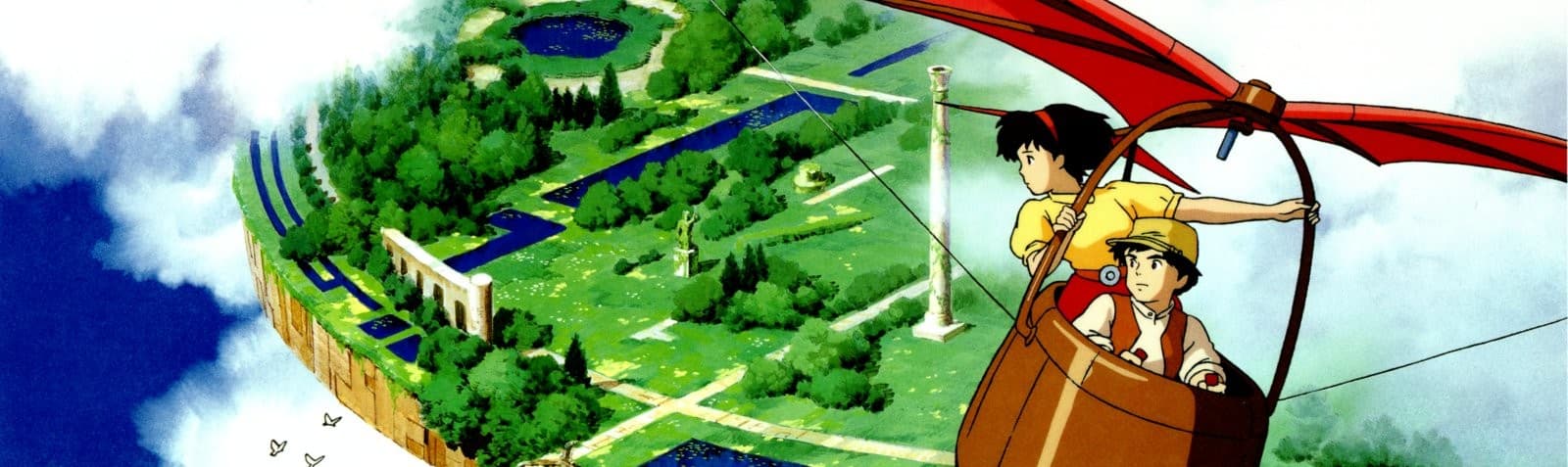
Castle in the Sky
a review by R2R
a review by R2R
A lot of newer/modern anime has female characters... actually, not just female characters, but pretty much every character has this archetype of 'need to be saved/protected' in some way. I guess it's a representation that the audience themselves wanted to be saved from whatever hell they felt like struggling with, but stories and characters became more and more insertable and escapist. This isn't to say that they're necessarily bad, some Anime use this trope as a method to lure the audience and then try to give some reality slap, which not only fails but they also gets misused, a lot of the times.
Miyazaki's characters are the opposite. They don't need saviors; they are the saviors. They have strong personalities that will never lose to the world and fight until the end. They are like the typical heroes you see in old films, which I initially found bland and unimpressive. They are engaging, but they are pretty one-note. Unlike many anime where they give a long narration to say that the MC is a weak high schooler or something along those "It's so ME" lines, the characters in Miyazaki films are straight-forward. This was very noticeable in Laputa. Pazu's entire characterization can be summed up in a few simple lines.
"My head is stronger than my owner's fist".
"My father isn't a liar."
"I could've protected her if I was stronger and more intelligent".
And it doesn't end with him. It doesn't take a lengthy time to make engaging characters, but it also doesn't do it haphazardly. You'll be engaged in their adventurous journey with sharp dialogue and strong personalities. But characters are not the main focus in Laputa or many of the later Miyazaki works. If characters are merely tools to drive the story, then what is the said story about?
Miyazaki films always deliver a message about human connection with nature, whether it be in a more playful tone as in Totoro, or in a more serious tone as in Mononoke Hime, but I found Laputa to be a mixture of both. There are some bubbly moments between our heroes, as they try to know each other better, and there are tense moments between heroes and antagonists, as they fight for each of their ideals.
The movie can be divided into 4 parts depending on the location of where the story is proceeding.
And when the conflict ends, the stage flies away into the sky, leaving the viewer with a fun and meaningful journey. But there are parts where it feels a bit dragged, especially during the ending.
While "Laputa" might not be my favourite Hayao Miyazaki film, it is definitely a great classic that still holds relevance and one that's definitely worth experiencing.
12 out of 13 users liked this review
