Steins;Gate 0
a review by dihahah
a review by dihahah
Plot
In this sequel we can see how the characters moved on from the events in the main series. We return to the alpha world line just as Okabe wished: Mayuri is safe and sound but at the cost of his beloved Kurisu. However, not entirely. We are introduced to Maho, Kurisu’s senior when she was in America who is working on an AI program named amadeus. Amadeus is based on Kurisu’s memories so it looks and acts just like her. Okabe, now in university, bumps into Maho and is able to interact with Amadeus. This gives him hope to reconcile with her as their blossoming relationship came to a tragic end. These interactions between Okabe and Kurisu were humorous at times and the AI managed to retain Kurisu’s infamous tsundere personality.
At the same time, the search for Steins gate continues. Suzuha desperately wants to stop World War 3 and we see her warrior form take shape. We also discover that Suzuha did not time travel alone, there was another girl called Kagari who went missing along the way. Unlike the previous series which had one, straightforward plot line, this show had many things going on at the same time but eventually converged into a single event and mission. There was some back and forth from the past to the present and the future to present which I found interesting. It helped to broaden the scope of the show. I feel that is the speciality of Steins gate: we literally get to see character from all angles and how they develop outside the timeline of the show. At first, AI Kurisu and Kagari may seem unrelated but as the show progresses you find that they are all related. In this show, the job of saving the day did not fall on Okabe alone but we also got to see Suzuha, and Mayuri in the forefront too. Yes, our sweet and innocent Mayuri.
Characters
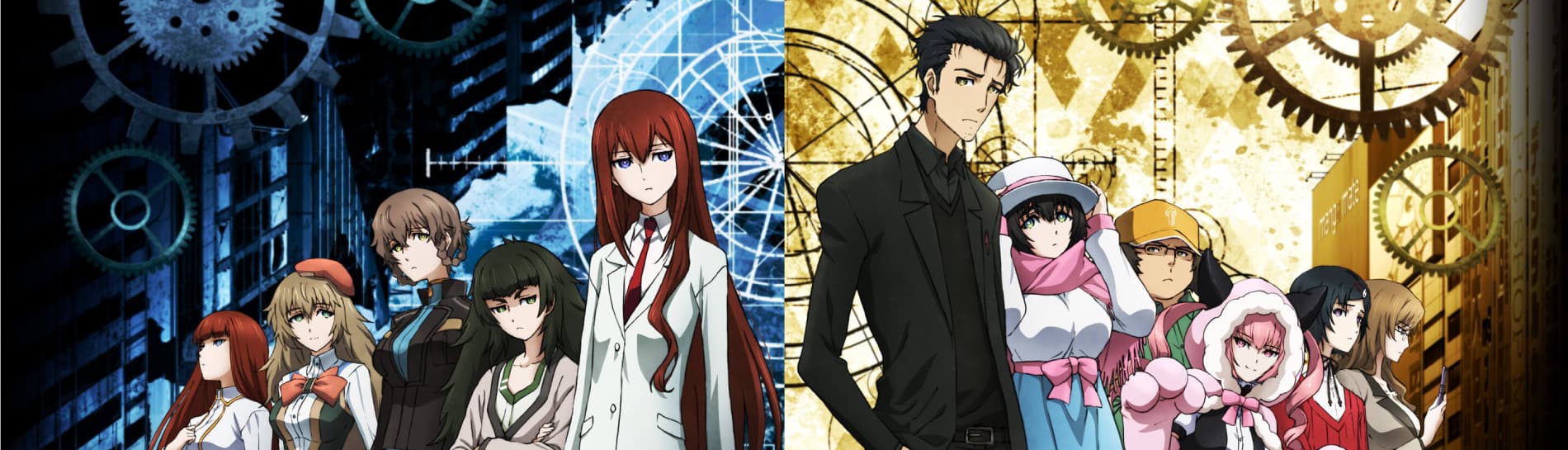
We can see that the characters from the previous show embrace their future selves. The only one who changed drastically is Okabe. Having to live through the events of the Beta world is not easy. Donned in an all black attire and having a forlorn look, he is definitely not the same Okabe Rintaro, or mad scientist Hououin Kyouma, that we were familiar with in the previous series. Facing the trauma of seeing Mayuri die countless times and losing Kurisu, Okabe just wants to leave time travel behind and lead a normal life and get through university. However, his interests come into conflict with Suzuha who still fears WW3. Suzuha , who repents her past mistakes, is more determined than ever to achieve her goals. I felt that she was a bit arrogant at times but I still admire her resilience and leadership skills. She works closely with Daru who has embraced that he is a father. Yuki, Suzuha's future mother, was another interesting addition to the main cast. Their relationship added to the humor of the show and it was emotional at times. The show retains the wholesomeness of the lab. They still have their get-togethers and parties. Moeka makes a return in this show and I was suspicious of her at first but her role was completely different despite having the same shy and timid personality.
The most prominent addition was Maho. When I heard that she was Kurisu’s senior, I expected her to be more knowledgeable than Kurisu. Surprisingly, she had always been Kurisu’s shadow instead. There was a recurring motif of Mozart and Salieri to describe their relationship which I found intriguing. As a fellow scientist, she has the responsibility of carrying on Kurisu's legacy. I wouldn’t say Maho is a direct replacement for Kurisu even though they have similar personalities and professions. She did reach the same goal as Kurisu just that she took a longer and harder road, especially since physics is not her area of expertise. Kagari was also another addition to the lab but I felt she did not have much depth as compared to the other characters. Her mysterious disappearance was crucial to the story but her personality and individualism never came through.
Animation
While the style of animation remains the same, there was much more action in this show. Explosions, guns and fights scenes were presented in a dramatic way and heightened the intensity of the situation. The OP and ED did not get to me and I do not listen to it as frequently as the previous one. Both were in English which I think is to match the general Western influence of the show. However, this is in a way related to Kurisu as her work in America was not really brought up in the previous part.
Major themes [spoliers ahead]:
AI vs Human
AI is very relevant in our society today. Hence, there was some relatiblity to the show and their inventions seemed more realistic than a time machine. While it does help to make our lives easier and maybe bring our loved one back to us, we are constantly reminded that she is not the real thing. Regardless of how similar Amadeus may seem to Kurisu, it is not actually her and Kurisu is gone for good (in the alpha line at least). However, this was symbolic in a way that Kurisu managed to stay by Okabe's side. Even in 2030 she still watched over him when he was in a coma. It was indeed heartbreaking when he had to bid farewell to her once again in order to stop WW3.
Brainwashing
Personally, I am fascinated by the idea that people’s minds can be engineered and controlled by someone else. Although what Leskinen did was ethically wrong, his plan was actually ingenious. It is bewildering that Kagari, who may seem normal, can be transformed into a human robot just by listening to a particular piece of music. In this case it was none other than a Mozart piece. Under Leskinen’s spell, she kept repeating she hears the “voice of god”. “Voice of God” is what Salieri described one of Mozart’s pieces in the movie Amadeus (1984). This mind control runs parallel to Leskinen’s project. His team was trying to make Amadaues, a robot, almost human-like. Moreover, Kagari and Kurisu almost look similar. I can’t really think of a reason for this resemblance. Perhaps in the prequel, Mayuri and Kurisu had this mother-daughter relationship (sisters, moreso) and the creators were trying to bring back this relationship through Kagari.
On the whole, the show fares slightly lower than its preceder, in my opinion. I liked the old Okabe better and the close knit community in the lab. Nevertheless, this show was action packed, had more suspense and the technological aspect was pretty cool. The ending was wonderfully done (although slightly confusing) and it was a good way to wrap up the series.
35 out of 38 users liked this review
