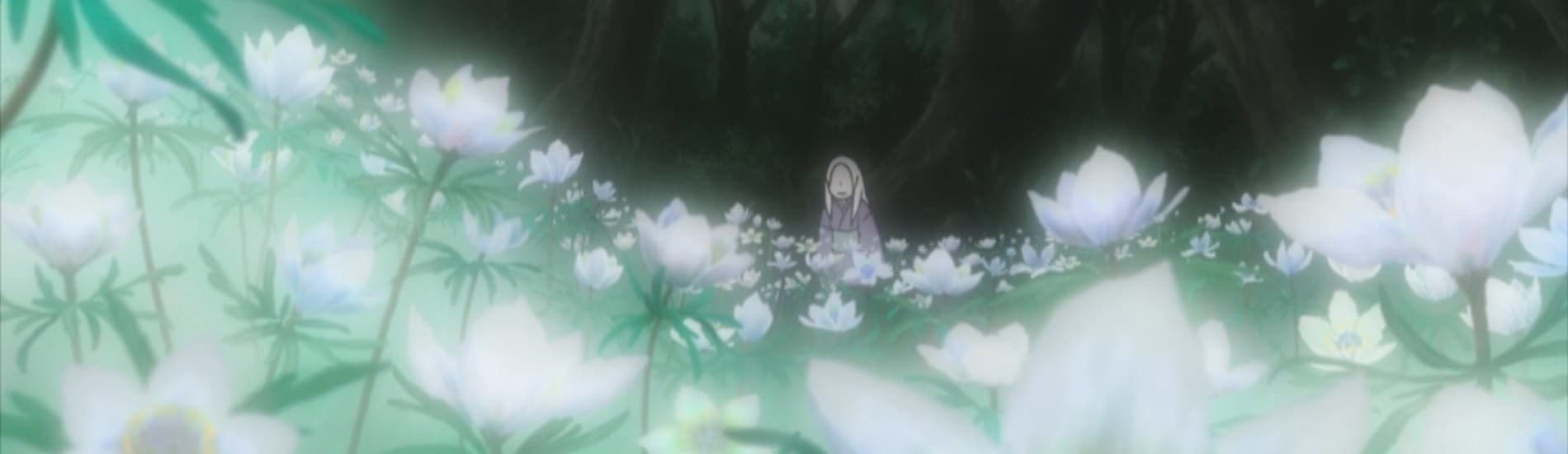
>“It never even crossed my mind that the sun could go away.” “Yeah… I took it for granted that it’d rise every day.” – Villagers in Hihamukage
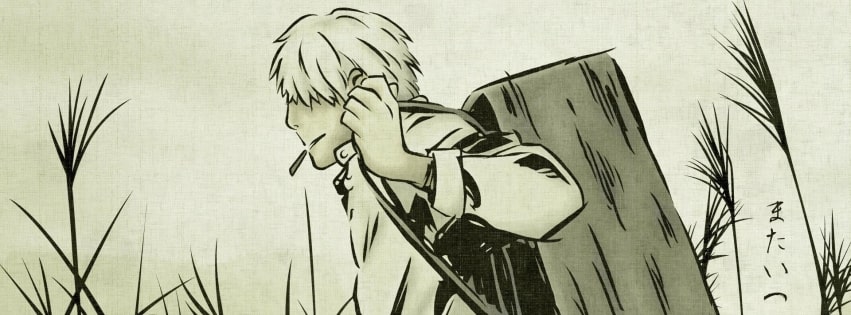
The Mushishi special Hihamukage feels like slipping back into a half-remembered dream and finding a new layer of darkness hiding under all that calm light. It’s only forty-odd minutes, but it carries the same slow, patient weight as a full episode run: quiet people in the countryside, an impossible phenomenon, and Ginko walking into the middle of it like it’s just another day on the job.
This time, the world isn’t gently strange so much as outright wrong. A village has been swallowed by an artificial eclipse, trapped in a kind of living dusk where the sun never really rises. Mushishi has always played with nature bending in small, unsettling ways, but here the premise is simple and primal: no light, no growth, no real sense of time — just people trying to pretend this is fine while everything slowly withers. The special leans into that uneasy stillness instead of turning it into an action plot; Ginko isn’t there to “defeat” anything evil so much as figure out what imbalance caused this and how to nudge the world back toward normal.
What I’ve always liked about Mushishi is that the mushi themselves aren’t villains, and Hihamukage sticks to that. The darkness over the village isn’t a big-bad monster with an evil speech; it’s more like nature misfiring, or a side effect of humans trying to control something they barely understand. That makes the tension quieter but also more interesting: it’s less “how do we kill this thing?” and more “what did we take for granted, and what is the cost of that?”
The special uses its side characters well, especially the two sisters at the center of the story. Their different attitudes toward the dark — fear, dependence, curiosity, denial — end up saying more about humans than about mushi. Mushishi is at its best when the supernatural problem is just a mirror for some very normal human weakness, and you can feel that here: clinging to comfort, ignoring danger because change is scary, or sacrificing your own freedom because the alternative might hurt someone you love.
Visually and sonically, this is pure Mushishi. The art leans into soft colors, drifting particles, and that hazy boundary between light and shadow, so the eclipse doesn’t just look like a filter slapped over the sky; it feels heavy, like it’s pressing down on the whole village. The sound design and music slide between eerie and soothing the way the series always has — the kind of score that doesn’t demand attention but quietly changes how you breathe while you’re watching. The only real disappointment is the absence of the usual opening song, which would’ve been a perfect way to ease back into this world.
In the end, Hihamukage isn’t some explosive, game-changing story for the franchise, and it’s not trying to be. It feels more like a concentrated dose of what Mushishi already does well: a gentle reminder not to take simple things — sunlight, time, being able to see what’s around you — for granted, and a small, strange mystery that resolves with more quiet understanding than drama. If you already like Ginko wandering from place to place and nudging the world back into balance, this special is absolutely worth the forty minutes.