
Ya Boy Kongming!
a review by Dxvid
a review by Dxvid

If there’s one thing that I really love about anime, it’s the medium’s ability to occasionally transform even the most absurd of story premises into something that feels real and able to reach our hearts and souls. For example, Zombie Land Saga grew to become my favorite anime due to the way that the series was able to take two completely different genres, zombies and idols, and combine them into something that was not only outlandishly fun and unique, but also very human and emotionally resonant when the chaos takes a backseat.
Spring 2022’s Ya Boy Kongming! is what I like to call a “ZLS-adjacent” kind of show, and that’s not only because the most popular recommendation for people who love this show is ZLS itself; It caught my eye much in the same vein that it did in the very first episode, giving us an insane music-based premise that soon evolved into something much more down-to-earth and compelling. Combining the history and culture of ancient China with modern-day Japan and the music industry shouldn’t be a combo that works, but somehow, someway, Kongming! makes it work.

(Story)
The story of Ya Boy Kongming! starts in ancient China, with brilliant military strategist and tactician Zhuge Liang, a.k.a. “Kongming”, falling ill and dying with one last wish to be reborn in a world without war. He gets his wish, but is reincarnated in the urban jungle of modern-day Shibuya. Not only does he get completely engulfed in culture shock by being transported to a different country, but he also has to adapt to almost 2,000 years of human evolution and innovation. Kongming soon finds himself in a bar, where he’s completely moved by a performance from a young aspiring singer named Eiko Tsukimi. The next morning, Eiko takes him to her home and teaches him the basics of modern-day Japan, and we’re soon treated to an acoustic performance of a song that moves Kongming to tears; curious to know more about modern music, Eiko helps him gain employment at the same bar they met at. Opening up about her struggles in life leading up to that point, she shares her dream of being a famous singer with him, and Kongming, who wholeheartedly believes in her talent and ability to reach said dream, volunteers to be her tactician.
Once the story premise presents itself, the story begins to move rather swiftly in its pacing, and it continually blends the ridiculous nature of Kongming with the very grounded nature of Eiko’s journey. With Kongming’s help, Eiko begins to progress up the ladders of the music industry, gaining friends and foes along the way; We get to see Eiko encounter famous singers, bands, rappers, and even idol groups, encapsulating multiple music genres and diversifying their approach to the top with the help of Kongming scheming up ways to showcase Eiko’s talent. What really gets me, though, is how Kongming approaches it: His schemes fall back upon Chinese history and the various strategies that made him such a legendary tactician, so at the same time that we’re seeing the wackiness and creativity of the show’s writing, we’re also getting insights into Chinese history to parallel the past with the present.
Where the story truly shines, however, is when it shifted to become less about Kongming and more about Eiko herself. It bugged me a bit that a show about Kongming became less about Kongming, but at the same time I actually feel like Eiko’s story is the shining highlight of the show and that unfortunately came at the expense of Kongming himself taking a backseat approach in the second half. Faced with a challenge named the “100,000 Likes Project”, her and her rapper friend Kabetaijin each undergo their own character arcs, being entrusted to find what they’re missing to take the next steps towards their goals. The story became less about Kongming cooking up schemes and more about Eiko finding her own voice, finding who she wants to reach with that voice, and using that voice to change the world. Luckily, with the addition of Nanami Kuon, it helps push this theme and character arc forward, and it resulted in what I felt like was a truly earned and satisfying ending to the show.
The soul of Ya Boy Kongming! isn’t the whimsical nature of Kongming’s schemes, but rather Eiko’s story as a musician and how powerful music can be. In the late stages of the story, Nanami Kuon’s group Azalea is juxtaposed with Eiko’s current situation, but reveals a darker side to the music industry, an industry that forced Nanami and friends to sell their souls for success. Whereas Eiko had a very raw, acoustic feel to her music similar to early Azalea, modern Azalea was very artificial and more about widespread appeal than emotionally impactful music, something that burdened Nanami for years as she and her friends had to suck it up in order to become the successful group they aspired to be. But even when it seemed like she may never go back to the girl she once was…it was through Eiko’s voice and through her music that she was able to change and rebel against the very system that was tying her and her friends down. It was through Eiko’s sincerity and her heartfelt passion for music that reached her, and not only was Eiko to find whose hearts she wanted to reach, but Nanami found the strength to be herself again and make the kind of music SHE wants to make. Music doesn’t always have to appeal to everyone, but it’s genuineness and the heart and soul of a musician that has the power to change people’s lives for the better. Messages like that are common in music anime - I love the genre specifically for this reason, and Kongming was no different.

(Audio-Visuals)
Before I started watching this show, I came across a clip of Kongming being moved by Eiko’s song in her room, and that single-handedly made me want to watch it. Not only were the visuals very crisp and the lighting was phenomenal, it stuck out to me because it complimented not only her singing but the atmosphere really well. This kind of audiovisual goodness is what I feel is a hallmark of P.A. Works’ anime and is part of their overall style and approach to their production.
Ya Boy Kongming! is another prime example of P.A. Works being in their bag as far as production values go, as throughout the show we get a pleasant mix of both creative visuals and stunning emotional shots. It’s funny when it needs to be and serious when it’s crunchtime, and it’s sold primarily through the way that the way the scenes are presented. Dramatic lighting is for dramatic scenes, and comedic visuals are for comedic moments, as it obviously should be, but I was surprised at how well-balanced it was. It never felt too goofy or too melancholic, and that certainly helped. The performances were also done in full 2D animation, which is a nice touch.
The primary reason why I feel like Ya Boy Kongming! is as great as it was is because of its music…at its high points. But before I get to the bad, let’s talk about the good first, and boy, there’s a whole lot of it!
Kongming’s musical highs are EXTREMELY high, and that’s because it blends different kinds of music from a ton of different backgrounds and cultures and somehow makes it work within the context of the show. Because of Kongming’s Chinese background, we’re treated to Chinese-influenced music and instrumentals during his character moments, and that’s just one of the many genres in the diverse OST. We get a wide variety of sounds, ranging from EDM, pop, rock, hip-hop and jazz, and I really appreciated getting almost the whole range within the soundtrack. The sheer whiplash of going from a slow, acoustic and emotional song like Eiko’s “I’m still alive today” to a more intense, fiery “UNDERWORLD” was a treat for my ears to hear unfold.
Perhaps the biggest and most popular piece of music that this anime spawned is through the insanely fun opening, fittingly titled “Chitty Chitty Bang Bang”. Not only was it an uptempo, straight-up fun song with funny lyrics and eye-popping visuals, but the best part is the background behind it. The song itself is a Japanese cover of a song called “Bulikirály” by Jolly, a Hungarian club banger from 2013, and if that doesn’t already scream “one-of-a-kind”, then I don’t know what will. It’s a perfect encapsulation of what this show is, what it’s trying to do, and is probably the biggest creative flex aside from, y’know, having a freakin’ Chinese war general speaking Japanese in modern times trying to help an aspiring musician. It’s a damn addicting one.
Now that I got through the good side of Kongming’s music, let’s get to the only part that really bugged me about the show’s music: the rapping. I love hip-hop, have always loved it, and will always love it, but for some reason, I just couldn’t stand the raps I heard in this show. The introduction of Kabetaijin and his arc was cool, and I don’t think he’s not talented, because he did show it off, but I found it and the couple of rap battles grating. There were a few moments where he and Kongming’s respective flows hit a pocket of nice rhymes and rhythm, but I kinda just found myself rolling my eyes a bit whenever it came on. I just wasn’t rocking with it, and it's unfortunately the biggest blemish in the show to me.
For the voice talents themselves, I already knew I was in for a treat when I heard Eiko’s voice for the first time. Kaede Hondo, of previous Zombie Land Saga fame as the voice of one of my favorite MCs in Sakura Minamoto, has a lead role as Eiko Tsukimi, and not only was I sold on it immediately, I was also really impressed with her performance. I wish that she got to sing as her like how she does in ZLS, but I love 96Neko’s performances and it sold Eiko’s singing talents extremely well. Ryoutarou Okiayu provides an effective performance as the quirky and cunning Kongming, Jun Fukushima provides voice work for the goofy ancient Chinese history buff bar owner, and Shouya Chiba turns in a nice performance for the gloomy Kabetaijin. Hibiku Yamamura did a nice job voicing Nanami Kuon, and Lezel’s singing voice was phenomenal and even better when put next to 96Neko. While I don’t think there were any all-time performances as far as voice acting goes, they all did their job and sold their characters well.

(Characters)
The character work ranges from okay to great, and that’s largely because the focused character arcs are limited to about three characters. I also feel like the set of antagonists minus Azalea and Karasawa that we were given kinda just came and went, and it kinda hurts knowing that Kongming! fell short in that category.
Kongming himself was a great character until the aforementioned second half of the show hit, and while he was reduced to being practically a supporting character in his own show, he’s unique enough as a character to be one of the standout ones from it. I don’t necessarily think he needed a character development arc, and he didn’t get one, so I don’t really have a problem with his character. I just wish that we got to see more of his involvement and more crazy schemes based on his various battles throughout his original lifetime, but the direction of the show led into a character arc that became the highlight of the show.
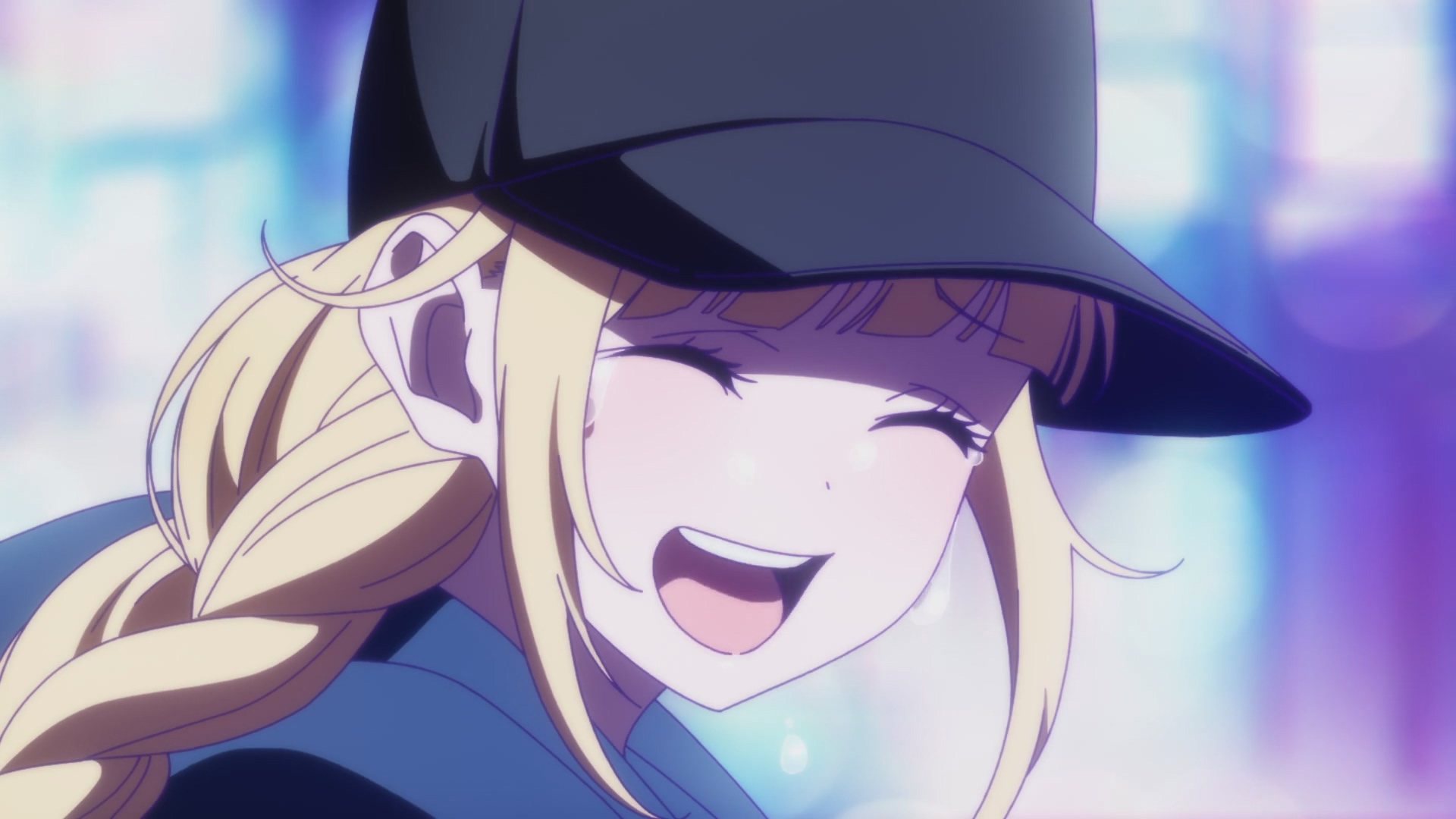
Eiko Tsukimi is the real main character of this show to me, and that’s largely because the story is her story from the beginning. Eiko throughout the show was able to grow not only in popularity with the help of Kongming, but was also able to grow into herself and her own individuality as a musician in the process. Pretty much the entire second half of the show focused on this development, and while Kongming’s character suffered from it, Eiko’s character blossomed. Endearing from the beginning of episode 1 all the way to the final moments of episode 12, her character was so easy to root for and want to see succeed, and that’s why all of her successes feel earned - we know what she’s been through, where she wants to go, and why she wants to do it, and it was very fulfilling to see her take steps towards realizing her dream. She’s a very standout character, and easily my favorite.
Kabetaijin is the secondary character that Kongming helps realize his own dreams for, and he pretty much undergoes the same type of arc that Eiko goes through over the course of the show. A talented battle rapper who was once a former champion but quit after collapsing in a rap battle due to a stress-induced ulcer, his arc is primarily about taking that next step and learning how to deal with the pressures of consistently being better than you were before, and it was done pretty well considering he’s just a secondary main character.
The final “main” character that I felt was a major standout was a character we didn’t get until the second half of the show in Nanami Kuon. Introduced at the beginning of Eiko’s journey to “finding her own voice”, she spots Nanami in the streets performing “I’m still alive today” using a bucket as drums, and impressed with her voice, Eiko joins her in these street performances and soon befriends her. Not only is her chemistry with Eiko off the charts, but her own character development arc coinciding with Eiko’s was really sweet and heartwarming. Nanami’s arc of rediscovering her lost passion for music through Eiko and gaining the strength to rebel and take back creative control of her and Azalea’s music was an extremely satisfying one, and given its ties to the series’ theme of music having the power to impact people’s lives for the better, it was an arc that I really enjoyed.
(Conclusion)
Even amongst the stacked Spring 2022 season, Ya Boy Kongming! did more than enough to solidify its place alongside the other amazing shows from it. While it didn’t reach the heights that I thought that it would reach and fell short in a few ways, I’m a sucker for quirky and absurd shows with a heartwarming message, and Kongming! had a few moments that moved me. It reminded me just how much I love music and how it can impact me and many others, and for that, I really appreciate it.
Ya Boy Kongming! is an extremely solid show with a lot of things to like about it, so if you’re up for an infectious comedy with great music and a wholesome journey of finding your voice, then give it a shot!
46.5 out of 49 users liked this review
