BELLE focuses on the struggle with oneself and society. Tackling on the issue that it's okay to be vulnerable. Not much of it had to with your usual romance.
It's an adaption of Beauty and the Beast, set on the modern era where virtual world is part of everyday lives.
There's similarities with Disney's Beauty and the Beast in terms of Belle being an idealistic outsider, a shunned and misunderstood beast, and a "villain" blinded by his own self-serving justice.
This adaption was made to be relevant to the era's existence of digital world and identities.
They decided to tell a story that vulnerability is important even in the environment where self-construction and masked identities are highly encouraged. Masks and guarded self only makes it harder to trust and have authentic connection. It only makes us more misunderstood and even more distant.
Meanwhile, vulnerability and love allows us and others to go through our built up walls and beliefs, without being highly judgmental, which the world has enough of.
So far, it has a good lesson. It was confusing at first with how it was portrayed, but it made sense after thinking about it. I think it can be portrayed better. Some things were lacking in terms of how some things came to be, but it was still worth to watch.
It has similar vibe to Disney and Pixar, and can be considered musical.
PERCEIVED IDENTITY

Suzu, our female protagonist, was introduced as aloof and bashful girl who grew up with a loving mother. During a vacation, her mother left young Suzu's side in an attempt to save a drowning child. While the child was saved, the mother unfortunately did not make it back. This begets to her beliefs that her own identity is someone who is "less important".
"Why did mom left me, (and put herself in danger) for another child?" -Suzu

Growing up, and throughout the story, Suzu always seems to avoid confrontation, whether this be a conversation with her dad, or her childhood friend.
She would struggle to get along with people when it involves singing (example: choir, karaoke) as it would remind her of the accident and her "less worthy self". After all, she always sang with her mother.
When her dad would ask if she would like dinner, she would refuse perhaps because she didn't want to her dad to waste food on her.
Then when it comes to her childhood friend, she thought ("I'm not the girl you knew in elementary school, you don't have to look after me anymore"). She prolly believes that she was not worth the attention.
In comparison to her identity in the virtual world though, she finds it easier to sing as she was under the concept of a blank state identity. Cutting ties to the flaws and perceived weaknesses of her identity in the real world.

Unfortunately, when her childhood friend knew she was the great Belle, she finds it hard to accept it. She's back to the idea that she is not worth it (despite being a global phenomenon in the virtual world.)
However, this belief was challenged when she started to look after the Beast.
LOVE and EMPATHY

When there was a media outroar on the identity of Beast. There are two sides that contrast each other.
One is the adults, and the other side are the kids and teenagers. The adults were more judgmental and less merciful toward the "criminal", while the younger ones were more sympathetic.
The adults make comments that the beast in real life is a murderer, or a corrupt person who evade taxes. As for the younger ones, they see beast as someone to be pitied and shown sympathy on. ("The adults are bullying the Beast!")
Real world or virtual, there are pity, curses, assumptions and judgements. It's easier to throw these especially if the surrounding is an echo chamber. As such, showing empathy for the beast, the minority, and the misunderstood is a double-edged sword. Despite that, Belle makes a difference by going through the action of actually reaching out for the beast in attempt to change and understand him.
The empathy that Belle tries to extend to the Beast, allowed Belle (Suzu) to see through rumors and break through the walls. It's thanks to Belle (Suzu), that the truth came out that Beast turns out to be a teenager who tries his best to protect his angel (younger brother). Both of these brothers were under an abusive father. While the virtual world sees beast as someone, who brings disorder in the virtual world, to the teenager (beast himself), it was his way of venting or having control.
This doesn't mean that Belle agrees that of beast's disorders and "chaos". Belle just wants to understand and listen. "Who are you?", "What are those bruises?"
In the end, she's not burning down and throwing assumptions as other "adults" out there, nor she tries to run away like a "child" when the beast instills fear on her. Rather, she's building bridges with empathy and vulnerability as her strength.
Another case of love is Suzu's dad, her childhood friend, friend, and her choir group. They were extremely patient with her. Despite all her avoidance tendencies, dad still keeps giving fruits, childhood friend still kept on asking how she is doing, choir still try to encourage her to sing.
The way Beast used to avoid Belle (Suzu), is also the way Suzu avoids the people around her in real life.
Suzu wanted to somehow change Beast, but the people around her knew that you can't change people. but you change yourself. Perhaps this is why all the loving people around Suzu could do was wait for her to be ready, and still love her for who she is. Suzu, fogged by her own perceived worthlessness missed these small gestures of love. Only when she tried to wish for the Beast to open up, which the people around her has been waiting long ago from her to do, she started to realize that it's okay to be vulnerable to those who love you.

VULNERABILITY IS CONTAGIOUS
"Contagious Vulnerability is authentic human connection."
Thinking about it, It was kind of foolish to go out for someone you didn't even know. However as Beast and Belle (Suzu) have same experience of losing their mother. Perhaps Belle found it easier to empathize. In the process, and with the slight push from her childhood friend, she overcame her hardened walls and finally opened up. She became similar to her mom in a sense that they go out they way for someone they didn't know, even if that is sacrificial. Perhaps this experience has also made her understood her mother's actions back then as well.
Someone famed on the internet who once sees Belle (Suzu) as rival or enemy, also now views her as respected friend when they realized that she was no real life celebrity but a young "nobody" girl like themselves.
Jealously was turned into admiration.
Her childhood friend's overprotection or guardian role, also ended when Suzu grew up into a mature person who no longer tries to run away from things. As a result, her childhood friend appears more like himself, and his walls are down after the some kind of internal promise with himself to protect "crybaby" Suzu finds it place no more.
At first, I didn't know why the abusive father run away in the end. It could be that Suzu's unwavering courage reminds him of her wife. Not sure how she died, but he could have felt guilty.

Art and music composition is great.
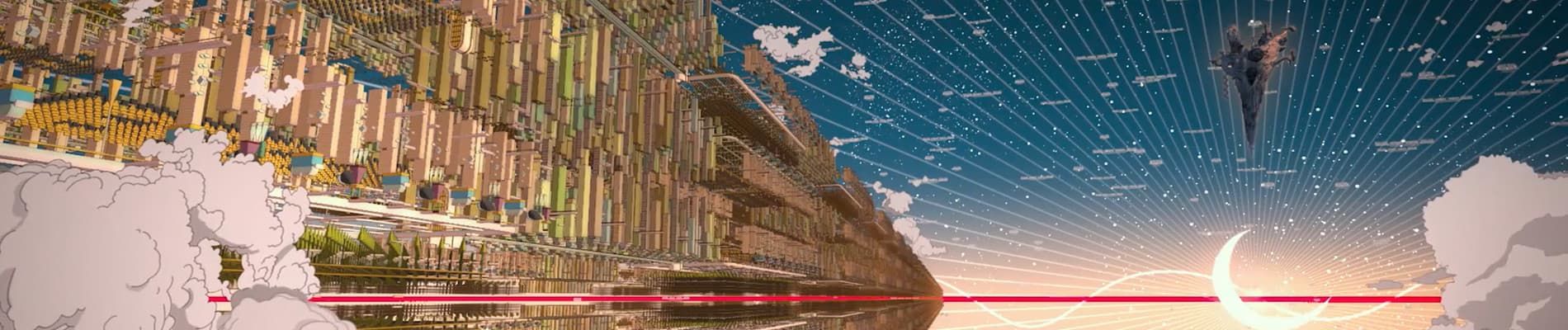
The real world feels grounded, while the virtual world feels "digital".
Some designs in the virtual world may not be realistic and practical (It also looks like a motherboard), but this could be their decision in making the visual world have more distinct separation from reality.

I'm not a fan of the justices' suit of "superhero". The suit may be that way since the justice team wasn't meant to be an official police force made by the creators of that world. Instead they were made by users coming together. It's possible that those were their character designs to highlight how badly they wanted to be seen as "superheroes" in the eyes of the public.
The lack luster of humanoid avatars at the start was a little disappointing, wish there were more humanoid characters but it gets better at the end.
Transition-wise, sometimes its confusing as if the characters just teleported to a certain spot, but it's tolerable.
Overall, it could be better in terms of world building, design choice and story arrangements, as some parts felt forced and incomplete for the sake of pushing a certain message in such a short amount of time, but it's still worth a try for its beautiful lesson, art aesthetic and music compositions.
BELLE Soundtrack: https://open.spotify.com/artist/1m9ZvxLFfX9avls54a0y40?si=adwBXSXYTjSB-58QgbKDEw
24 out of 25 users liked this review
