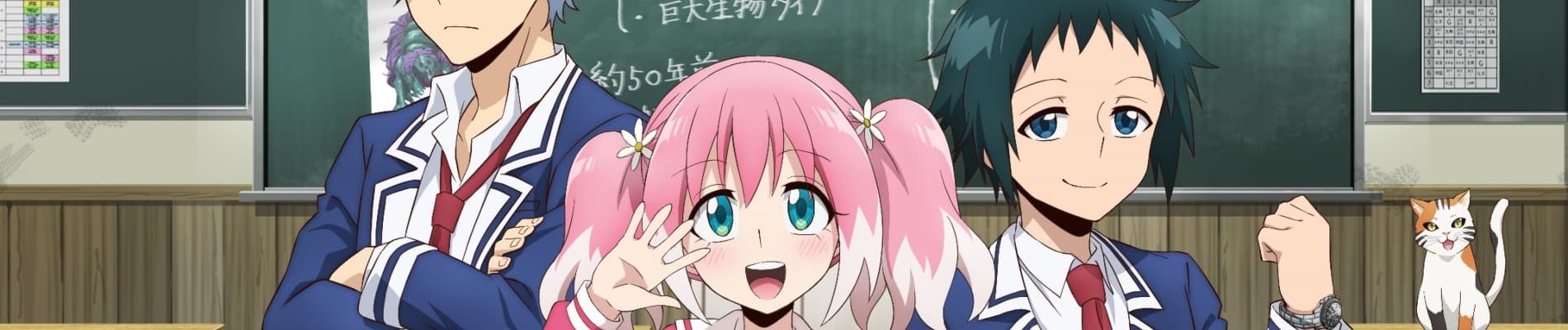
Talentless Nana
a review by ZNote
a review by ZNote

This above freeze-frame happens five seconds into the first episode of Talentless Nana. And it's at this moment that the series effectively cuts off its own legs.
Famed British director Alfred Hitchcock is rightfully considered one of film’s greatest figures in suspense. Part of the reason for this was his thorough understanding of suspense versus shock. A scene that he loved using as an example was this: two people are sitting at a dinner table, when suddenly a bomb goes off. You get a few seconds of intense shock. Now, try the scene again, but reveal to the audience that during that dinnertime conversation, a bomb will go off in five minutes. It’s a small change, but one that makes a world of difference in experiencing a scene, as the suspense towards the timer reaching zero ticks away. The point to emphasize is that there is a distinct difference between what the audience knows and what the characters know. By feeding the audience just enough information to keep them aware of what’s happening, it allows a scene to crackle with nervous anticipation even if the characters themselves are blissfully unaware of anything wrong.
Mysteries and thrillers are perhaps the genres most conventionally-suited to suspense – the entire conceit of these types of stories is that there is a particularly significant event that has happened, leading to a large series of unknowns that the characters must confront. The ability to reason out which mysteries are solved and others that still need to be addressed as the narrative continues is one of the driving forces, as revelations can bring twists and recontextualizations can cause you or the characters to realize that something vital was missed initially. Depending on the route that a story wants to take, it can rely on setting further atmosphere to heighten a mystery or thriller’s sense of escalation, or go for raw visceral affect and let the adrenaline take command. But there’s a danger here – simply feeding the audience the necessary information is not enough; revealing too much, or revealing it at the wrong time, is lethal for a story’s sense of drama.
____
It’s with these last distinctions that Talentless Nana stumbles. A psychological thriller released by studio Bridge in Fall 2020 based on Loose Boy and Furuya Irio’s manga, the series immediately makes the mistake of revealing too much within the first five seconds. Before the series has any real chance to build its suspense, we are immediately spoiled to a main character’s mission via her cellphone, commanding her to kill all the enemies of mankind on the island. As the episode progresses and we “get to know” the class dynamic, and the story’s world concerning the students called The Talented and the “enemies of mankind,” the episode pulls of its first twist by killing one of its red herring main characters in the final seconds.
The show’s framing sets up this moment to be absolutely shocking, that it’s such a twist and revelation that Nana is actually a killer out to destroy the real “enemies of humanity,” which are The Talented. The problem is that, as stated before, we are already tipped off early that Nana’s real mission was to kill the “enemies of mankind,” and given the sheer extent to which she goes to try and ingratiate herself to the red herring main character, it likewise reveals too much to the audience both narratively and character-wise. There is little build-up or payoff for a character whose façade could be read within the first few minutes of getting to know her. The secondary impact of the moment is that it conveys that we shouldn’t get too attached to anyone since Nana will try to kill them, regardless of their backstories or their personalities.
As Nana’s kill count gradually rises, some of the more-endearing characters are killed off early, which leaves several of the more-incorrigible characters behind in the middle and at the end. Therefore, the other characters often don’t leave us much room to want to see them survive in a time where the tensions should be at their most-heightened. The fact that some of the students are actually terrible people reads as an attempt to fix the flaw that the narrative had not properly justified why the government deems their lives forfeit in a tangible fashion beyond the theoretical. So rather than have the question of “Will she even kill the kind characters” as one of the cliffhanger hooks, it instead opts for a more-dismissive “Alright, who’s next?” So, even if kind characters do remain, the sense of danger looming over them due to Nana’s mission means that their fate is more or less a foregone conclusion in one way or another.
And remember, Nana’s mission from her higher-ups is predicated on the theory that the Talented might become troublesome and dangerous later on, since the infodump we get implies that in the past, the Talented grew out of control and needed to be reined in. As much hubris and ego as the students have with their powers, they haven’t actually done anything wrong yet that we can glean, at least initially. In large part because of the main twist being spoiled in the first five seconds of the anime, Talentless Nana presents its overall scenario in a functionally out-of-order manner, pulling the roots out from underneath before the story can properly get planted. Killing your kind character early under the auspice of world peace, and relying on that for shock value resonance, leads to an incongruous attempt to argue that the ends justify the means.
With all of this in mind, the narrative pushes the audience to root for Nana’s attempts to kill, with justification for that finally coming after some time has already elapsed and we get her backstory. In having the revelation about Nana’s past come up, and at such a late hour of the show, it is in itself far too late to justify why she is carrying out the murders in the first place. That’s not to say that the justification is not sensible, but rather that it’s another case of mistiming the important details. Nana’s life is rooted in tragedy, but anger, resentment, and orders, even regarding The Talented, does not by default make her previous actions compelling either sympathetically or dramaturgically.
And that’s not getting into the show’s tendency to introduce random new characters at the drop of a hat with only the tiniest bit of reasoning for their inclusion. Talentless Nana seems to mis-prioritize the scope of how large the cast itself should be. With so many classmates on the island, there was already enough of a character roster that the show could have used to develop its in-universe mystery. Instead, by having more individuals arrive later in the game, it throws additional wrenches into an already-stumbling machine. The effect is that the current mystery narrative framework is in and of itself not engaging enough to warrant a full 13-episode run, so it has to dogpile more information into the fold to artificially pad the suspense.
There’s one other approach to consider with this series – that it’s not meant to be “suspenseful” in the sense of mystery, but in the exhilaration of watching Nana 5D chess her way out of suspicion. But that’s built on the foundation that most of the other characters, besides Kyouya, are not that bright. Even in the instances where Nana is cornered by circumstantial evidence pointing to her as the killer, or when other students manage to get dirt on her somehow, it always comes across as hollow. I can understand an argument that the kids are only in high school and the state’s propaganda about “enemies of humanity” could lead to indoctrination and thus limiting their ways of interpreting their situation.
However, Nana’s intellect is so stacked against everyone else that there’s no real tension. The other students are often too drunk on their own hubris or unable to wonder why there are no security cameras around to watch over them 24/7 to supposedly “protect them” despite the government labeling them as dangers to society. This could, on some level, be ascribed to Nana being the main character, so she naturally is given some degree of protection from those who could stop her, even in the midst of her mistakes. And yet, I never felt that Nana was sincerely threatened at any point for much of the story. It’s mostly set up for her to be nigh-untouchable.
This, I think, is ultimately why Talentless Nana doesn’t work. The reveal in the first five seconds, the end of the first episode, and the sheer disparity between Nana’s intellect and everyone she’s trying to murder over the rest of the series, all make for a rather toothless thriller. Ironically, in revealing Nana to have the fangs early, the bites left behind was little more than an itch.
__________
Talentless Nana manages to capsize its own potential for twists, suspense, and whatnot early on, leaving much of what happens later with little impact. Although Nana managing to outwit her classmates does provide a source of amusement, it is rather slight since the formulaic approach causes attempts to shock or amaze feel limp in their wake, and the rest of the cast being so underdeveloped can’t contribute to the sense that they should be rescued. The show takes it upon itself to do so much of the heavy lifting at the cost of it not leaving much in the way of intrigue. With surprises thrown in that come too often at the last-minute and quite a bit of loose ends left unaddressed, it’s a thriller that doesn’t thrill. I know that the manga continues the story from where it left off in the anime, but the tension of what could possibly happen next simply isn’t there for me.
39 out of 51 users liked this review
