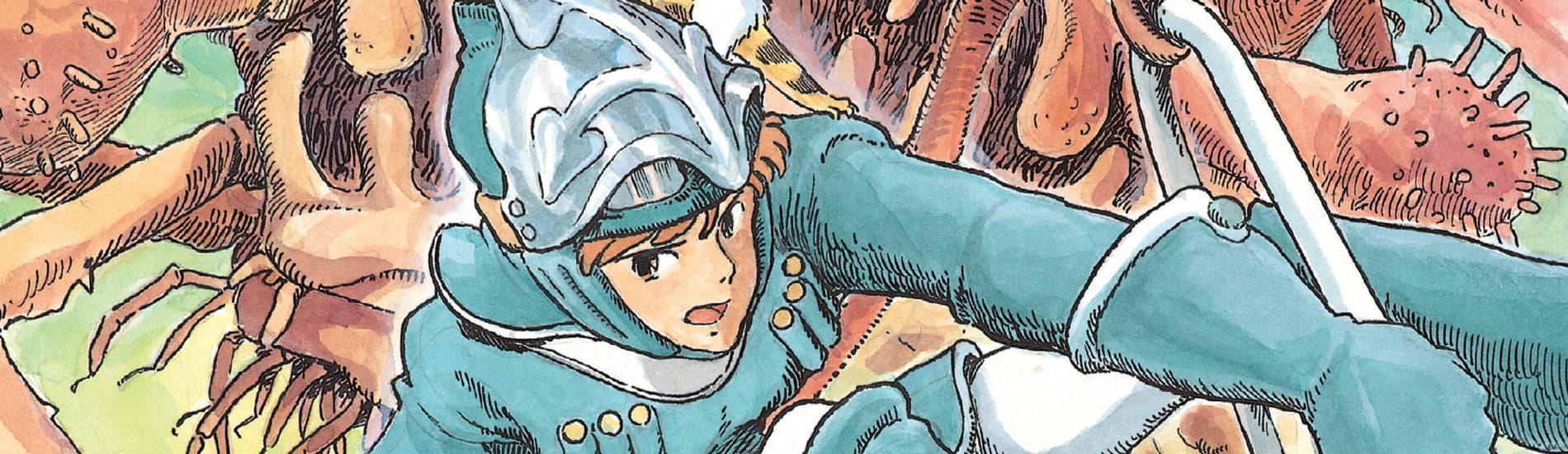
Since I first read it, I considered Nausicaä of the Valley of the Wind to be a totally different kind of experience compared to all the other stuff I read and watch daily, but I was never quite able to tell out why that was. Now that I just finished reading it all once again, after about 8 months, I feel I grew a little more conscious of that answer, so I’ll try to put it into words.
I'm not writing this to be a commentary on Nausicaä itself, rather, a discourse about how I personally perceive and evaluate art in its forms.
My first approach with Nausicaä of the Valley of the Wind was the 1984 movie. At that time, I had barely any experience with Ghibli movies and Hayao Miyazaki’s works, but I had already seen Princess Mononoke (which basically everyone told me to be the “polished version of Nausicaä”), however to me, Nausicaä of the Valley of the Wind was, and still is to this day, an overall much better experience.
To me, any artistic product holds a value in itself, and it has become very hard to talk about this concept in a world where artistic products are but merch produced by an industry which objective is to sell said product to their costumers. Being part of this world and community for many years now, I think that many people become accustomed to evaluate art (manga and anime, specifically in this case) with the same criteria the industry does, that is evaluating the “shape” and “content” of a product with the same esteem, if not considering the “shape” to be the most relevant one.
I recently saw a video about an anime series stating that “even if it tells nothing but it does entertain the public, it’s still a good product", and I see this argument being used in discussions on this topic pretty often, like how “something doesn’t need to be deep or have a big meaning behind it to be likeable”, and while I agree with this statement to some degree, this is something that is true if considering only the “industrial” aspect of the product, in my opinion.
The “shape” does not create “value”, it “adds” value to a product. The “content” of the product is what creates its “value”.
A godly-written and entertaining story that has nothing to tell or teach is worth nothing. Instead, a story maybe full of flaws, but still able to convey a meaning, is a great story, to me. Art in itself is the only mean a person has to express himself, art is indeed the purest expression of the self and it certainly was never about “shape” to begin with. A story is told because someone has something within himself that he wants to tell to others, that is to me the essence of art. And that is why a product empty of meaning will never be as valuable as one that relies on its meaning.
This is not to say, of course, that “shape” is worth nothing; without a shape the content cannot be conveyed, and thus cannot reach the “others”. But I can’t go as far as to say that the shape is then as important as the content is. To me, this is not true, as the “content” in itself is reason why art is born in the first place, and conveying it is the “end goal” of the artistic product. Prioritizing “shape”, sometimes ends up restricting the strength in which the “content” is conveyed, and this is the reason why I still prefer Nausicaä of the Valley of the Wind over Princess Mononoke.
This whole discourse reminds me of Hideaki Anno’s comment on the release of the manga “Mobile Suit Gundam: The Origin” he made in 2005, titled “Celebrating the Revival of Gundam as a Tale”, in which he stated:
“In recent years, the hollowing out of mainstream culture severely diluted and eroded the standing of the Tale. TV-type mass consumption laid the impoverished grounds of contemporary entertainment, giving rise to masses that can only respond with praise for superficial details and technical proficiency. That is why I am so glad that Gundam is showing us here a true Tale, through the medium of manga. I want as many people as possible to reconfirm and savor the essence and allure of Tales.”
To me, the manga Nausicaä of the Valley of the Wind accomplishes the achievement of telling a true Tale, one that relies completely on its meaning and that was born from the innate need of its author to tell something to others, something that will remain endlessly in time. That’s why it feels to me as a completely different experience, one that you cannot really stop learning from, and that is capable of shaping you as a person. I hope this aspect of art won’t be lost as the industry keeps exploiting artistic products for entertainment’s sake, but I do have a feeling that humans cannot live without art.
31 out of 31 users liked this review