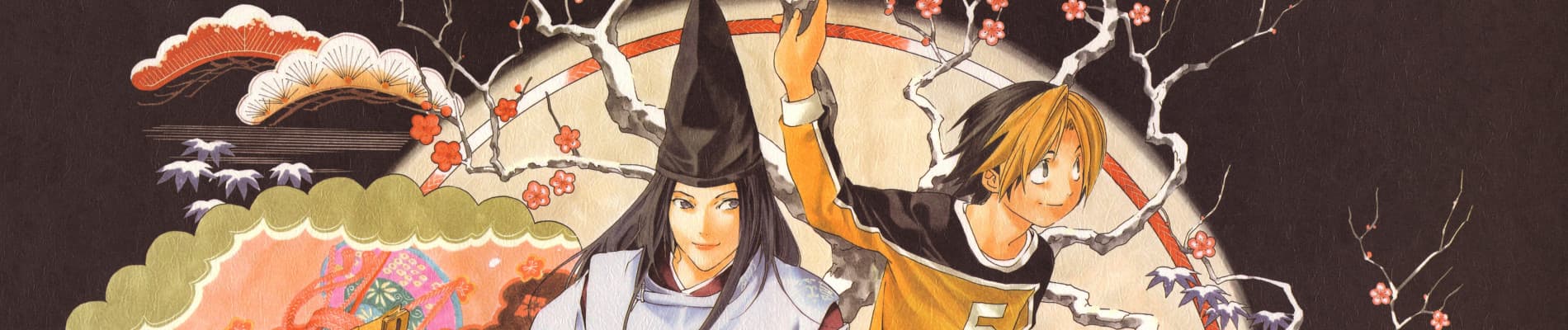
Hikaru no Go
a review by apokos7
a review by apokos7
There were quite a few anime broadcast on television during my childhood, and as far as I remember, I enjoyed them more than any other activity I did at the time. Their japanese origin and the term anime first became known to me at my early teenage years and that was when I started watching them systematically, mainly via the shounen demographic and specifically Weekly Shounen Jump's works. It was not long until I also delved into the manga world and, true to my inclinations, began exploring works almost exclusively from that magazine. I had probably touched upon less than a dozen titles, when I decided to check Hikaru no Go and it was a magical experience that I could not get enough of, one that sparked my interest in the game it presented and had me learning its rules making me want to start playing it myself.

Over a decade later, it is now a period when I regularly find myself revisiting titles in order to freshen them up in my memory and form a better and more representative opinion of them, accurately mirroring my tastes and understanding as they have formed over the years. Hikaru no Go is the latest in this process and I can confidently state that it was by far the most eye opening one, one that had me relive the passion my younger self experienced during my first readthrough, that rekindled the flame of curiosity around the game itself, and a rebirth of a slightly forgotten favorite. Without further ado, prepare your Go board, pick up your stones and let's go for a deep study into the world of Go.

Go is a strategy board game originating in China and is believed to be the oldest board game that has survived to this day. It was prominent enough to be considered one of the four arts that were essential for every noble man to be educated in along with the musical instrument guqin, calligraphy, and painting. The game was later spread to Korea and finally introduced to Japan becoming popular enough to hold a prominent position among members of the imperial court. It was there that the rules and the ranking system were finalized and took the shape that holds to this day, and from where it eventually reached international audiences.
The Go board has a 19x19 grid of lines, creating 361 points. Two players take turns and alternately place stones in those points. Go is a game of encirclement and the two players' goal is to surround a larger territory with their stones than their opponent. Those extremely simple and easy to understand and apply rules give birth to the most complex strategy board game. The large board and the freedom of moves create legal board positions that number approximately 2.1×10^170, when at the same time the number of atoms in the universe is of the order of 10^80. The numbers are awe-inducing and make it clear that we are talking about an impressively complex and intelligent game after all.

Hikaru no Go is a shounen manga from Weekly Shounen Jump and it features the game of Go. The story begins when naturally curious and energetic Shindou Hikaru stumbles upon a stained old Go board in his grandfather's attic. The board houses the spirit of Fujiwara no Sai, a Go player and instructor from the Heian era, who possesses Hikaru as a separate coexisting spiritual entity inside of him, which only the young boy can perceive. As Sai wishes to explore the modern Go scene and reach the Divine Move, a once in a lifetime game changing move, he drags Hikaru into his quest and the journey to the world of Go begins.

The story benefits from all the great shounen elements in presentation, substance and style, while it retains a distinct aura that diverges from the normal making it a more grounded and well-rounded experience than the typical shounen or sports manga. The plot never drags and evolves immensely and in multiple directions, there is a great and dynamic cast of characters, all of them loveable with a well earned place and purpose in the story, and the art is perfectly detailed, clean, expressive and full of life, as legendary creator's Obata Takeshi sensei's breakthrough manga could only be. There is constantly a focus on the games themselves, yet the presentation is easy to follow and has educational qualities. Alongside Hikaru we also get acquainted with the game's rules, playstyles and philosophy. Yet, at the same time, it is never an element that feels too specialized, technical or that subtracts from the reader's immersion. This is achieved due to the charismatic characters and their worries, as each presented game has a purpose for either the plot to be advanced or the characters themselves to grow and learn.

It is the second time Sai has experienced the possession phenomenon with the first being the real life figure of Honinbou Shuusaku, a renowned Go player from the past. This carries the advantage of moving the plot forward fast without stalling as Sai immediately understands the situation he is in. Hikaru's carefree attitude enforces that and the two soon decide to have Sai play Go with Hikaru moving the stones in his place, and thus the duo's misadventures begin.
Hikaru's first game is a fateful encounter at a Go salon with a kid his age, Touya Akira, and one that will create what I consider one of the best depictions of rivalries in manga. Akira is actually the son of the current Meijin, one of the major title holders in Go in Japan, and good enough to be a pro himself. His reality will take a drastic turn when a kid his age who is playing for the first time and cannot even hold the stones properly soundly defeats him twice, from his perspective. It is not only Hikaru's, but Akira's destiny that is altered because of the involvement of Sai.

After the story's introduction, Hikaru's journey starts at the middle school he is about to enroll. Through various shenanigans regarding the school's Go club, existing and soon to be recruited members, and an upcoming tournament, Hikaru's intuition and game sense are made evident and he starts getting involved with Go himself wishing to walk down the path of a Go player. Many new interesting characters are introduced, giving new aspects to the game and its approach towards it.
At the same time Akira decides to follow after Hikaru and joins his school's Go club himself, in a decision most would consider a waste of time. He is also given a hard time by his classmates because of his overwhelming ability, but he faces everything composed and with pride in his Go. When Hikaru and Akira's premature confrontation arrives and they genuinely play together for the first time the emotional outbursts rising up inside Akira are taken up another notch and create a sense of confusion and frustration regarding Shindou and his inconsistent performance.

The next step of Hikaru's path accidentally leads him to internet Go. The anonymity of the internet is the perfect opportunity for Sai to play to his heart's content, and Hikaru can also keep developing while playing his own games without raising further suspicion. Sai immediately starts dominating the internet world as he is taking down powerful international players one after the other attracting attention. He shakes up the Go world which ultimately leads to a proper rematch between Akira and Sai. At its resolution Hikaru clearly declares his resolve to catch up to Akira and even surpass him. Our protagonist is now deeply invested in the game he has been playing for a while. Concurrently, the internet arc gives a first glimpse at the structure of the professional stage such as the existence of the Insei, people studying at the Go association in order to take the pro test, which Akira has now passed. I consider the arc to be a great touch and a choice that brings modern elements such as the internet to a game with rich history and culture, and acts as a bridge on how historical activities in today's setting can function and generate interest.

With Hikaru's resolve shaping his actions to follow, he registers as an Insei with the goal of reaching the professional stage. No longer an amateur he bids farewell to his school's Go club which is shown to attract new players and steadily gaining momentum, and has to focus on the challenging Insei matches. Throughout the process Hikaru is shown to evolve at a rapid pace, despite being struck by uncertainty because of the high level he initially came across. The confusing image people around him shape because of Sai's involvement continues as a motif, and his fellow Go apprentices are ever curious about him, and his involvement with Touya Akira. Hikaru also faces his fear developed by playing against Sai now that he has cultivated an understanding of the game and by extension his mentor's power level.

As his apprenticeship continues and Hikaru climbes up the ranks, there is a tournament taking place between pros and Insei, where he once again wins the attention of many seasoned players. During the preliminaries for the pro exam, he often visits Go salons with his fellow Insei friends and gains skills mirroring the growth of his lifelong rival. He is also seen facing against a Korean Insei, which is a clever first glimpse of future events and the final part of the story. Even moments before succeeding and passing the pro exams he often faces defeat as part of his approach and mentality to the game and not only as a result of his developed skills.
Both elements are two I greatly respect Hikaru no Go for. The manga casually mentions characters or events that will smoothly tie in to the story later on and is very subtle about it. It also never fails to have its characters face defeat. In fact, despite Hikaru's talent having him evolve extremely fast, I am under the impression that he is shown more often losing than managing to snatch a victory in most matches of importance. Especially the latter, is something that offers a sense of reality and is a factor of immense immersion to the story's pace.

In parallel to Hikaru's growth, Sai displays a similar upgrade in his playstyle as well. A masterful player from the past getting acquainted with modern strategies and tactics could only serve to further his game and reach a higher peak than he did during his years at the Heian era or his time as Honinbou Shuusaku's mentor. When Hikaru, now a pro himself, sets his gaze at the top ranked players, Sai feels uncertainty about whether he will ever have the chance to have a proper match again and requests a game with Touya Meijin, the one who is closest to the Divine Move, same as he, for a confrontation which has been setup from the start of the series and was reminded at various points throughout it.

With few misadventures, characteristic of our dynamic duo, in between, Sai faces the Meijin twice. The first time he took over Hikaru's first match as a pro, but Sai is forced to do so under a huge handicap in order to prevent further suspicion from being raised. The second time is the proper final match between the two great masters and Sai's grand climax as a character. Hikaru manages to arrange a match between the two via the internet, something that will add to the sense of intrigue regarding his unusual performance flunctuations and behavior in other characters of the manga. As for the match itself, we see Sai more gallant and noble than ever and finally achieving a match that will leave him satisfied. However, the true winner of that match might have been Hikaru all along, having a direct role in it, which leads to a deep understanding in the way it is being unfolded and even displaying his great ingenuity and genius underlining a game changing move both masters of the game have missed.

Sai has finally realized the purpose of him being given a chance to live partially once more through Hikaru. It was so that he could nurture him and show him the way to his natural calling and the arena that can fully utilize his talents, and upon that realization he disappears from this world.
Hikaru wakes up and cannot find Sai anywhere. Driven by panic he starts searching everywhere and travels to famous landmarks and places associated with Shuusaku and his recorded life. Unable to find him and accepting his disappearance he reaches the wrong conclusion, thinking it would have been preferable if he never played Go himself and gave his matches to Sai. He crumbles emotionally, shuts down and abnegates Go even skipping his professional games.

The part of the story where Hikaru entered the Go association as an Insei opened up the world introducing many memorable characters and their different approaches and situations regarding their desired profession. Isumi Shinichirou, a fan favorite, failed the previous pro exams, when Hikaru passed them, and is now seen studying Go in China as he tries to level up his game and overcome his doubts. Upon his return right before the next pro exam, he hears of Hikaru's abstinence from Go and visits his home in order to have a final match with him and settle their previous skirmish which was concluded in a way that left a bitter taste to both of them. By the time the match is over, Hikaru realizes that he can only honor Sai and be close to him by continuing down the path of Go.

This is the turning point of the series in more ways than one. Hikaru has successfully overcome his reliance on Sai, and the emotional setback from the latter's departure and is now capable of standing on his own two feet and is willing to walk down the path of a Go professional. Secondly, the ever expanding world created in the manga is now ready to introduce an international element to the story and bring a higher level of challenge to the table. And lastly, the art itself, which had initially started with cartoony, playful and dynamic qualities, has now evolved into a more crisp and sharp style and it has masterfully done so in a way that feels natural in a process that goes hand in hand with the protagonist's growth and development. Hikaru's renowed attachment and passion towards Go and his confident and powerful approach is now boosted by more detailed and expressive lines that elevate the experience.

Hikaru returns to the pro stage stronger than ever, and being unable to climb up the ranks for a while because of the games he had previously forfeited, he is nicknamed the strongest Shodan, the lowest rank of pros. His comeback sees him playing Akira and developing their healthy rivalry as they now often train together, with lots of bickering involved, with Akira going as far as to acknowledge both natures of Hikaru, his own and Sai's teachings and elements in it.
The ever expanding and intricately detailed world of Hikaru no Go features a newly established tournament competition between Japan, China and Korea as the next and final step of the story. Through the qualification process to determine its participants, we first get a glimpse of a more detailed look on how Go is organized in other parts of Japan as well. We also keep getting information on the often featured title matches, and their preliminary stages gradually reveal the complexity with which the tournaments for them are being scheduled.

Right before the Hokuto Cup is about to start, a misunderstanding will stir up a storm as the top young Korean player is wrongfully believed to underestimate and disrespect Honinbou Shuusaku's strength and historical importance, something that will spark Hikaru's competitiveness and make their competition personal. By the time the fierce games that take place conclude, we find not only Shindou's strength and Go talent accepted by everyone, but also the manga's main thematic made clear, and what makes the option of ending it at that point a great one.

Go is infinite, a game that people can dedicate their entire lives in and never reach a point of satisfaction or display full mastery of. A seemingly endless set of moves create innumerable plays and strategies, which makes involvement with it a lifelong pursuit. Sai even had to transcend eras and live thrice to feel a sense of satisfaction. The manga itself has such a vast, deep and layered overworld where a typical approach of a protagonist simply aiming for the top spot in the manga's field, or following the end point of every character's journey would probably only serve to make the manga devolve into an endless and tiring piece of work full of uninspired competitions. I would have probably still loved this endlessly compelling universe even if it had kept publishing to this day, but I am even happier that it knew when to stop and keep itself concise. Being a short, complete, character driven story, it utilizes all the best qualities of a sports manga while failing to lose itself in a constant stream of games void of substance.

Nothing ever is.
Hikaru no Go is a coming of age story. Or even better, simply an extended origin story, one of Hikaru being shown the path of Go, a strategy board game that will become his natural calling and place to belong, and the process of overcoming his childish qualities in order to be the better version of himself, while attracting everyone he meets along the way and affecting their destinies forever.
The manga promotes a healthy, positive, energetic stance on life, striving to better oneself through sort midterm goals while retaining ambition and strength of character in a journey of self improvement. Free of hyperboles or conveniences, it has a very realistic approach and presentation making its characters face obstacles and defeat as frequently as their triumphs, if not more often. And elevating its basic structure is the immensely funny and easy to follow way the story is presented resulting in extreme immersion and the desire to genuinely root for the characters and that makes them feel warm and human.

The art is of the highest quality. Obata Takeshi sensei's breakthrough work features all the great elements he is known for; clean and detailed art, impressive color pages and doublespreads, panelling with excellent flow, memorable character designs, and highly expressive reactions. I simply adore the way he draws people in suits and consider him an unparalleled, distinct and unique creative genius.
A series with an easy to get into premise, hard to detach yourself from plot development, an educational and immersive presentation, compelling and fully explored character arcs, and more importantly character interactions and dynamics, mainly its very many duos and rivalries, with all of the above reinforced by a great finale highlighting the story's purpose and elevating its message and the substance of Go itself. It has no missteps, every choice regarding on how the story progresses serves its purpose and there is intelligent set up of events and characters. All in all, it has the entire package and no particular flaws can be attributed to it.

There is often talk of works that are considered "hidden gems" or "criminally underrated". I personally find most of the time these phrases are used to be fully exaggerated, yet this is one of the few cases I could borrow them, since I believe Hikaru no Go to have aged in a way that has rendered it extremely unpopular and unknown to today's people's consciousness contrary to its high quality. If there is anything to be gained from this analysis, is that I would simply hope for people to give this manga a chance and experience its well crafted structure and timeless character themselves. Personally, I have definitely relived a classic for the ages and an all time favorite and I will keep regularly returning to the intriguing and intelligent world of Go, and the beautiful journey of Hikaru, Sai, Akira and everyone's infinite possibilites.
Embracing our role as links between the past and the future, I hope I properly communicated the manga's touching experience, and that the passion it is brimmed with has reached you and generated interest in it. Thank you for taking the time to read this. I would be glad to have you visit my profile for more on my approach and preferences regarding anime and manga and maybe check my other reviews. Until next time.
24 out of 24 users liked this review
