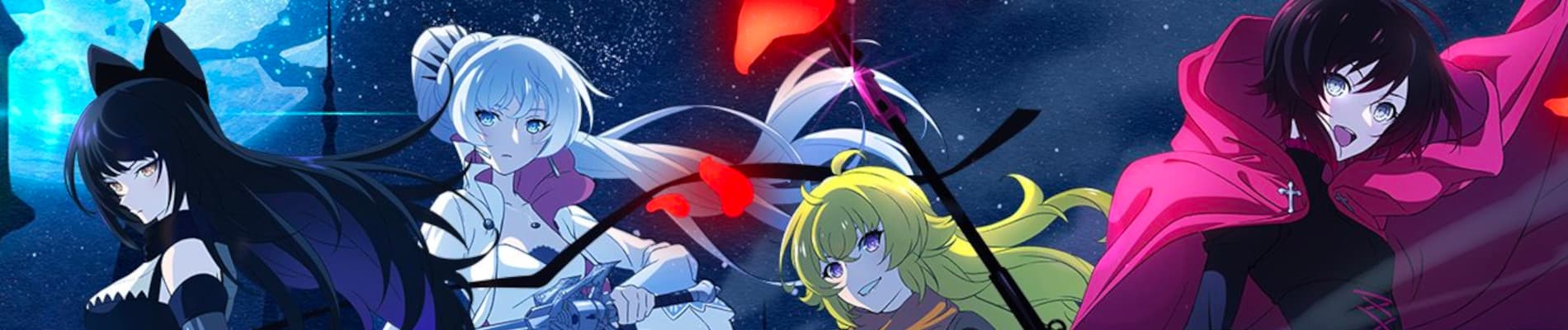
RWBY: Ice Queendom is a fascinatingly in-depth misfire, and a hastily put-together mess of a concept, which is a shame, because I feel like in the right hands, it could have been the kick-in-the-pants its source series desperately needed. It faltered not because the team behind it didn’t care, but for desperately lacking a level of consideration and hindsight to tell the story it wanted to tell in the best way possible while being exciting for existing fans or a good jumping in point for newcomers.
As someone who has seen all eight current seasons of the original RWBY series, my general opinion is that despite some goofy character charm, distinctive character designs with appropriately distinct powers, rocking musical inserts, a 3D animation aesthetic that grows more professional as the years go on, and a share of incredibly kinetic action scenes (primarily in the first two seasons when its creator Monty Oum was still alive, RIP), it’s easy to look behind the curtain and see the inexperience of its writers stacking the fragile house of cards that is the series’ worldbuilding and character writing. The majority of the show’s seasons tend to focus on an excess of character factions, dead end subplots, badly conveyed worldbuilding and an incredibly questionable racism allegory with pacing that doesn’t tend to give its better ideas (such as the lead character’s grief about her lost mother) enough time to properly coalesce. It’s to the point where the RWBY Chibi spinoff series entirely about zany gags uses its cast better than the show it’s based off of. But it does have a lot of ideas, and a lot of fans that attach to some of those ideas, despite the series gaining a similar reputation to Sword Art Online among dissenters and outsiders for how amateurish writing underlies much of its production and conceptual strengths.
My hope with RWBY Ice Queendom was that this series, with the benefit of hindsight and eight seasons worth of character material to pull from, could tell a tighter, incredibly cohesive story about its four title characters, with talented 2D animators mirroring Monty Oum’s gift for dynamic, kinetic and characterful action scenes to scatter throughout. This series could epitomize the genuine appeal of RWBY’s action and character concepts separated from all of the excess junk the main show had been piling up. Remind longtime fans why they should keep caring about the series while hooking new fans. Sadly, I don’t think it accomplished either goal.
Regarding Recap
First of all, if you are a newcomer to RWBY scared off by the MMD level of animation quality, Ice Queendom starts with a three episode recap of the first season of the web series in the show’s new 2D style. It’s a conceptually basic story at the start, starring four girls (Ruby Rose, Weiss Schnee, Blake Belladona and Yang Xiao Long) who are accepted into an academy to train their fighting abilities to become peacekeepers of a world overrun by ravenous monsters known as Grimm. The recap is to get everyone up to speed on where the characters were at that point in time.
I can understand this was done specifically in relation to Weiss Schnee, the series’ Snow White analog, to bring her negative character traits to the forefront. She’s haughty, selfish, domineering, has a need to appease her demanding father, feels constantly judged by her siblings, and is flagarently racist against the Faunus, a species of animal human hybrids meant to represent the oppressed races of the world (yes, really). They needed to make all of this clear in order to have substantial psychological ammo to dissect for the series’s main arc, and I think they succeeded, but there are obvious concessions made in having to cover so much content unrelated to Weiss that was happening at the same time.
To Ice Queendom’s credit, a lot of the more egregious/extra parts from the original first season are cut, such as Yang arbitrarily leaving with shadow people extras to excuse Ruby meeting other characters on her own or having to go to three separate scenes to show Blake’s and Weiss’s introductions randomly stumbling onto Ruby in an empty fountain plaza, the main four bickering in a dorm at night, to then hearing an announcement from the school’s headmaster Ozpin the next day. Scenes such as these are all consolidated in a way that makes a lot of sense, and character dialogue is generally a bit more natural throughout the recapped material. The widely hated story arc for the character of Jaune is cut almost entirely aside from introducing a new original Nightmare Grimm that comes into play later. That said, this is a case of less bad, but also less good, since this comes at the expense of the humor. There’s some jokier parts in later sections of Ice Queendom that bring in some charm, but for the first three episodes, much of what gave V1 RWBY its spirit in spite of the questionable plotting and wonky non-battle animation, is fairly excised. Despite 2D being inherently more limiting than 3D in terms of camera space, this section has a handful of strong animated moments (mostly from Hiroto Nagata) that match what Monty Oum was capable of nearly a decade ago on a program that could barely get character walk cycles right.
All of this though mostly only applies to the first two episodes. Episode 3 has to cover far too much of the original series in only a short 22 minute runtime while also planting seeds for the anime’s original story. This makes the already messy plotting the original series had of needing to spontaneously introduce two entirely new characters for the season’s final action climax even more rushed. To make up for Weiss’s lack of presence in Volume 1’s climax, they removed the entire fight. I know it sounds really really really really really really really really dumb, but trust me that this is the most likely scenario. It then leads to the episode’s closer feeling like it happened too early.
There is one other issue this manner of recap brings, which is that if you’re not already a fan of RWBY or invested in the journey that its characters have gone on for nearly a decade at this point, I have to think it would be harder to care once the original material starts and Ice Queendom has a lot of intense, high-strung emotional scenes between characters who, to you, have hardly had the time to know each other.
This can be seen right away in Episode 3 when the implied incredibly close bond between Jaune, Nora, Pyrrha and Ren is told, not shown, as an attempt to parallel Ruby and Weiss’s shown struggle to get along, but there being almost no time to show Team JNPR’s kinship prior to that moment. And this continues when the Ice Queendom plot takes center stage and you see Ruby and Weiss having these grand emotional moments regarding their relationship while Blake and Yang have their own sort of rapport hardly seen prior but given a fair amount of time in later seasons of the original show. And yes, I do think this is an issue to take with Ice Queendom because the series is presented like an alternate timeline, not a sequel like Metal Gear Solid 4 or Kingdom Hearts III which are in series with one timeline and naturally suggest by name you need a lot of knowledge going into it. As someone who’s followed the original series, I do appreciate more of what’s going on there, but to newcomers I can see them being out of the loop.
To Ice Queendom’s credit, these scenes are presented very earnestly, with Saori Hayami and the other Japanese VAs genuinely putting their best foot forward to carry whatever drama is there. FAR better than their English VAs being pulled to voice the cast with little training or direction at the start. It’s just that the foundation to care about these characters is built on long term engagement to material outside of this anime. That being said, it also doesn’t help that a lot of these payoffs are mulled by the series’s production issues.
Woefully Underpar Animation
Now, despite what I say about the original series gaining somewhat of a punching bag reputation overtime, one element that was hard to deny from the start was the appeal of Monty Oum’s action scenes. He had the ability to show these power-imbued characters as acrobats, using the 3D camera to create long uninterrupted sequences of action scenes that feel like performances, taking similar influence to what made action scenes in The Matrix trilogy so fun to watch, assisted by the metal butt rock score. After Monty’s unfortunate passing, the latter seasons of RWBY made the fights more cohesive with the story, but with a couple exceptions, they gradually lost that rhythm. Music could still hit, but many action scenes felt stiffer, more weightless, more inconsistently boarded and with more unwelcome dialogue to separate the action segments. So I hoped that this new creative team could mirror a similar spark that Oum’s action had for the original series, but unfortunately, much like with the anime adaptation of Devil May Cry, a series known for its action scenes gets an anime that barely has any worth praising.
Aside from an even stronger finish, the rest of the giant bird fight represented in Episode 2 feels far stiffer and less conveying of character than the original web series. I had hoped that the anime-exclusive action scenes would go hard considering Episode 3 cutting the first season’s entire original climax, but sadly no. COVID definitely played a huge part in preventing SHAFT from getting a vast swath of talent in person, but even still, what’s present is unfortunately lacking. Much of the anime episodes are exposition, not action scenes, and a lot of the action is limited to Ruby, Yang and Blake running away from an overpowered Weiss to little if any memorable scuffles given all of the cuts made that prevent the action from flowing well. Episodes 6 and 10 in particular are absolutely egregious examples of needing to shortcut for action scenes, doing very little to hide the replacement of the 2D characters into CGI models for certain shots, which is the same criticism I levied at SHAFT’s Assault Lily Bouquet two years ago. These models look ugly and awkward with their differing frame rates compared to the 2D characters. Inserting these between 2D shots only makes the action even less cohesive. I understand that some of the rendering issues can be fixed in a Blu-Ray release, but the scenes themselves are still stuck with the same borked action pace. This rushed schedule even affects the static dialogue scenes, with one conversation between Blake and Yang in Episode 10 cutting off Yang’s legs during a pan.
It’s not all bad. I do think some of the characters, such as Ruby, Weiss, Yang and Penny still look cute in the new art style despite other characters like Ozpin not transferring over particularly well. I like the added highlights to certain characters’ hair that were unshaded in the original series, and some of the backdrops of Weiss’s dream realm like the violet-tinged sky with her emblem pattern scattered about, the consolidated town and the mysterious interiors of Weiss’s family manor do also let the visuals shine. Lastly, Episode 11 does have the few actual free-flowing and kinetic action cuts that are original to the series synced with exciting music and in those brief moments, it gave me a sense of what the series could have been, had its structure and production woes not undermined its efforts and made the majority of scene payoffs (aside from the final one) feel hollow.
Baffling Pacing, Editing and Story Structure
In addition to the clunky battle animation, the editing of the series is often annoyingly standout when it really has no reason to be. Many episodes feature a frequent amount of hard cuts to character stills circling around a small scene, which gives the production the feeling that a lot of the shots were rushed out the door and had to be cobbled together at the last minute to fit the weekly TV episode deadline. One scene in particular of Blake sneaking her way inside a bedroom to meet up with Ruby and Yang was so badly cut together I struggled to tell what was happening. In an attempt to add some signature SHAFT flair into the mix, they use this Hulk (2003) multiple panel style where they can pan on multiple shots happening at the same time, and sadly, I can’t say its usage ever added substantially relative to its frequency, aside from the ending of Episode 5. Perhaps this is also the time to say that nearly every episode of the “Ice Queendom arc” feels the need to tag itself with a cliffhanger that often doesn’t match the exciting payoffs.
Most of the anime makes up the “Ice Queendom arc”, where Ruby, Blake and Yang travel inside of Weiss’s nightmare realm to recover her soul from a nightmare eating away at her, fighting a version of Weiss that seems to embody her worst traits in the process. Initially it seems promising that the arc slows the pace way down from the insanely rushed Episode 3, but the further in you get the more you question if it needed to be THAT slow. So much time is spent expositing about how the dream realm works, directly explaining all of the correlations Weiss is making in her head in case viewers don’t pick up on them and repeating a lot of the same motions. There’s a back and forth between characters trying to enter the town, confronting the alternate Weiss, and getting arbitrarily pushed back after badly edited action scenes with middling at best material in between. One of the exits is initially promising, with the series using side characters to genuinely set the leads on the right track to better understand their friend and become a stronger team for it. And then Jaune gets prominence. . . .
The moment I knew this series was ABSOLUTELY heading on the wrong track with this story was when the show decided to include Jaune Arc into a prominent role alongside the four girls. The writers try to justify this by saying he exists as a cloak to the Nightmare energy, but this purpose goes away after a single scene and all he actually does is open a door, drag along a sword he can barely carry and defeat a miniboss he has no connection to. He’s not exactly a loved character among fans of the original, with many thinking he’s either a bland tepid tagalong that steals screentime from other main characters, or a borderline author insert for one of the show’s writers, and Ice Queendom making him more prominent than he should be doesn’t help his case. It’s unfortunate because there was an obviously better method of handling an extra party member tagalong.
One of the few animation highlights outside of Episode 11 is a moment when a dream version of Pyrrha, a character the original series gives some parallels to Weiss, sings Mirror Mirror, Weiss’s original theme song. Her character is gorgeously animated in the scene, and Megumi Toyoguchi does a wonderful job covering the song in English. I was hoping that this meant that Pyrrha would have more of a role in the series, perhaps directly getting through to Weiss with her own feelings of being lonely despite being seen like a celebrity. But, no, despite Jaune having a widely hated mini-arc in the original show’s first season, and having plenty of time after that to interact with the main characters, Jaune gets to be a character here who does nothing and contributes nothing besides opening one door, while Pyrrha after her song is presented as a mute piece of cardboard Jaune carries around from scene to scene in a subplot that accomplishes nothing. Another character could have opened the door, and Pyrrha’s character would have benefited substantially more from interacting with the four lead girls away from Jaune to parallel Weiss’s dilemma, like they seemed to imply by giving her Weiss’s theme song. It’s choices like this obviously padded subplot that has me asking:
You needed 12 episodes for this?!
It’s unfortunate, honestly. When I first started watching Ice Queendom upon the premiere of the first three episodes, one of my earliest thoughts was that they could’ve used an additional episode of Volume 1 recap so that the events of Episode 3 could be less hastily sped through and maybe they could have actually shown a rendition of the dock battle at the Volume’s end, a major highlight of the original series’s first season. Then later, when the show actually gets to the Ice Queendom part of the story, you see just how little every episode contributes to the overall story, how many parts of the story could have been cut entirety (particularly everything involving Jaune) and how several of the repeated plot events (RBY reaching Nightmare Weiss and then getting pushed back three times over, Ruby needing to enter the dream three times, the gang entering the city over and over again by train) could have accomplished their same intended goal without needing to waste almost three hours through as simple as a choice as only having two dives into the dream world instead of three.
For the sake of Ice Queendom’s production, which, with exception to most of Episode 11, falls apart at the seams the longer you go on, the Ice Queendom portion should have been, at most, a 2 hour movie, and not a 3 hour slog where over a third of that time is either repeated content, irrelevant content or exclamation that could’ve been better left unsaid.
Perhaps giving the series fewer total episodes could have better consolidated the handful of talented animators SHAFT did manage to get so the show could consistently look better when it counted, instead of wasting talent on a song sequence that failed to connect to anything and making the majority of fights jittery messes where they don’t even try to hide their CGI model replacement. But I can only think about what could have been for so long when analyzing the product that SHAFT and Rooster Teeth put out to commemorate their long running series for me to say it just isn’t good enough.
Despite all my complaining, as someone who’s been hard on the sunk cost fallacy of RWBY’s existence, there were moments of Ice Queendom I did greatly appreciate, such as giving us more insight into Weiss’s psychological hangups at a time when she was suffering from them the most. I liked getting to see how a small Weiss looks up to her grandfather, and how Ruby feels about Weiss being pushed to an emotional breaking point. I like Sun and Penny’s use here and despite them missing the latter’s iconic catchphrase, her seiyuu does a lot to convey her character. The new OST was generally solid enough and while Jeff and Casey Lee Williams’s music from the original series is sorely missed, the vocal inserts present here capture the show’s style appropriately. It’s a conceptually solid idea, and it says something that there’s a heartwarming conclusion at the end of this messy, hastily put together brand extension that makes me genuinely feel something for these characters despite the poorly paced narratives they find themselves stuck in time and time again.
I just wish Ice Queendom could’ve been something different, instead of a hacked out production that serves as a standard bearer for why a series constructed out of many scattered concepts to feel “anime” enough struggles to look beyond that lens and hit the same incredible highs of what it chooses to imitate.
15.5 out of 17 users liked this review