SPOILER-FREE
Every anime fan has something that is near and dear to their hearts, and it’s called a “watchlist.” Since there are tens of thousands of anime that have been produced over the decades, needing a list to help keep track of what you plan to see at some point is necessary to help you navigate the neverending expanse of content and answer the age-old question, “What am I going to see next?” The unintended problem that arises is that some shows sit there for months or years at a time, gathering dust while the list gets bigger no matter how much you try to whittle it down. It’s especially bad when you have a franchise on there, with as many as a dozen slots taken up by its presence. Sometimes the episode count is daunting, and sometime there’s no reason why you haven’t started it yet.
Gintama was one franchise that was like that for me. When I first formed a MAL account several years ago, it was one of the first things I put on my watchlist. But as the years rolled by, it just stayed there unmoving. Even though I knew it had over three-hundred episodes, other long-form shows that I’ve seen came and went, but this one stuck around for whatever reason. It wasn’t until the news came out that the franchise was finally reaching its end that I decided to suck it up and start watching, lest it be stuck in purgatory forever.
_______
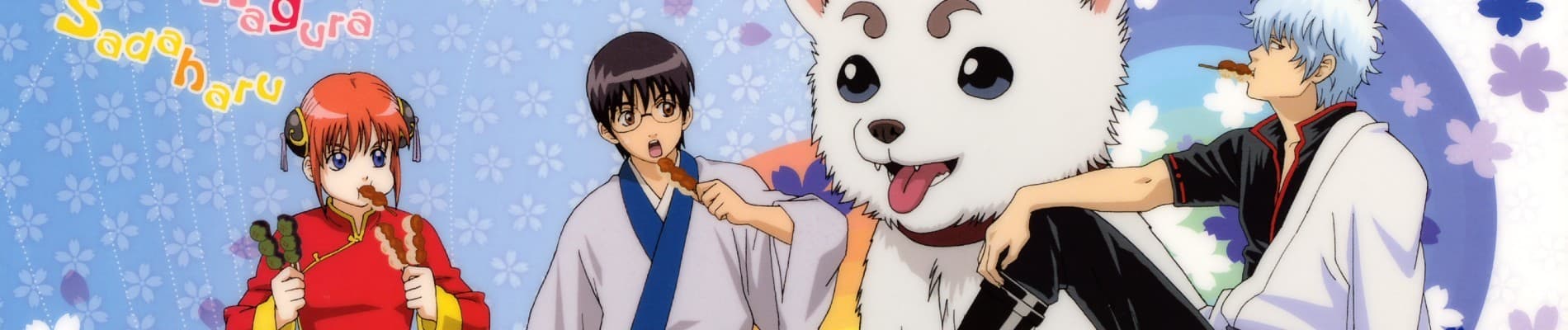
In an alternate-universe Japan, aliens known as the Amanto had invaded during the Edo period. Despite the resistance by the samurai to defend their home, the shogun surrendered and an unequal treaty was forced upon the Japanese populace, with a puppet government installed. Years later, an odd silver-haired samurai named Sakata Gintoki, runs an odd-jobs shop with his friends Shimura Shinpachi, Kagura, and the dog Sadaharu. Taking any sort of crazy jobs needed of them in order to pay their rent, they find themselves frequently, and comedically, tangled up in the goings-on with various people and things across the Kabuki district. Such people include the Shinsengumi police force, the terrorists Kotaro Katsura and Elizabeth, Shinpachi’s older sister Otae, the Gintoki-obsessed Sarutobi Ayame, and too many others to simply list here.
And boy, it is a lot! Gintama’s characters literally and metaphorically comprise all the colors of the rainbow, and each personality is as crazy and different as the next. Even as the ensemble cast gradually increases over its long run, each character feels like a worthwhile addition. The cross between Edo period Japan and science-fiction affords a great wealth of variety, as anything from robots to aliens to other samurai could get introduced seemingly out of nowhere. Each character also comes with their own set of recurring jokes, some of which last throughout the entire run, like everyone getting Katsura’s name wrong, Shinpachi’s glasses, or breaking the fourth wall by pointing out the lazy animation or the fact that a story ends early and they jump right into the next one.
The gags themselves range from lame puns to visual humor and violent bursts of physical slapstick. There’s a sea of possibilities for any avenue of humor you could think of, and each one comes across naturally. The absurd setting for the overall story creates an environment of “anything goes” as far as comedy, and the visual and audio presentation helps cement that. The animation at times can get janky and awkward-looking, or smooth if a situation appropriately calls for it, and the music and sound-mixing adopts a tone that offers that final push to make a joke land effectively. It left an eager anticipation as to what potential future gags or parodies would lie in store, as I found myself not being able to get enough of the goofiness.
No matter how large the cast gets or how zany the jokes are, it is the three primary members of Odd Jobs that best exemplify what makes the show so wonderful. Gintoki, Shinpachi, and Kagura may all work under the same company and roof, but they could hardly be called a harmonious unit. Shinpachi’s straight-man persona clashes often with Gintoki and Kagura, while Kagura’s unkempt behavior and Gintoki’s aloofness, strawberry milk addiction, and desire to read manga can easily cause friction. All character easily provides foil for the other two, making any time all three of them are on screen a delight. Even in episodes where I wasn’t laughing or I found the comedy to be completely unengaging, these three misfits were almost always enough to hold my attention, especially Kagura.
And there certainly were a few times where I did find myself tuning out. With over three-hundred sixty episodes in its entirety, Gintama naturally cannot make every outing or every joke a home run. This mostly rests on whether you find a particular episode’s central gimmick to be humorous, regardless of the other jokes that may be thrown in. That said, the show still succeeded far more often than it didn’t as far as delivering laughs. When the show ran into the problem of needing to let the manga get more material before pushing to the finale, it handled that particular season well!
Though it lives largely within the realm of comedy, Gintama is still a shonen, and as a result is packed with numerous action scenes and escalating tension. It’s true that these moments can and do exist in most of the episodes, but the series has several arcs throughout that mostly dispense with the comedy and instead play up the seriousness of a situation. These serious arcs are not an intrusion upon the show’s overarching comedy, but rather give the comedy even more meaning. As greater threats are introduced to the characters and Japan outside of situational or one-shot episode fragments, it comes not just with the desire to see the villain defeated, but also so that the characters can survive and return to the good times they had before. It is a testament to Gintama’s impressive storytelling that, although there are numerous moments that made me laugh out loud, it was the serious moments that tended to linger the longest in my memory, either through their imagery (which at times can get visceral), or because the dramatic weight of what transpired felt like moving mountains.
With any series that walks the line between comedy and drama, the inevitable question that comes up is which tone will the series be taking in the final push to the end of the run? Although Gintama resided within comedy for most of its existence, it leans all-in towards drama in its final hours. Although this can be perceived as a misunderstanding or betrayal of what the series was doing throughout its run, I see it more as being a necessary ingredient to push the series into a new level. Both in the show’s intros and through dialogue and flashback sequences, we get small glimpses into what life for Gintoki and others was like before the first episode began. Gintama may be a comedy show, but it never struck me as being about the comedy. Instead, it’s about the lives of the people in the Kabuki district, and the comedy is but one part of a greater whole. In calling attention to the past and the trials and tribulations of the here-and-now, it would have been a disservice to the character development to not explore why they’re so important. The series understands when comedy must be left at the door.
The flashbacks are not isolated from one another either, as the prologues, the Amanto invasion and subsequent events afterwards touch the lives of nearly everyone. By the time the franchise reaches its final film, all of the various pieces, motivations, and journeys have come together for a gigantic battle that was both thrilling and a surprisingly-fit conclusion to it all. The franchise ultimately left me with the feeling of wanting to see more, and more certainly being possible, but thoroughly happy with what I had seen.
________
Gintama is one of those franchises that demonstrates the sheer range and capability of anime as a medium. Filled to the brim with a colorful array of characters, comedic moments that had me frequently laughing, drama that worked surprisingly well, moments of animated brilliance, energy that never seemed to be in short supply, and constantly having me ask what could happen next, I loved the franchise’s crazy ride. It truly took the approach of throwing every idea at the wall to see if it would stick, and so many of them did. A few too many lackluster or dull episodes stop it from getting my perfect score, but if there’s one thing I’ve learned, it’s that sometimes, silver is better than gold. And yes, that is a reference.
43 out of 46 users liked this review
