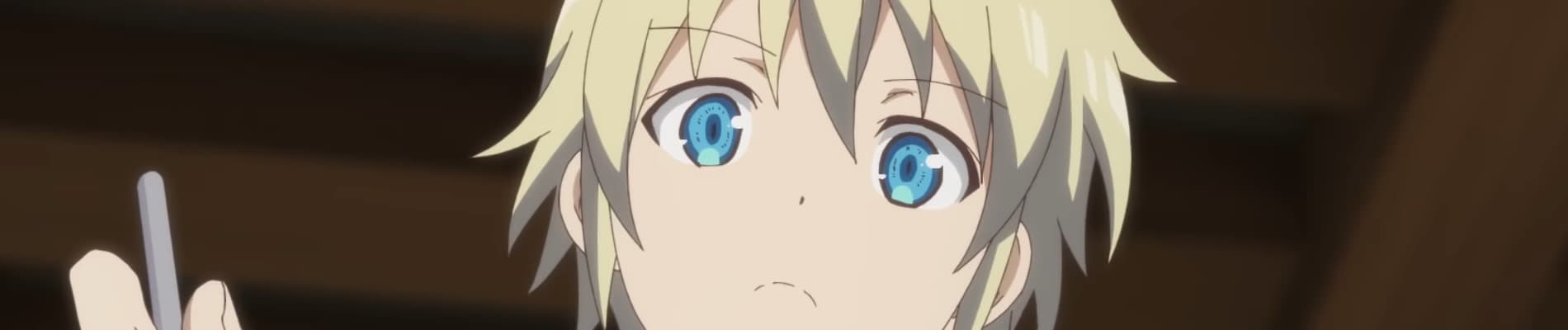
In an oversaturated market dominated by cliché trends, I appreciate that Parallel World Pharmacy at least attempted to be something different. Instead of the usual "main character gets ploughed into another world by an oncoming truck" troupe that's been used so much it's been memed to death, Farma, our main character, overworks himself trying to cure an incurable disease that led to the demise of his little sister.
Already we, as the audience, can sympathise with him. The loss of a close family member is never easy to take, especially when you were as young as Farma was when he lost his little sister. This establishes his motivations of not wanting others to go through the pain he had gone through as a young boy well. It lends him some emotional weight a lot of Isekai protagonists would do well to follow.
Upon waking up, he finds himself in another room and in another body entirely. As a doctor with high education, it feasibly doesn't take him long at all to rationalize he's been reincarnated into someone else's body, this being the original Farma who died upon being struck by lightning. Because of this, the markings the new Farma found on his arms were at first believed to be a Lichtenberg figure; a lightning scar. Even as his adorably cute attendant says otherwise. It's honestly believable that he wouldn't believe he's a god right off the bat. The first episode does an adequate job setting up the world and building suspense, getting the reincarnated Farma accustomed to the world with the plausible excuse that he's suffering from memory loss following his "fatal" brush with death. This also allows for natural exposition. As Farma learns about the world and his new family, so do we as the audience. We learn he has another little sister and how subtly that hits him as well as him being reborn into a family of noble pharmacists.
Standard stuff really. The series "The World's Finest Assassin Gets Reincarnated in Another World as an Aristocrat" has already used the concept of a character reborn into the exact profession of his previous life.
It's also here in episode 1 where we get introduced to this world's magic; aka Divine Arts. The series does a more than sufficient job portraying it as magical while keeping it simple to understand. Farma's left hand has the power of creation while his right hand possesses the power to erase, and as long as he knows the components of whatever he's making, he can more or less create anything. I do like how much of his overpowered medical prowess comes from his own knowledge he obtained through years studying through school, rather than his Divine Arts. It acts merely as a compliment to his already impressive knowledge instead of a tool or device that conveniently hands him all the answers.
He gets gifted a unique eye power he ended up dubbing "Diagnostic eye" or "Divine eye." This was also naturally revealed to the viewer.
After his first magic lesson went terribly wrong due to the reveal of his godlike power, his teacher's glasses slid off her face. Near-sighted, she struggled to see without them, so Farma suggested she uses the eye of a needle approach by covering her eyes with her open fists. As he demonstrates this, though, his world turns a dark shade of blue and part of her finger lights up as though he were performing an X-ray on her, revealing she sprained her finger. She freaks out knowing this is a trait the god of their world possessed, even more so when she sees he doesn't have a shadow.
The whole scene was brilliantly done and felt so natural. I can believe the family wouldn't want to believe their son's drastically changed following a near-death experience. They would just be relieved he's not dead. I can buy a close, but not too close attendant would immediately notice the different in their pupil right away, too, like how Eléonore noticed how wildly different the new Farma-kun was from the original. I can also suspend my disbelief that not many would notice Farma doesn't have a shadow. Really, do we ever pay close attention to people's shadows? It's such a minor detail that it's easy to forget we even have shadows.
There's plenty of suspenseful moments sprinkled throughout the series, too. They don't amount too much, admittedly, but I rather they were there than not. They made me relish and appreciate all the wholesome moments all the more. If there were nothing but sweet moments, then those very moments would gradually lose their effect. Seeing Farma overcome his father's, Bruno's, eventual intense scrutiny when he wanted to cure the queen's tuberculosis, which should've been incurable in their historical world, makes these precious moments stand out all the more.
The series was a good feel anime.
Even the tension Farma's existence brings dissipates and fuels the good vibes the series radiates.
This is best exemplified in the maid, Charlotte. An immensely precious character whose cuteness is only embellished by the superb voice acting of Hondo Kaede. Kaede's acting was fabulous, imbuing Charlotte with so much expressive cuteness. She's an absolutely superb voice-actress that I've now favourited. She earned her role as, ironically enough, "Honjou Kaede" from the anime BOFURI: I Don't Want to Get Hurt, so I'll Max Out My Defense.
Parallel World Pharmacy is just a good vibes Isekai. If you're looking for something a little more laid-back without any silly harem antics, I would recommend it. The tension can be undercut and swept away rather easily considering how powerful Farma is, and the final villain was unceremoniously defeated in the only and final episode he appeared in (seriously disappointing considering he had been foreshadowed a bit with Bruno knowing him) but it has plenty of wholesome, tender moments that I'm sure you would enjoy.
Characters - 7.5/10
World Building - 6.9/10
Animation - 9/10
Score - 6/10
Story - 7/10
Overall - 6.8/10
15.5 out of 17 users liked this review