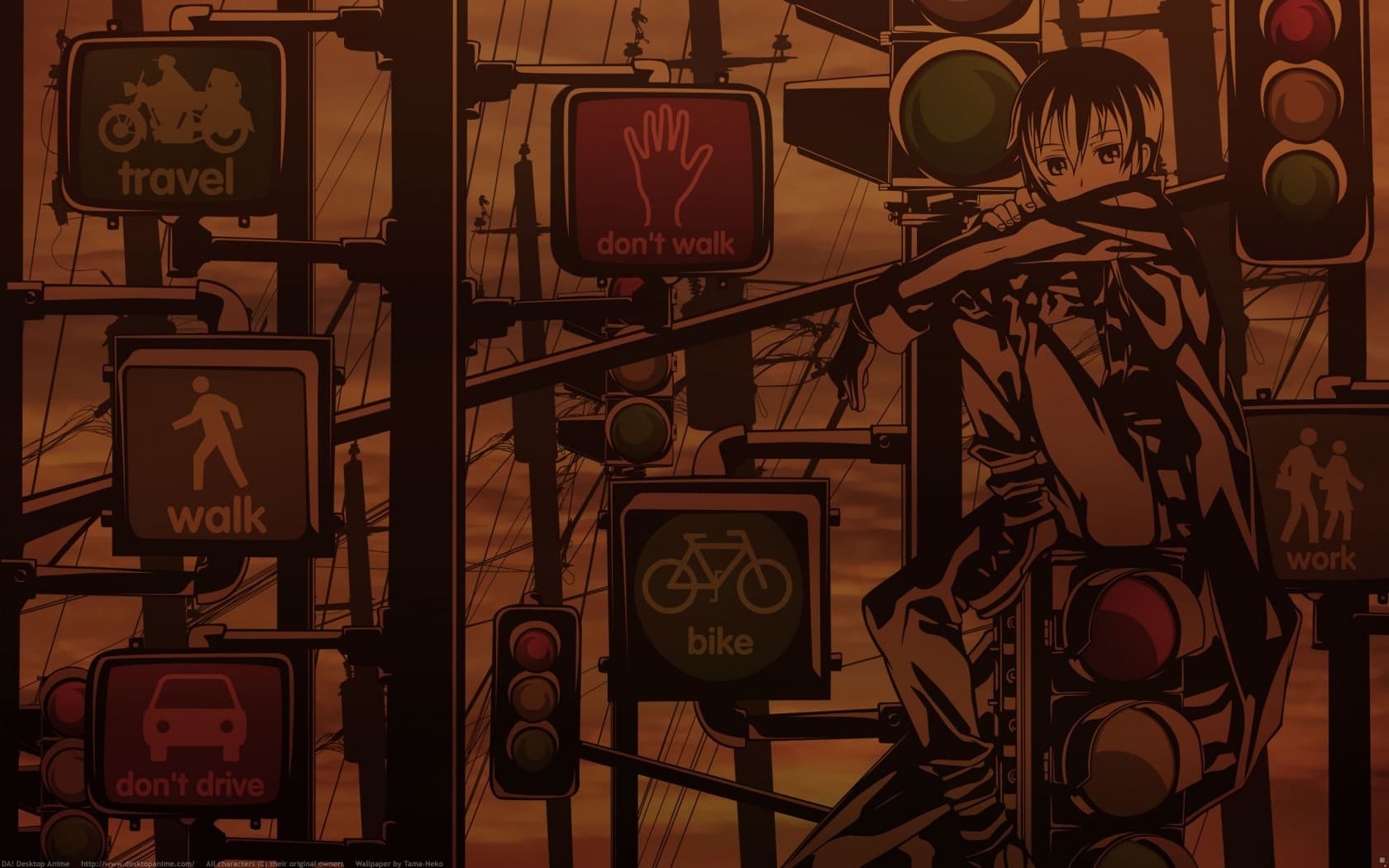
Kino's Travels: The Beautiful World is a light novel series, created by light novel writer Keiichi Sigsawa, first published in March 2000, which was adapted into two anime series, with 13 and 12 episodes respectively, plus one OVA and two movies,
It is about a restless young woman who travels the world accompanied by her means of transportation: a motorcycle called Hermes and with the ability to speak. She travels when and how she wants, but always fulfilling two very important premises: Not interfering with the peculiarities of the places she visits
Plot
Kino (who is a girl, which I hope you know by now) travels from city to city on her Hermes talking motorcycle, staying three days and two nights, getting to know the people and customs of the city, and They leave to continue their adventure.
Where is Kino headed? Nowhere in particular, she just wants to see the world. Is there a relationship between one episode and another? Very rarely. In general, each chapter presents us with a self-contained story, so the work can be considered more of a collection of independent stories. That's right, the series is episodic and does not have a very defined continuity. This is something that makes it not a series for everyone, as there are many people who do not enjoy this modality.
But for those who do, they will see a collection of very creative stories, with numerous messages capable of making us reflect for a long time. And it is that the ingenuity with which some of them were written is worthy of praise. They manage to cover a lot of interesting themes and social critiques in an easy and intelligent way, showing a creativity that I rarely saw in episodic series.
There is a strong criticism of fundamentalist religions, and how they can interpret their sacred writings in the worst possible way, which would end in a violent and bloody way. In fact, the message that what is dangerous is the interpretation given to these documents, and not the documents themselves, is something that is dealt with in more than one episode in a different way and with different approaches, equally more ingenious.
Another that I found very interesting is the idea of whether work alone is something worthwhile, even if it has no use. Does it have value for the simple fact of representing the effort of a person, and therefore deserves remuneration? I leave them for the philosophy of economic thought class. is a mature and eloquent series that features numerous dilemmas and jarring philosophies, but that's not to say there isn't some action along the way. After all, the world can be brutal at times, and it is necessary for the protagonist to know how to defend herself against it during her travels, which is why we can see moments of great tension in many episodes. Obviously, don't expect to see spectacular fights or anything like that, but the series is not just dialogues and monologues. There is much more than that.
Art and Sound
Well, let's keep in mind that it is a series that is many years old and produced by a not very prominent studio. The technical section is not entirely polished and shows a bit of age, yes. The animation (outside of the film, which was done by the Shaft studio) is rough overall. But it's not that it looks bad or anything like that, I just warn you that if you're overly critical in that aspect, it might bother you a bit. It fits perfectly with the calm rhythm that the series has, and it is also worth mentioning that it shows very the dark moments that it has thanks to the muted and tenuous colors that are used with shades of green and brown.
The music is also quite nice, being notable for being atmospheric and relaxing, and it has a memorable opening and ending, albeit quite calm.
Characters
Well, the thing about Kino is that he tends to take on the role of a completely unbiased observer, being a very stoic person and barely reacting to the injustices he comes across. However, it seems to me that this is exactly what the character is about. He is not there to issue his value judgment regarding the situations he finds himself in, but rather so that we can see the world through his eyes, to make a punctual comment in each place, but not to interfere excessively in East. As for Kino's story, it is revealed in a couple of flashbacks, which, in addition to revealing that she is a girl (I don't even bother hiding it, everyone already knows), give us a glimpse of why she thinks the way he does it, why he has that characteristic androgynous look, and they show very interesting facets of the character. The journey is undertaken with his talking motorcycle, Hermes. Why can she talk? Well, because yes, period. It's part of the magical realism that the series seems to take place in.
Kino no Tabi is a work that can boast of being extremely cunning and intriguing, but at the same time calming. A very mature and fresh work, with interesting concepts that will make you eat your mind for hours after finishing. And above all, it represents very well that feeling that, even with all our faults, human beings, our customs and our actions, are very interesting.
21 out of 21 users liked this review