Call of the Night
a review by ZNote
a review by ZNote
While we often associate the start of Gothic vampire fiction with Bram Stoker’s Dracula from 1897, it would be more accurate to say that it grew in 1872 with Irish writer Sheridan Le Fanu’s Carmilla. The novella tells of a girl named Laura and the vampire mistress she meets and later takes into her family home, named Carmilla. Laura and Carmilla’s relationship however is not predatory, but mutual as both recognize the other from their dreams and develop a friendship that carries romantic overtones. As Carmilla feasts on Laura’s blood, the obvious allusion to lesbianism cannot be ignored in-text, and one can only imagine a Victorian British reader’s view of the material. It all ties into the larger literary space that vampires and other monsters of fiction occupy in their own way.
Vampires, and the use of monsters in media in the general sense, have often served the underlying purpose of standing in for some kind of “Other.” This is, admittedly, a gross oversimplification of a complex subject, but the “Other” in this case is something or someone that exists outside the bounds of societal or cultural norms, a presence that can be portrayed as either alluring or terrifying, if not both. But within that emotional core is fascination and curiosity. Vampires specifically play into the notion of sexual or romantic behavior beyond the normal. The idea of “giving blood”—code for kissing or sex—to a foreign entity that resides in the night, rather than your familiar diurnal human neighbors, is central to vampire mythos. It is true that some vampire stories have the vampire as predator, where antagonism is more overt and an allegory might not exist at all. However, the notable vampiric fiction often has this “Othering” in place, and either celebrates it and / or condemns it. The tone of Carmilla never states the female homosexuality is wrong and leaves the matter ambiguous. To make such a case, while also making the men of the story out to be rather useless and unhelpful, is indicative of a world where the social gender / sexual norms are absent.
_________
Call of the Night, a Summer 2022 anime based on Kotoyama’s manga, takes the tenets of the vampire mythology and drops them into the modern age. The realm of classy Victorian estates is replaced with artificial lights, and tight corsets and neckerchiefs are replaced with street clothes and sneakers. Our main character, the fourteen-year-old Yamori Ko, wanders the nighttime scenery, dissatisfied with his boredom-inducing life at the present after rejecting a classmate’s love confession. It’s a tiny escape, but the first step into a larger and—more importantly—different world. It is easy to forget that, as a young teenager, the night is still largely quartered off from you without adult supervision. Sure, you can stay up late, but especially depending on where one grew up, it’s not like one can just mill about however you please, at the mercies and whims of whatever the night or its denizens have in store for you. The night in this case represents a newness, a metaphorical “awakening,” if you will.
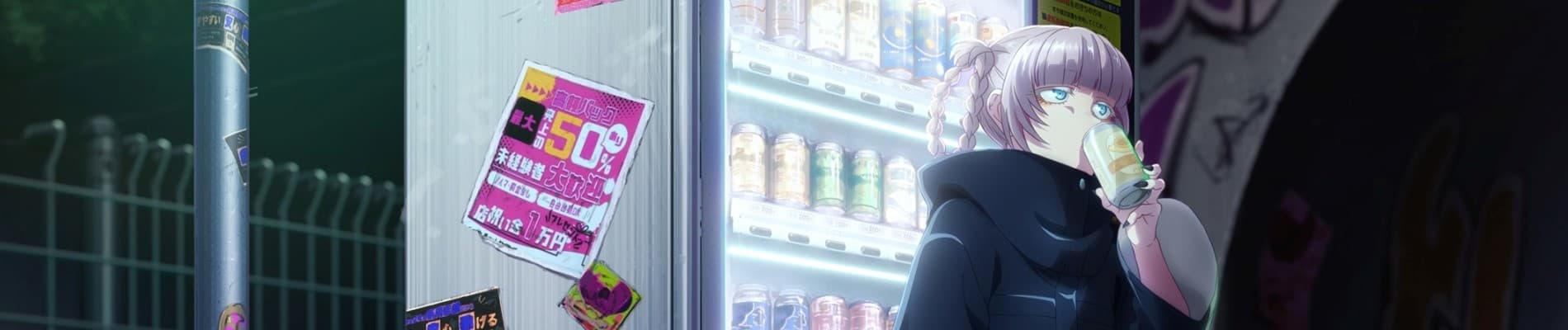
As we’re brought into Call of the Night’s odd, nighttime-blanketed world, it is vital for the aesthetic to make us feel welcome there, just like Ko. Director Itamura Tomoyuki (famous for directing many of the TV installments in the Monogatari franchise), especially in conjunction with color designer Takizawa Izumi and art director Yokomatsu Norihiko, strove to create nothing less than an almost-surreal cityscape illuminated by neon and stars. The wash of purples, blues, and the occasional whites and yellows are less focused on the idea of depicting night as it is in reality and more about the “art of the night,” or impressions of night. In creating a familiar-yet-still-fantastical visual display, it brings the dual-implication that we are leaving the world we knew behind, both in terms of how it looked and, by extension, by what was metaphorically “out there” in the world we knew.
So, it therefore comes as no surprise that in his nighttime escapade, Ko meets the alluring Nanakusa Nazuna, who likewise enjoys the freedoms that the night provides. Fraternizing with drunken strangers on a bench and teasing Ko, she invites him to her apartment. The implication played here is a comedic double play – being invited back to someone’s place afterhours implies a sexual encounter (which Ko assumes quickly and nervously), and Nazuna in true vampiric fashion sucks Ko’s blood. But as a twist, Ko is still a human, and it’s here that the gimmick is unveiled: Ko cannot become a vampire unless he falls in love with Nazuna, Ko finds the idea of turning into a vampire attractive though, and decides that he’ll fall in love with Nazuna and become like her.
Even with this little expository first episode, the narrative has already begun to show how it attempts to distinguish itself from other vampire mythologies. Some of the dialogue after the initial blood-sucking comes tinged with the kind of modern sardonicism or bluntness that tends to lend itself to Twitter thread memes (“Wouldn’t it suck if you got new family members every time you ate?”). As the “mechanics” of how vampires operate in this world are explained, we likewise learn that Nazuna, despite the stereotype of vampires creating offspring and breeding, really has no interest in doing so. If blood-sucking is her form of eating, she’s perfectly content with doing simply that.
It is for this reason why Nazuna is a peculiar presence; she herself is an “Other” within the realm of vampires, or at the very least, the vampire archetype that we have come to know and familiarize ourselves with. The vampire as a sexualized being still exists within Call of the Night through Nazuna, but is more in the sense of playful jabbing humor, nighttime residing, and visual imagery rather than its more-grotesque connotations. Nazuna herself is completely embarrassed by the idea of love, which creates a rather unusual bond between her and Ko. In what is supposed to be an emotional force that draws two people together, it acts as a repulsing element. But paradoxically, that similar repulsion is what attracts them to the other. The result is an interplay between the perverse concept of loving a vampire through the eyes of an immature human and a perverse concept of love through the eyes of an immature vampire that must rely on blood-feasting to survive and risking creating offspring.
The side effect of such a dynamic is that it does create a sense of stagnancy, of not really progressing the idea of the falling-in-love story in a tangible, meaningful way. Aside from the fact that the original manga is still running, this is, in part, because the humor style tends to lend itself better to quicker little jabs than creating larger looming scenarios. That’s not to say that it’s unfunny or that it never works, but if the jokes are intended to be one of the primary ways in which Nazuna and Ko interact, I was never able to fully bridge the gap into thinking that they’re getting closer. To put it in a way that Nazuna might find amusing, the show’s romantic humor goes for foreplay rather than copulation, constantly hinting and winking at the taboo of human-vampire relations without actually crossing the barrier. I do want to be clear – I’m not saying that these two characters need to have sex or kiss in order to keep my interest. I have no objections to the series primarily being a romantic comedy and putting off the final moment. Rather, if it wants to lean more heavily into this “Othering” of vampiric love, it has to do heavier lifting comedically than what it’s giving.
Though Call of the Night narratively establishes the end goal of Ko becoming a vampire through Nazuna sucking his blood, the series also makes it clear that the night has its fair share of oddness and quirky life. The comedy and drama tends to be at its sharpest and most-impactful when the show leaves the romantic tone behind to focus more on the night as an overarching construct, or focusing on things and other people that inhabit it. After all, nightlife is not limited to vampires, and the modern world has no shortage of silly moments for its denizens, vampiric or otherwise. As such, Ko’s connection to the daylight is not fully severed – his nighttime circle includes those that he knew at school and in the past.
This makes Ko a twilight figure who has his feet planted in both day and night, though he spends most of his time leaning towards one side more than the other. To put it another way, he stands in the “Other” space between familiar day and vampiric night, unfamiliar territory for a human. While the friends of the day may serve as one anchor for his characterization, his attention is still directed towards the night he considers so alluring. But his presence in this “Other” space causes several problems depending on who you’re talking to, and some take rather aggressive stances in just letting Ko know the dangerous game he might be playing.
And though the night can be beautiful, it is no secret that it holds many similarly-dark shadows. Nazuna is not the only vampire that roams the night and finds their way into Ko’s life. They seem to come one after another, as though in true Monogatari fashion. As the vampiric mythology begins to take shape, we see Nazuna as an “Other” not only in terms of vampires as we traditionally know them, but additionally as an “Other” within her own sphere. The overall scenario is itself so strange even in the midst of its mythology that it serves as both tension and comedy not just in terms of her embarrassment, but in how she’s treated and regarded by others. In constantly upending our expectations, the longer we stay in Call of the Night’s world, the more “Other” is able to stay in focus and continuously manifest in new ways.
_________
Call of the Night beautifully captures the mysterious ambiance of a night different from that which we understand innately, and uses its modern setting to take the “Othering” aspect of vampires and vampirism and twist it in fun ways. While the comedy may not always be the sharpest and the characterization sometimes leaves the narrative a little wanting in terms of progression, it nevertheless keeps a strange hold. Visually-impressive and full of weirdness that manages to maintain its off-beat state of being, it’s a memorable little series that playfully teases more of everything down the line.
35 out of 41 users liked this review
