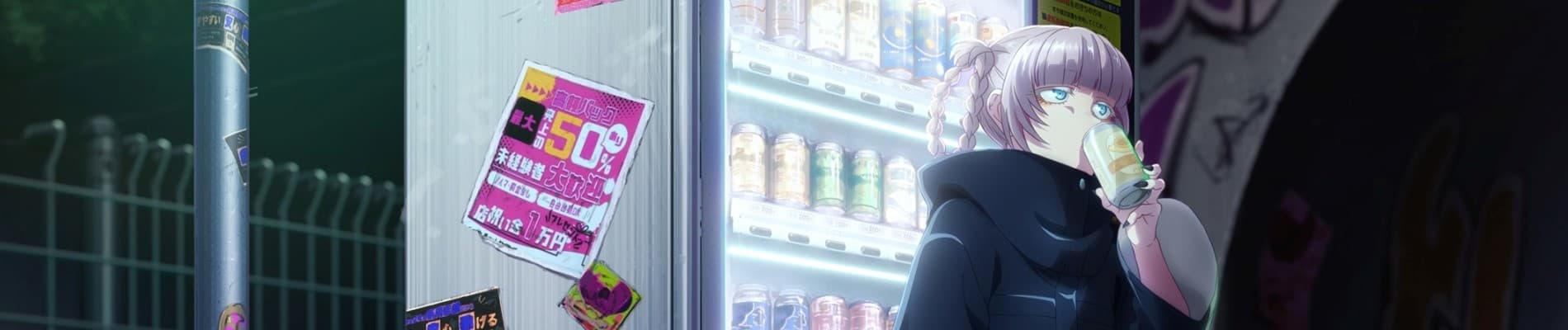
Genuine question: is the Monogatari series still relevant in today’s weebdom? I know when I started getting into anime back in 2017, it was still hot on everyone’s mind. But now that it’s finished airing, I wonder if Shaft’s decade-long arthouse supernatural romantic dramedy still holds the same pull it used to. Will weebs of today and tomorrow still hold it in high regard, or are we leaving it behind for greener pastures, preferably pastures with at least 90% less child molestation? Perhaps only time will tell. But one thing’s for sure: as long as longtime series director Tomoyuki Itamura is still putting out new work, the spirit of Monogatari will never truly die. And if you’ve been missing that magic in your life, then Call of the Night is here to fill the hole left by its absence. A vampire story set in the supernatural underbelly of ordinary society that’s sort of but not really about romance? Check. Dialogue that crackles with the snap of a writer perhaps a little too impressed with himself? Check. A trippy, gorgeous visual aesthetic that paints the normal world like you’ve never seen it before? Check. Problematic elements up the wazoo? Oh, you better believe that’s a check. Monogatari may be gone, but Call of the Night is proof that its spirit will live on for quite some time to come, for better or worse.
So, the story. Ko Yamori is an average fourteen-year-old kid, does well in school, gets along with people, perfectly normal and content. Until one day he just... isn’t. Suddenly, that normalcy he built his life around starts to feel suffocating and unbearable, the mores of normal life a prison he yearns to break out of. So, he does what any rebellious would do: he stars going out in the dead of night, wandering the empty city streets that were so full and bustling in the day. In this weird nocturnal universe, both familiar and alien, Yamori finds an escape from the pressures of society, a place where he can just exist. He also finds vampires. Or rather, he finds a vampire: the flighty, snarky Nazuna Nanakusa who eagerly pulls him deeper into the night’s siren call. She’s as much of an awkward mess as he is, albeit in different ways, but the two of them find an extremely powerful comfort in each other. And Yamori, feeling more alive at night than he ever did during the day, decides to become a vampire himself, an eternal denizen of the early AM alongside Nazuna. The catch? In order to become a vampire, Yamori has to be in love with Nazuna when she sucks his blood. And there are few things that Yamori feels less of a connection to than romance.
It’s certainly a unique take on the vampire mythos: what happens when a supernaturally beautiful undead and a confused aromantic delinquent decide to start hanging out? And while Call of the Night is certainly a horny show- if you’ve seen Monogatari, you know exactly the kind of lavishly detailed body part fanservice you’re in for- I appreciate how low-key it keeps most of its sexual elements. Sex is part of the equation, but rarely in a distracting way; the real appeal comes from the complicated emotions and relationships that grow among its cast. Nazuna and Yamori aren’t the only ones awake at night, after all, and as the show goes on, we meet a wide cast of characters with their own reasons to shrink from the light of day. Stress at work, alienation from classmates, the thrill of a new experience, wallowing in misery... the night in Call of the Night is at once a fully fleshed-out setting and the thematic crux behind its ruminations on society. Night is where people go to be free, to escape, to leave everything behind and start fresh. But it’s also where people go to sink, to succumb, to stagnate in an entirely new way. Sometimes, it’s all of those things at once. Who’s to say what drives people to leave the waking world behind?
And Call of the Night is at its best when it’s leaning into that ennui. As a grand metaphor for societal alienation, there is so much powerful and captivating about, well, the call of the night. It’s a beautiful portrayal of the myriad of reasons we seek to leave the familiar behind, and the unexpected discoveries we make when we step into the unknown, for good or ill. It’s wandering a place you’ve never been before and letting yourself just happen upon whatever comes your way. It’s discovering a new subculture and finding a community there among like-minded weirdos and outcasts. It’s the unexpected rush of danger when you realize that this new, exciting world has problems just as terrifying as the one you left behind. And it doesn’t hurt that the character banter is uniformly fantastic, the music is a lo-fi-beats-to-relax-to masterpiece, and the gorgeous color palette makes for the single most alluring nightscape I’ve ever seen. Seriously, the way Itamura brings life to the empty 2 AM streets and overexposed city lights is some absolutely mind-expanding shit. It makes me want to wander a city’s streets at night myself, experiencing the same entrancing pull as any of these wallpaper-worthy shots.
But like I said above, it wouldn’t be in the spirit of Monogatari if there wasn’t some cringe-ass problematic content amidst all this artistic genius. The most obvious issue is the giant, raging Oedipus complex this show has; it reeeeeeally likes to build sexual tension between the fourteen-year-old protagonist and the very adult vampire women in his orbit. It’s never specified exactly what age all the immortal bloodsuckers are, but they definitely all read mature in an often fetish-y way, Nazuna included. Which, you know, there’s always gonna be some unavoidable issues when you’re writing a story about a human in love with an ageless being who can live for hundreds of years, and vampire fiction isn’t exactly new to this territory. So on the one hand, I can’t really blame Call of the Night for wearing its onee-san kink so proudly on its sleeve. But by the time you reach the final arc and there’s an actual human woman putting the moves on Yamori, it starts to feel like author Kotoyama has some serious childhood issues he needs to work through.
That said, there’s another issue here that’s a lot more subtle, but also makes me a lot more uncomfortable. Let’s cut right to the chase: Call of the Night has a weird habit of bringing up something sexist and predatory that men do to women, but writing it in a scenario where it’s kind of the woman’s fault. The gyaru vampire has a stalker who literally tries to break down the door of the karaoke both she’s in, but he quickly realizes his mistake and it’s portrayed more as the gyaru’s fault for listlessly going through relationships and not giving them that much thought. There’s a subplot about someone taking sneak photos in a changing room, but it turns out it was just one of the girls taking photos of herself to try and boost her online popularity. The final arc kicks off with an attack from a savage vampire that has some very loaded imagery of him attacking and menacing Yamori’s female classmate Akira, but he’s dispatched with a peaceful goodbye and it’s implied he was led astray by a female vampire who turned him into a monster. Time and again, this show sets itself up to comment on misogynist attitudes and actions, but backs off from it and makes it all about some girl’s mistakes leading to this point. And I’m genuinely not sure if Kotoyama was doing this intentionally, didn’t realize the implications, or wanted to explore this theme but chickened out. Either way, it’s a weird noxious undercurrent that isn’t immediately obvious, but becomes impossible to ignore once you’re aware of it. I’m not asking the horny vampire show to be some grand feminist statement, but it would be nice if it didn’t feel so dumb about gender roles, especially since a big part of its finale explicitly calls attention to the limits of gender roles and the importance of moving beyond them, Kind of a mixed message, that’s all I’m saying.
But you know what? if I could stomach the worst of Monogatari’s missteps to enjoy that show on its own terms, I can stomach this. Call of the Night may have its missteps, but it’s one of the most engrossing shows I watched all season, as eclectic and singular as its older sibling before it. It’s a deliciously captivating look at what inspires people to throw off the shackles of conformity, and what new questions one finds to ponder after crossing to the other side. It’s an alluring show about the nature of allure itself, and it mesmerized me like few anime ever do. So why not answer its call yourself? You might just find something beautiful waiting beyond the boundaries of the ordinary.
32.5 out of 39 users liked this review