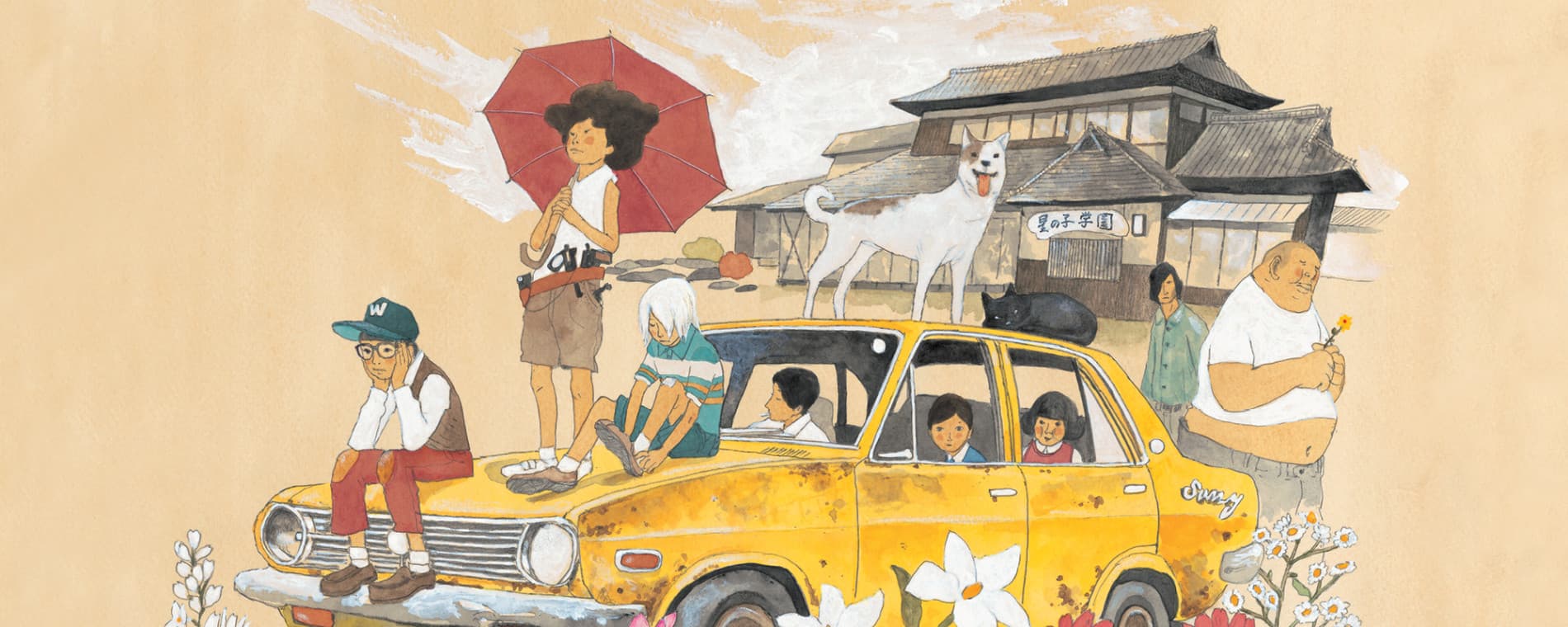
If there is anything I have noticed while reading many stories, it's that authors often struggle to really flesh out any sort of younger character. I'm sure the annoying and shallowly written kid is a familiar trope for most people, which feels strange considering we all once were children after all.
Taiyō Matsumoto's Sunny does not have this problem at all, which rather subverted my expectations as almost the entire cast of characters is children. The foster family of the Star kids is not only not frustrating, but extremely likable and often very emotionally relatable. There are a few reasons why this works so well. A big one is that Matsumoto is extremely skilled at representing emotions in a realistic way, especially for children. He does a great job by leaving a lot unstated and instead using many different ways of showing facial expressions, sometimes having pure and palpable silence between characters, and showing them doing things with their hands like playing with toys or writing. Haruo is a great example of this usually. We see him try to be cool and tough like his favorite manga characters and professional wrestlers around the other kids, tilting his head back and always wearing sunglasses. Then there is an intentional shift when he is around his mom, with his sunglasses being off and him constantly being engaged and actively looking up. He smiles while playing with his action figures, and when alone in the Sunny he goes from having impenetrable thoughts to imagining a whimsical fantasy world around him. It's these subtle ways of telling us about the characters where Matsumoto really allows us to get a sense of how their personalities are.
Of course, establishing these characters has an important purpose for showing the situations each one of them is in. Matsumoto uniquely only uses the perspective of children to frame different backgrounds, issues, and experiences. Every character expresses their feelings in the way a child realistically would and it leads to them being surprisingly complex. Going back to Haruo, we are shown the impact of not having his mom in his life by the way he acts around others. He often gets in trouble, and acts out for attention while struggling to show gratitude out of what seems to be both fear of letting go of his mother and trying to not show weakness to others. He often is smelling a can of Nivea to remind himself of her, expressing his feelings of missing her in a very simple but effective and realistic way. This connects to how we often associate memories or people to smells, particularly as children incapable of expressing complex emotions. Megumu and Kiko show the value of befriending people despite them not always being in the same socioeconomic group as you through simple school interactions, along with showing the struggles of being different than one's classmates. Similarly, we see how Junsuke and Shosuke handle having a parent that is very ill, dealing with a pain that is difficult for them to comprehend by convincing themsleves that the magical powers of clovers can heal their mother. Junsuke in particular has a lot of great imaginative moments shown. One highlight is when he is sick, showing the familiar combination of childlike creativity and a fever-addled brain:
 Now would be a good time to mention the art. The characters that Matsumoto draws are probably a bit weird to look for first time viewers of his style, but they quickly prove to be very good at showing distinct faces and emotions with their simplicity while also making every character look very unique and memorable. This is contrasted well with the detailed but clean art elsewhere and he knows how to raise and lower the scaling of the world depending on the character's perspective.
Impressive as it is, Matsumoto writing these characters well does not come as too much of a surpise. He has said in interviews surrounding the manga that he himself spent time at a similar group home as a child and it gave him inspiration for the series and a factual basis for many of the events. It's easy to see the passion he had for this as well as the insight he had into writing these vignettes. Unfortunately, the structure of these vignettes would be the first complaint for me. It feels very choppy most of the time, even by slice of life standards. It can be difficult to feel a consistent flow with the characters when the perspective is shifting around a lot and every other character that isn't being followed at that time is suddenly thrown into the background. It's not horrible but I think it definitely harmed the story sometimes. Kenji, being an older POV character, has more complex emotions than the rest but they start to fly all over the place with the constant cuts to where it felt strangely hard to follow what his personality was like.
Ultimately though, the biggest disappointment was the ending for me. There just feels like a real rush to wrap it up, like at least a few chapters between the last and second-to-last were left out. Sei is a blank slate character for most of the story who starts to get some plot development and we are seeing the culmination of Haruo's arc at the end but both of them are left out to dry and are resolved in between chapters. In general while we see some character's conclusions it really sucks that we didn't get to see what the emotional process to get there was. The ending is probably meant to be more punchy than it actually ends up being but there just needed to be some more development here to really elevate it to a story instead of just an experience.
While I would be lying to say I was full of satisfaction after finishing, Sunny still left me feeling pretty content. Even if it's just an experience, it was still an enjoyable one that really served as a testament to the author's personal experiences and ability to write characters that are compelling and likable in a unique, subtle way.
7 out of 8 users liked this review
