####This review contains spoilers.
Have you ever swam at night? Weightlessly floating on your back, looking up into the sky. It seems to stretch on forever. In that moment there is nothing between you and the stars. And so they begin to pull on you.
On the water, you sway. Up and down with the tide. No sound save the lapping of the waves, which, in turn, fade from your mind. The little points in the sky become overwhelming. A confrontation with nothingness and everything. The tiny specks of light, so much bigger than we can even comprehend. And there’s more of them than we could possibly count. An engulfing vista. And so we ask the questions that have been asked many times before us. Why are we here? And why here? Why can I float on the ocean? Why do I have to swim back to shore and continue with my life?
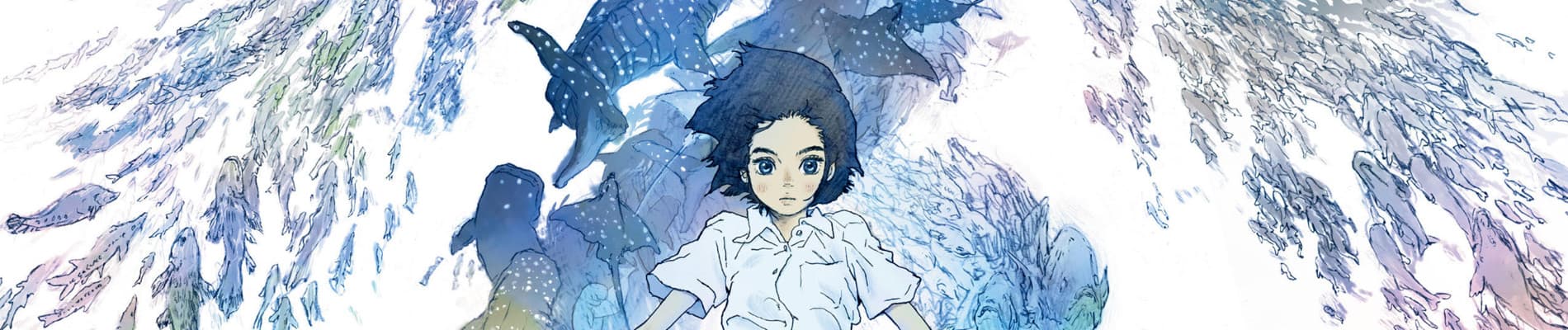
There is no one nor true answer for these questions. But Children of the Sea proposes its own: we are but eyes to see the universe, connected to its memory as observers. Although we may try, our words have limits. But our vision can be limitless.
The life on this planet is connect by a thread of evolution. Follow the line and we are led back to the ocean. There is now life below the sea and above it. We are divided by the limits of our physique. Symbolic, however, of the fragility of this divide is the whale. A body like our own, yet also like the fish below the water. Can we too exist along this divide? Can we adapt to go where we can’t, to see what we couldn’t.
Children of the Sea wants us to. It wants us to see the beauty of the world, to connect with others not through words but through the shared experience. And Children of the Sea does not believe in a shared human experience, but a universal experience. From mother to daughter, ad infinitum, a connection that traces back to the crucible of life. That is our shared experience. We all live on this planet. We all live in this universe.
With this in mind Children of the Sea wants you to consider your place as a human within this universal experience. Why do you look at the world? Why, when you see its beauty and fragility, do you act like you know best? It does not suggest that curiosity is our failing. No, it is our hubris, that we think that we’ve seen enough to act when really we should be looking.
With childlike innocence, Ruka learns this lesson before she makes mankind’s mistakes. She asks, at the end of the film, “why me?” And when she asks, we know the answer. The old lady responds, “have some faith in Umi and Sora, and yourself.” Children of the Sea believes it can be and should be anyone. Anyone that is willing to watch and not act. Anyone that knows how little they know. When floating on the sea we can become its children. Born to feel, to smell, to see.
In that weightless moment, starring up into the black sea of stars above and drifting atop the one below, we form a primal connection with our world. So find the time to float and watch.
55.5 out of 56 users liked this review