Angel's Egg
a review by Illuya
a review by Illuya
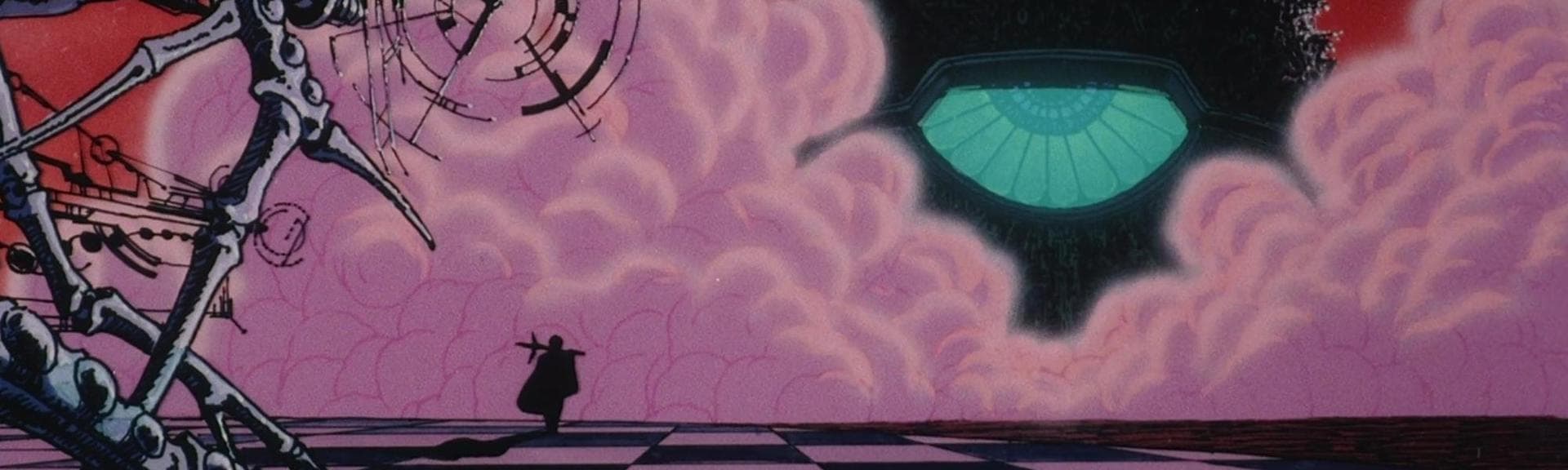
A bell rings out across the nocturnal city. On darkened streets of brick buildings and cobblestone pavement walks a lone girl, egg concealed in her shirt, trying to navigate its labyrinthian structure. Her striped, pink sweater and dark red coat stand out in the bleak alleyways, while her droopy countenance bears a hint of dejection and dismay. And yet, she pushes on. What could she be searching for? And why is the city so quiet?
There’s something special about Angel’s Egg. Across its 90-minute runtime, dialogue is sparse and characters few: things happen seemingly without cause, and we are transported from landscape to landscape as if viewing the journey through a hazy window, able to make out only an adumbration. Discarding conventional rules of storytelling, director Mamoru Oshii doubles down on the unity of sound and visuals. Here, there is no true meaning, no correct interpretation. The movie is whatever you make of it.
This makes Angel’s Egg tough to review. How do you evaluate that which doesn’t have a clear purpose? I thought long and hard about this, and eventually, I decided to focus on my personal interpretation—what the movie means to me. Of course, I could play it safe and describe only what is certain, but that wouldn’t yield much, so I’m willing to make a gamble. I have no doubt that some will read this review and think, “he got it all wrong, he missed the point!”, and that’s alright. No two people will come out of Angel’s Egg the same, and if anything, a disagreement like that would only speak volumes about the strength of the movie, its ability to proliferate within its viewers in so many ways, to be approached from so many angles and still enjoyed regardless of the one you take.
The director himself has recognized this. "When it comes down to it, I think the director doesn’t know everything about the movie. Everyone always thinks if you want to know something, talk to the director. I don’t think that’s true. I think the answer lies inside every single viewer.” A story doesn’t belong only to its creator: it belongs to everyone who consumes and shares it. Oshii is bold enough to conceal his intentions and instead ask, “what do you think this means?” That, to me, is the beauty of art, that a single story can reveal new aspects in each member of its audience. Art is about the creator’s intention, yes, but it’s also about interpretation.
By now, my newfound passion for Angel’s Egg should be clear. I watched it only a month ago at the time of writing, yet it has already placed itself among my favorite pieces of media. In this review, I’ll delve into why it’s so special to me, and I hope you’ll join me along the way. Without further ado, let’s begin!

In 1843, Danish philosopher Søren Kierkegaard published his philosophical essay Fear and Trembling. Written under a pseudonym, the essay attempts to understand Abraham’s faith while also giving birth to a religious, existentialist philosophy.
Kierkegaard argues that, in remaining faithful to God, the individual can draw strength and face any number of challenges. On the matter of Abraham’s determination, he states the following: “Abraham believed, and therefore he was young; for he who always hopes for the best becomes old, deceived by life, and he who is always prepared for the worst becomes old prematurely; but he who has faith, retains eternal youth.”
To Kierkegaard, faith in God represents an acceptance of all fortune and misfortune as belonging to the will of a higher being. Whether Abraham’s actions, his conviction to kill Isaac, were ethically wrong doesn’t matter; it was the will of God, and God transcends universal morality. However, he also believes in the free will of the individual, the power to act as you please. Everyone is of the same value, except the one who loves God; they are greater than all. While those who concern themselves only with the secular are constricted by the sands of time, the faithful can transcend the boundaries of their mortal coils and exist, too, in the eternal. As such, their meaning transcends humanity. You could rob them of their loved ones, burn down their home, break their limbs one by one; they are, through their faith in God and salvation, protected from earthly pain.
But not everyone is Abraham. It takes immense willpower to resign oneself to the absurdity of a higher power—what Kierkegaard calls a leap of faith—and in this world, there are few whose faith outrivals their earthly desires. Throughout the book, he expresses his utmost adoration for Abraham, but he cannot, no matter how hard he tries, replicate his faith. He knows what to do, he tries his hardest to perform the leap, but he always comes up short, he is always dragged down by human emotions…

In Angel’s Egg, the girl represents faith. She carries the egg and trots from place to place believing it to contain something important, but she doesn’t know its contents. And yet, she’s sure it most contain something. She hopes. Similarly, the religious individual cannot definitively prove the existence of a god, yet they are convinced there must be one, that somewhere out there, a higher being resides. This is the essence of faith: as stated in Fear and Trembling, it “begins precisely where thinking leaves off.”
But what would happen if this hope turned out to be futile?
As a character, he serves to confront the girl’s beliefs along the way, but also to provide her company. His motives are beside the point. They’re the only two characters, which also limits the amount of dialogue. Because of this, every line feels meaningful: as I watching, I would frequently pause to scribble down sentences that resonated with me in my notes, and even now, I have these stored in a document, like my own little stash of meaning.
Together, they traverse a bleak world. Outside the city we see only dust and ruin: grass fields coated blue by the moonlight, punctuated only by a few standing stones, trees whose tangled branches look like fingers of the dead, and gigantic bones of long-dead creatures. In this landscape the girl emits an aura of light, while the boy blends right in.
This setting, combined with the haunting, sometimes choral soundtrack, creates a haunting atmosphere. Often, the only sound we’ll hear is that of the wind as it slides across the landscapes, making the occasional shriek all the more frightening and off-putting. The world of Angel’s Egg is scary not because we know what happened, but because we don’t. It’s a mystery.

"The gods had condemned Sisyphus to ceaselessly rolling a rock to the top of a mountain, whence the stone would fall back of its own weight. They had thought with some reason that there is no more dreadful punishment than futile and hopeless labor. (…) At the very end of his long effort measured by skyless space and time without depth, the purpose is achieved. Then Sisyphus watches the stone rush down in a few moments towards that lower world whence he will have to push it up again towards the summit. He goes back down to the plain.”
This is a quote from Albert Camus’ philosophical essay The Myth of Sisyphus. Published in 1942, the book sought not only to elucidate the reason as to why people commit suicide, but also to explore in depth Camus’ philosophy of revolt—the one he dubbed absurdism. In many ways, it can be seen as a response to the religious existentialists like Kierkegaard who, having arrived at the absurd, nevertheless fell back on their god and continued to hope. Kierkegaard tells us to throw ourselves into the absurd, Camus wants us to rebel against it: if we are conscious of the futility of our efforts yet continue them without yielding, we can push against our own fate. To put it in layman’s terms: by declaring life meaningless and at the same time continuing to take pleasure in the things around us, we defy the lack of meaning.
To many, Sisyphus’ fate seems tragic and bleak. But that doesn’t stop him. In remaining conscious in every step of the misfortune that awaits him—the boulder rolling back down the mountain—he finds his meaning. It would’ve been meaningless for him to hope that one day, the boulder would remain at the top and his duty end, because he knows there is no such salvation. So on he pushes, up and down the mountain, although not to subject himself to the punishment of the gods, but rather to riot against it. As Camus puts it, “the lucidity that was to constitute his torture at the same time crowns his victory. There is no fate that cannot be surmounted by scorn.”
Sisyphus’ predicament is not so different from ordinary life. We wake up in the morning, go to work from 9 to 5, go home again; and the next day, the work has returned and the cycle repeats anew. At some point, we start questioning why we’re doing this. What’s keeping us going? This is what Camus regards as consciousness, and from consciousness follows either a return to the cycle or the awakening. The awakening is the important part. This is where the individual can choose between surrendering to a higher purpose, to hope, or revolting against the absurd. And to Camus, revolt is the better option: he believes that, through hope, the individual deceives oneself, lives in ignorance, whereas recognizing the absurd allows one to live fully. Rather than preparing for and expecting an afterlife, the absurd individual can put all their focus on the current one.
This, ultimately, is the point. Many shudder when hearing the phrase “life is meaningless,” but it doesn’t have to be a negative declaration. If life is meaningless, that merely allows us to choose our own meaning as opposed to a predefined one; and what about that could possibly be terrifying?
Let’s return to Sisyphus. Whenever he reaches the top and sees the boulder roll down again, he doesn’t let it get the better of him. Rather, he takes pride in the struggle, carves out his own meaning—as should we. The task that was once cruel and bleak now takes on a new meaning, one decided on by himself. As Camus concludes, “one must imagine Sisyphus happy.”

Towards the end of Angel’s Egg, the boy opts to destroy the egg in secret. When the girl discovers this, she is first furious—and then, she despairs. Not because the egg has been destroyed, but because, in the end, it contained nothing. All along, her hope had been empty, a futile search for meaning, a leap of faith that led to a fall.
This plot point could be interpreted in multiple ways. The most obvious would be that religion is ignorance, but I think that’s too cynical a view and not Oshii’s aim. The way I see it, the girl losing her hope is meant not as a message about religion as a whole, but rather as an examination of the individual. As Kierkegaard discussed, faith is something that needs to be maintained. It’s delicate and could easily break.
The same can be said for the absurdist. Although we can easily write on paper that life itself is meaningless and purpose is something we need to find ourselves, sticking to this can be as hard as it is for the religious to retain hope. When life comes at us with all it’s got, throwing our minds into turmoil, the idea of a higher purpose can be comforting. It can help us pick ourselves up. To resist that pull, the inclination to hope, is easier said than done.
If it sounds like I’m assuming two conflicting stances, that’s because I am. Even if I prefer one over the other, I can’t tell you which is correct. Both Kierkegaard and Camus encountered the absurd, but their interpretations of it were wildly different, and these are only two of many philosophers. Humankind has been debating the meaning of life since the dawn of existence, and even now, we are not one step closer to an answer. In this sense, the narrative of Angel’s Egg—the desperate search for meaning, however fleeting—represents one of the largest human dilemmas: do we hope or not?

In Angel’s Egg, the girl comes up with her explanation for the egg’s origin. Long ago, Noah stood on the ark and sent out a dove to search for land. The bird did not return. Although the pessimist would argue the bird drowned somewhere in the sea, she believes it must’ve found land eventually, landed there, and planted the egg. Inside the egg, she reasons, must be a new bird capable of saving humanity from the bleak world. This is her hope: salvation.
Whether she receives that salvation is left ambiguous. After the boy destroys her egg and it’s revealed to contain nothing, she drowns herself in a river and is then reincarnated as a statue on a floating ship. As it takes flight, the boy stands lonely on the shore, wind blowing through his ashen hair, a look of sorrow, or perhaps doubtfulness, on his face. The camera pans out. Slowly, his figure grows smaller, until we can make out only a silhouette. The camera continues. Now, the rocks which stood tall upon the beach are but dark dots on the sand. And finally, even the island is obscured as the screen goes black, the choir fades out… and the credits roll.

Sources
Søren Kierkegaard: Fear and Trembling. Translated by Alastair Hannay. Quotations from pages 18, 14, 61.
Albert Camus: The Myth of Sisyphus. Translated by Justin O’Brien. Quotations from pages 115, 117, 119.
92.5 out of 97 users liked this review
