In addition, this review was written in a style and a voice which I wouldn't use in my current-day writing. If you're curious to read—what I consider to be, at least—my more thoughtfully and precisely articulated work, please check out some of my newer reviews or my list notes.
I'm leaving this review itself untouched, though–both for posterity's sake as well as a reflection of the fact that the writing you see below is what readers like yourself had judged its merit on over the years.
"Where am I? I'm falling from the sky. Strange. Why am I not afraid?"
━━━
The opening scene of Haibane Renmei sets the tone for the entire show — its mystery and symbolism immediately jump out at you, and throughout the remaining thirteen episodes, they never let go. Rather, they give way to something far simpler yet meaningful, a product and a message that is larger than its presentation.
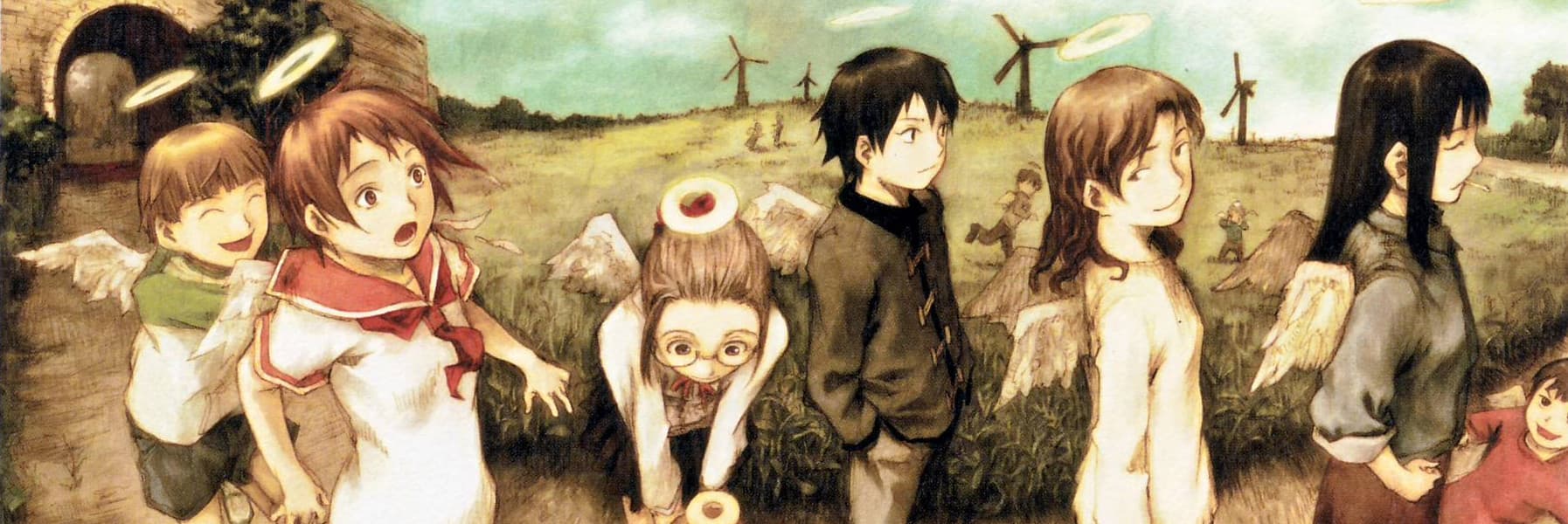
Welcome to Old Home, a settlement in the outskirts of the town of Glie. Our protagonist, Rakka, finds herself in a place that couldn't be more unfamiliar, without any of her memories, and with no knowledge of the people and the society surrounding her. Slowly but surely, she comes to familiarize herself with her new environment. Rakka has been reborn as a Haibane, with no memories of her previous life, and a vague, incomplete idea of the dream that she had before she awoke; a dream that all Haibane had before coming into this world.
Haibane are loosely named after their respective dreams, which are the sole precursor to their life before waking up in Old Home. These dreams are the first brushstroke on the blank canvas of the Haibane; another way to frame it is that that they are the lingering remnants of a Haibane's life prior to their rebirth. The only semblance of a past that they can call their own.
Haibane are also required to work in order to fully integrate themselves in Glie's society, a society that also houses humans in the city centre in addition to Haibane on the outskirts. Thankfully, Haibane have the luxury of selecting whichever job appeals most to them. Quite quickly, the narrative makes evident the importance of the self in this story, no matter how insignificant this sense of self may be. A dream that defines you. A job that you choose.
And in finding their place in this world, both Rakka and the rest of the Haibane pursue something far more existential and abstract than employment or remembering their memories. Themes of identity, of belonging. Of purpose.
Again, the first half of this show focuses on a more carefree, exploratory sense of worldbuilding, continuing to acquaint themselves with Glie as a whole. Yet, there remains a subtle and ever-so-mysterious aura which underscores Rakka's early days as a Haibane. This is a product of the masterful balance of information that this show crafts, where you're given just enough to answer the most immediate and simple questions. However, a lot of the more big-picture conventions and mechanisms of the society as a whole remain unexplained, and it is up to Rakka to seek out the answers to these questions herself.
It is soon revealed that the Haibane are not allowed to leave Glie. In fact, no one can, save for a select group of people as well as the crows. Which seems strange, the framework and outlook in regards to personal autonomy within Glie betrays any semblance of confinement. The Haibane are generally happy, they're able to work jobs that they enjoy, they're respected and almost revered by their fellow human inhabitants, they have their basic humanity and rights guaranteed. There seems to be almost no reason why any of the inhabitants of Glie should be banned from leaving, nor does there seem to be any reason why they would want to in the first place.
Yet, the fact remains — the Haibane are locked in. Rakka is locked in. I think we can all relate to the basic idea that freedom is desirable. No matter how utopian life inside of Glie may seem, it is only natural that one would want to leave it. Maybe not now, or this week, or even this year. But someday, for sure.
Confinement is a curse, and in her search to break free, Rakka begins a journey of personal discovery, one where her purpose cannot be essentialized to her job at hand, or any other aspect of life within Glie. It's much larger than that; Rakka begins to look for her place as a Haibane, as a living being, irrespective of any connotations or ideas of attaching belonging to anything else. It's about self-affirmation, acceptance, and forgiveness.
This part of the review is kept even more vague than the previous bits, as a lot of the more central plot points and revelations happen in this point in the story. However, one of the key concepts of Haibane Renmei's premise now becomes incredibly relevant in its second half — the idea of being reborn. It can seem quite contradictory to combine ideas of rebirth with introspective, almost incompatible themes of self-discovery. After all, you're living a new life, right?
This is where the beauty of Haibane Renmei truly lies. In a way, Rakka and the Haibane are unable to fully escape their previous lives, while they can't recall any of their memories or the people they were in their previous lives, they remain shackled regardless, by virtue of their names.
Their dreams (which, as aforementioned, are where their names are derived from), turn out to be the only remnants of their previous lives in any form. It's this ingenious link between the past life and the current life that contextualizes most of the narrative elements. The Haibane aren't reborn in the sense of working towards a new brand new life. They're trying to move on.
And while one of the strengths of the show is that it remains extremely open ended and interpretable for the viewer to take home whatever they want to from its melancholic presentation, there is clear purpose to what it wants to earnestly tell its audience.
Haibane Renmei is Rakka's story, but only in the sense that our journey starts and follows along with Rakka. While she is quite clearly one of the main characters, this show's cast functions closely to an ensemble at the same time. And for good reason.
As we experience the world of Glie and how the Haibane are situated in this seemingly utopian world, Rakka can't escape the feeling of guilt, of incompleteness and struggles. But so are the rest of the Haibane. Remember? They all have their own separate dreams that link them to their previous lives. They're all on their own personal journeys, much like Rakka is.
Through Haibane Renmei's seemingly multilayered and complex themes of soul-searching and forgiveness in its second half, one message stands tall above all else — it's okay to not be okay.
A journey of self-actualization and atoning for previous mistakes or misgivings has to be started and completed by yourself, but it doesn't have to be ventured alone. The Haibane are able to find comfort in each other, knowing that lost souls are capable of eventually finding their way home, of accepting their past and leaving room only for the future that's yet to come.
Haibane Renmei sees rebirth not as a second life, but a second opportunity; one that can manifest in any manner, but also one that has to start with coming to terms with how you've gotten there. I've done my best to not explain what certain aspects of its world strictly mean, and focused mostly on how their presence sets the tonal stage for our characters and ourselves as viewers to navigate.
Because once you're finished the last scene and watched the ED for the last time, that really is the biggest strength of this show. Its overarching themes and central message couldn't be more clear. Rather, it's how we choose to interpret, internalize, and carry its ideas with us that are most valuable. Laying the foundation and asking us to be its architects, Haibane Renmei constructs a powerful journey that, above all else, asks us to see the value in moving on and accepting ourselves, reaching out to others if we need it, but forever emphasizing the value of taking that meaningful first step towards self-discovery.