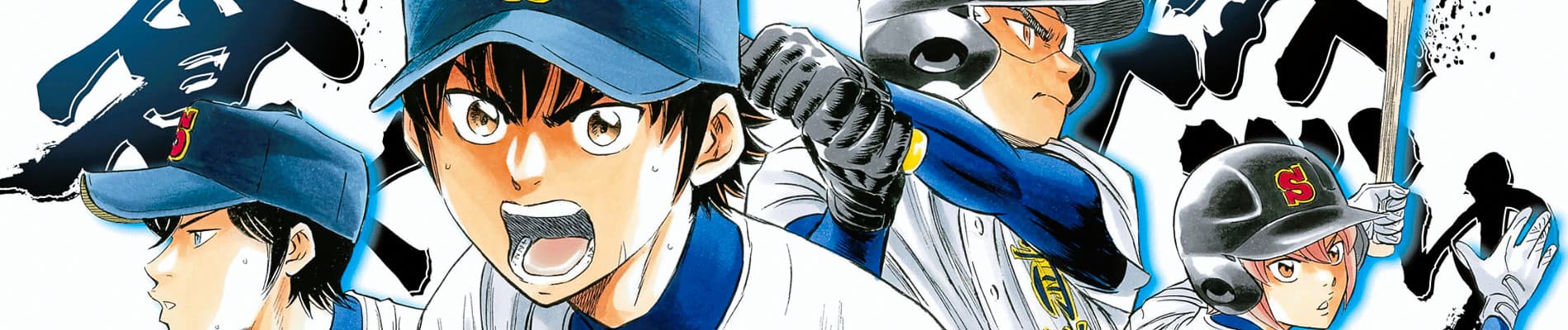

Daiya no Ace Act II is a direct sequel to the original Daiya no Ace manga, and as my analysis of it will be a continuation from the one I recently wrote about Act I, I will skip my usual "Before the Introduction" segment for anyone familiar with my review structure.
In Act II we get all the great qualities and characteristics that made Daiya no Ace an amazingly memorable and highly entertaining experience, not only continuing those in a linear way that has the reader satisfied with more of the familiar, effective formula, but building upon them, evolving the story and characters, elevating the entirety of this body of work into a masterful piece of fiction that few could hope to compare in terms of consistency and development, much less find faults with.

At the start of the manga we find Seidou at the National High School Invitational Tournament, Spring Koushien, the right to participate in which was won during Act I's grand final game that resulted in the team's victory at the Fall Tournament. The team is in good shape, winning its first couple of rounds, which goes double for Furuya. The stoic Ace lives up to his role throwing immensely powerful pitches impressing audiences across the nation and gaining the attention of interviewers, reporters and rival teams. On the other hand, our protagonist does not fare so well, hardly ever getting any chances to prove his worth during the Invitational. Yet his drive and passion are not diminished in the slightest, and even when his team loses at the quarter-finals against the eventual champions from Hokkaido, Komadai Fujimaki, he keeps his eyes firmly upon his goal.

Straight out of the gates, there is a distinct difference in pacing and storytelling compared to Act I. The games take considerably shorter page space and the mangaka adopts a heavier narrative style to present their progress and results, instead of what we are familiar with. The reason for that is clear. He does not want to give excessive time at the Spring Koushien, as he only wishes to use it as a base, in order to set major adversaries across the nation, and, of course, Seidou's own situation, standing, level, and changes to their status quo since we last saw them.

The Seidou baseball team returns to its home field having experienced the national level only a selected few can hope to gain a perspective on. Aware of their shortcomings, now knowledgeable about the things they lack, everyone feels more determined than ever to rebuild and pursue the dream once more. With no time to lose, they immediately take part in the Spring Tournament, the top two teams of which advance to the Kanto Tournament and with a larger number of them getting a seeded status for the one in summer.
Following Koushien, Furuya who has grasped something even above his well received performance there, in an effort to become an unbeatable pitcher and offer his team flawless victory, sees his game become unstable and uncontrollable, resulting in misplays and creating visible weaknesses for his opponents to exploit.

At the same time, Sawamura is seen working diligently in his training, steadily improving, as well as polishing his new weapon, namely the Numbers. At the final stretch of the original Act I manga, Sawamura had completed his basic skillset, now able to accurately control pitches from the inside high corner to the outside low of the strike zone, and his fastball had also become stronger during the entire process. And then, thanks to coach Ochiai's teachings, he had a glimpse of genius regarding different grips that result in various breaking balls, the perfect element to bring versatility to his playstyle. The Numbers are the sum of the breaking balls he is able to pitch, a fitting evolution to his natural moving balls, but are highly volatile in usability on a daily basis. Thus, his training, largely relies on perfecting his control over his fastball which has become his most powerful weapon, and then adding extra layers of depth to his pitching by stabilizing his breaking balls and making them usable in real matches.

Act II is basically the part of the story when Sawamura has become a second year in high school. This means that there is a fresh bunch of first years joining the team, and because of last year's accomplishments, many promising talents are seen joining, many of which were hinted back during the Fall Tournament.
Sawamura's streak of starting relationships with the team's catchers on the wrong foot is bound to continue this year as well. His aloof nature and misplaced willingness to put his nose where it does not belong, despite his good intentions, will incite a reaction from the prideful Okumura Koushuu, and the atmosphere between the two will become awkward for a while. Okumura is a personal highlight of this part of the manga, not only because of his core and the strength of character he has as a person, even if he is still partly immature, or maybe because of it, but mostly due to the exceptional chemistry and process of understanding he goes through together with our protagonist. The mutual respect they end up cultivating feels well earned, and his participation and assistance in the future development of the Numbers, immediately renders him as one of the most important and interesting characters in the entire manga.

We can locate the major turning point for the series, and I mean it as a whole, at the Spring Tournament's semi-finals, the game against Ichidaisan High. Ichidaisan, led by the genius pitcher Amahisa Kousei, has risen back to power after their series of losses against Yakushi that they suffered last year, scoring a clear victory against the team, and gunning straight for the nationals. Seidou plays a demanding game against them, and despite the score not reaching a point where it is irreversible, Furuya's self-destructing pitching while in the process figuring out what he wishes to achieve, will bring the team that believes in him to carry him to a major predicament. At the worst possible timing and with all odds against him Sawamura takes over the mound and displays perfect relief pitching, not giving room to breathe to the Ichidaisan batting line up, even if Seidou could not turn the game around ultimately.

Thus begins one of the longest training arcs in manga. The goal is nationals and everything we saw back at the timeframe between the Summer and the Fall Tournaments now feels like a game played on easy mode. The jersey numbers are revoked, the position of every player on the main team's roster as a regular means nothing, and everyone that can produce results has an equal chance at being chosen. Terajima sensei makes a bold choice, choosing to work on a huge number of characters, giving them clear stats from every practice game they participate in, and having the readers evaluate their performance themselves and wish everyone could take part in the games to come. But the number of players can only be twenty and the Ace may only be one.
Part of the process of the practice matches are familiar recurring events in Seidou's calendar, for example the match between the first years that have just entered the team against second and third years not part of the first string. We may have already experienced those in Act I, but it is an interesting touch to have them shown from the perspective of the second years now that Sawamura has become one himself, having the same plot development now generating completely different feelings.

Adding to the above, is the fact that the period being detailed is full of slice of life moments and endless tiring training, but the context is not one as passionate and even desperate as our characters felt during Act I when it comes to skill acquisition. The players now have a strong basis of practical experience and achievements under their belts, and we see them move on to detailed theoretical and technical analysis when it comes to opponents, things to improve during training, or even gamecalling options and ways of thinking in order to deepen their understanding and develop a self reliant thinking process for themselves.
During the practice matches there is an additional element that impressed me, and it would come from coach Kataoka's side. First seen in a somewhat similar form by Sakurazawa High School, an opponent of Inajitsu during Act I, coach Kataoka has each and every player of Seidou's baseball club keep a notebook through which he communicates with, raising questions for the players to think through and properly answer, that he in turn reads regularly and takes into consideration for the team's and every individual's growth.

After his performance against Ichidaisan, the rest of the Seidou team starts acknowledging the level of baseball Sawamura has reached, as well as his contribution to his team. More than anyone, coach Kataoka decides to leave all their important practice games against the nation's powerhouses to him, and in this way the manga begins constantly accelerating and providing a triumphant experience.
Hakuryuu is a team distinct for boasting high mobility with one of the most celebrated high school players nationally. In the game covered by reporters, Sawamura pitched for all nine innings and allowed only a single run, showing that he can hold his own through his ability, tenacity, and without yielding to pressure, and was even featured in an article garnering attention and fame. This practice match is one of my favorites in the entirety of Daiya no Ace and one of the most defining for our protagonist and his rise to glory.

In the series of dozens of games that Seidou played before it was time for the Summer Tournament to begin, the most crucial time for the team was when Miyuki was called to take part in an experimental representative Tokyo team against one from the United States. During that time, Seidou hosted a doubleheader against Yamamori High School and Seihou High School. With their captain and main catcher absent, it was a period of time when the rest of Seidou's members were tested, something that goes twice for our pitchers aiming for the Ace spot.
Sawamura, being entrusted with the Seihou game, displayed yet again his bottomless mental fortitude, his newfound understanding of baseball that went beyond his natural gifts, and his ability to lead his team, all the while trusting his teammates be it Okumura's mitt or the third years fielding behind him, who were not part of the main team during the previous team compositions.

The new Ace is crowned. And he is the one who led the team, inspired it, never losing sight of his dream, nor ever stopping appealing for it. The Summer Tournament is about to start and Sawamura Eijun is the one to wear the jersey number one. He might not have reached the full technical package required for the coaches to consider him an undisputed Ace, but even in the process of shuffling up their numbers to inspire growth to both Sawamura and Furuya, Seidou's southpaw has now achieved the goal he set his eyes on, when he first joined the baseball kingdom and powerhouse that has become his school.

At this point, I would like to note that ever since the Ichidaisan game during the Spring Tournament, the manga has shedded the different writting style it had previously adopted, and by now it has returned to the previous immersive formula it had for its games during Act I, only with a more detailed and high level presentation of baseball itself. It is not only the games that have become more elaborate, executed by more skilled players and via plays that have been polished time and time again through practice. The art itself has become much more intelligent and expressive, beautifully presenting the various plays with key imagery and with only the necessary moments that visually describe entire sequences, having no amount of excessive information or text overexplaining things. The use of detailed background art is also heavier, replacing the often found panels that were filled with power lines or special effects, a welcome change that adds to the experience.

Of course, it would not be a Summer Tournament without the Seidou curse kicking in and certain injuries, accidents or mishappenings taking place. Thankfully, they all add to dramatic effects for promised victories and new chances for the people injured or underperforming during certain matches to prove their worth anew.
Sawamura himself during his first game bearing the title he longed for since the very beginning, tries to overperform, unable to relax, providing a lackluster performance and being drawn off the mound. Understanding the burden he witnessed his rival Furuya carry brilliantly only to later crumble under its weight, he turns his performance on that day into a valuable experience and recalls his calling as a pitcher and as an Ace.


Meanwhile, Furuya himself is seen recovering, returning to basics, and stabilizing his performance, thus connecting the game at which he was the starting pitcher to the next one. Seidou's powerful pitching relay is in full effect and rotating their talented players, gives them room for rest and planning against every type of opponent.
As the tournament progresses and the effects of the rigorous training are made obvious by the achievements of our batting lineup and their amount of runs scored, the semi-finals are before us with two matches separating Seidou from the ticket to the national stage. On their path stand two of the most amazing pitchers of Tokyo and their respective teams and fellow powerhouses, genius Amahisa Kousei with the revived Ichidaisan, and king Narumiya Mei with the consecutive winners of West Tokyo, Inajitsu.

The semi-final against Ichidaisan is probably my favorite game in Daiya no Ace. Ichidaisan during Act II were an absolute blast to read. Highly entertaining, extremely dangerous, passionate, earnest, loveable, a team that lost its share of spotlight during Act I in spite of being the powerhouse that it is, they are now back stronger than ever and won my impressions, and then some.
In preparation against the genius and his evolved weapon, Sawamura's development caught me totally off guard. Discussing with Miyuki and Okumura, and working on his breaking balls, he applies intelligent reasoning and an analytical explanation of the state his Numbers are at, wishing to stabilize his repertoire and make his plays more consistent. He then goes to actually prove how to make things work through a process he arrived at on his own and by his own thinking and training, in a moment that had me celebrating to the maximum.

As for the game itself, Sawamura handled all of it, proving his Ace qualities and the effectiveness of his newfound weapon in an impressive pitching duel with Amahisa with constant back and forths, impeccable pitching from both sides, striking out highly capable batters, getting out of dangerous predicaments, and relying on the infield. Sawamura's entire carrying through the game had me taking pride in how far he had come as a pitcher and as a person, and Amahisa's charismatic persona proved an alluring rival.

Right when I thought Sawamura had peaked momentarily, Terajima sensei decides to follow with a somewhat unexpected development to prove me wrong and excite me even further. While preparing for the finals and the revenge match against Inajitsu, Sawamura accidentally overhears a discussion between Miyuki and Furuya in which the former declares his intention to continue as a professional baseball player, and asks the latter whether he has ever considered the same. Sawamura takes his time to think, ponders the world beyond high school baseball, and understands the endless nature of the pursuit of an activity to excellence. A fantastic and powerful moment that highlights his loss of naivete, cultivated maturity, and understanding of the overall baseball stage and what it means to walk the path of constant improvement.

The final match, holds tremendous importance for Seidou, serving as a rematch from last year's finals, when they failed to overcome the wall the princely pitcher of the capital had placed before them. With the retired third years in the stands, the players that have expended their all training for this game proceed to challenge the unparalleled southpaw and his carefully selected team. The game had many great moments as players of their caliber could only produce, it was another match where the pitchers' qualities decided the game, and while Narumiya's performance could not be bested from a single Seidou pitcher, the team managed to protect its lead and reach the national stage as a whole, seeing their efforts bear fruits.

Nothing ever is.
However, I fail to recall many manga that manage to reach the size of Daiya no Ace, not only never dropping the ball at a certain point of their run, but being a constant source of energy through their entirety, always evolving into something more interesting and entertaining, adding layers and depth to the world and characters, retaining an intense focus on the sport itself and always being educational about it.

Sawamura is amongst the best protagonists that have ever been created. His first character arc was a particularly common one, in which a mostly clueless yet talented person starts acquiring knowledge and skills in order to be able to stand in an equal footing with his opposition. Act II is the stage that has him stand true to his basic core, while paving the ground for him to start developing into his own person, and as a trustworthy, undisputed force to be reckoned with. All of the above executed flawlessly.
The rest of the cast is comprised of a magnitude of loveable characters seldom found in other works, that have been given caring attention which is obvious to the reader. A huge number of memorable teams all with their distinct and quirky traits, making picking a side to root for a tricky dilemma. The most important factor that contributes to the above is that the manga never shies away from taking its time to present the daily life and struggles of the characters we follow, instead of constantly relying on an endless stream of matches and action, thus giving a fresh approach to the sport player's reality.

As a sports manga it passes the test with flying colors, since it always keeps baseball at the forefront, be it the demanding tournaments, the arduous training, or the more serene character moments. The depiction of baseball is always educational, immersive, inspiring, and motivational.
On the art department Act II trimmed down the excessive roughness of its predecessor and was polished into the true diamond that this manga is. A multitude of characters, drawn in a somewhat cartoonishly distinct style when it comes to their features, detailed backgrounds, kinetic action, panelling that is easy on the eyes, and clean lines create a visual treat of a manga.

Terajima sensei has created a piece of work that is as compact, consistent, immersive, expansive, analytical, engaging, educational, passionate, layered and ingenius as no other. Daiya no Ace truly stands as one of the finest examples of what a sports manga, a shounen manga, or a piece of fiction in general has to offer, an unparalleled experience you will never find yourself getting tired of or wishing to take a break from.

Act II has ended because of the mangaka's fatigue caused from a lengthy weekly serialization, as is often the case in the manga industry. Firstly, I would love for him to recover and regain his drive and fire in his heart. The story of Daiya no Ace is far from over and there are many things I would love to see, such as the many opponents on the national level that have been teased or set up, mainly the unparalleled Emperor, Hongou Masamune, and Komadai Fujimaki, how far the team led by Miyuki can go, Sawamura standing as a person on his own without being reliant on Miyuki's game-calling, his development as a battery with Okumura, how Furuya will be handled in parallel to Sawamura's growth, and whether we will get a glimpse at elements of the professional baseball life after high school is over. Contrary to other works in the genre, in which open endings accompanied by the life lessons and character studies they promote, work just perfectly, I believe that is simply not the case with Daiya no Ace. Terajima sensei writes in such a detailed manner and takes the time to set up so many characters, events and interactions, that the reader is always waiting for their delivery.

In any case, so far we have a partly complete experience that has scored a homerun, and then some. I deeply respect everything the mangaka tries to do with this piece of work and consider its execution exemplary, and believe that Daiya no Ace is a manga for everybody to find enjoyment in and anticipate the developments of the ever expanding journey of Sawamura, Seidou, and their road to glory.
I extend my evergrowing gratitude to everyone taking their time and reading through my reviews. If you liked this one you might want to have a glance at my profile to better understand my approach to anime and manga, and maybe even check the other analyses I have written. Until next time.