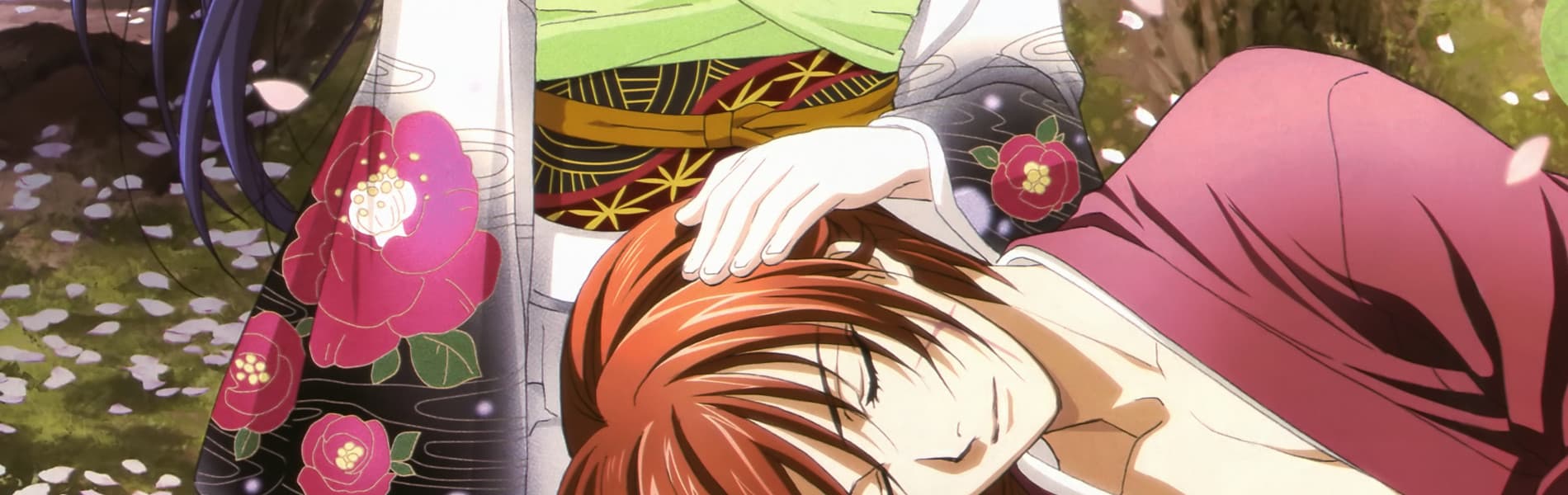

This is the typical case of a change in audience leading to a sudden and tremendous improvement in the storytelling. Rurouni Kenshin - Tsuioku-hen is a prequel to the original series Rurouni Kenshin, going in more detail over the past of Kenshin during the Meiji Revolution and what made him give up on his life as a killer.
To make a very relevant comparison, Tsuioku-hen is to Rurouni Kenshin what the Patlabor movies (and more accurately, the second movie) were to the original series and OVA: the story told through episodic content with various degrees of humor poured in gives way to a continuous and darker story where humor is utterly nonexistent. The production values, originally stretched over a large amount of episodes, are now focused on a shorter production to offer consistent and beautiful animation and more realistic character designs, going as far as making characters hard to recognize for some. And the directing takes on a whole new level, offering a cinematic experience enhanced by the soundtrack.
Beyond the disclaimer as soon as you start episode 1, the opening scene itself makes very clear whom it is meant for, and this goes beyond the opener: very slow pacing, many graphic depictions of characters slaughtering one another, slight nudity and some hinting at sexual relationship are the highlights that make Tsuioku-hen a work for mature audiences who aren't scared of seeing blood run red in the streets of Japan.
The action scenes are quite numerous and they definitely show how beautifully ruthless and cruel swordfights happen: breaking away from any concept of "ultimate sword technique" or powerlevel that weighed the original series down, Tsuioku-hen gets inspiration from jidaigeki movies for the treatment of the choreographies, and you can be sure that when blades are drawn, the stone pavement will be tainted red after a few moments, displaying a stark level of cruelty very much suited to samurai stories.
▶ VideoThis OVA is definitely beautiful. Beyond any questionable technique used in the making (I have identified some use of 90s CGI for water, one brief IRL footage for a bonfire, and some backgrounds passed through a weird computer filter), it's almost fully animated and it is one of those rare "show, don't tell" type of works where what is shown on-screen tells a more important story than what the characters says, thanks to a particular care put in the character animation. You can read dozens of things on Tomoe's face and her silence is basically a confession of those feelings she harbors.
A lot of backgrounds are also very beautiful and I'm sure you will pause at times to admire like I did.
The musical aspect is also a point where the OVA decides to make things different compared to the series by removing any electric guitar and choosing a fully cinematic, orchestral soundtrack for pure emphasis on the elements on-screen, leading to one of the most poetically beautiful endings to a Japanese work I have seen to date.

Tsuioku-hen is of course not without its flaws. Without counting the few... "interesting" animation techniques I have spoken about above, episode 1 and 2 show awkwardness in how some scenes are cut, as if they were meant to go on for longer originally but some choices had to be made to fit within the allotted timeframe of the OVA. Also, I cannot deny it can be a bit too slow in some later parts that drag on for longer than they should. The studio probably didn't manage to reach a balance when it come to those things.
Overall, Tsuioku-hen plays it with its cards on the table and gives it to us raw. It's a powerful depiction of the brutality of samurai stories played with a very strong tragic side that doesn't even hide itself. Its sincerity, its brute force and its genuineness makes it much more emotional and powerful than the original series ever was, and it's thanks to these that it's nowadays still one of the best Japanese OVAs to date.