“I’d like more of the world go back to being wild.” - Hayao Miyazaki
Hayao Miyazaki has always been an easily identifiable storyteller. Obviously, in a visual sense — there’s no animator like him when it comes to constructing a world and its inhabitants — but also thematically. It’s sometimes easy to forget how not-so-subtle his works are; whether it be his harmonious depictions of nature, his anti-war sentiments, or his strong-willed heroines, there’s a wide variety of topics that he’s tackled in his nearly six decade long career, but there’s one work of his that’s been left out of the bigger discussion. Before Miyazaki co-founded Studio Ghibli with Isao Takahata and became widely considered one of the most influential figures in animation history, he made his directorial debut at Nippon Animation with Mirai Shōnen Konan or Future Boy Conan.
Now, when I say that Conan has been left out, what I really mean is that it’s been left out in North America. Conan is (technically) an adaptation of The Incredible Tide, a novel by Alexander Key, who was so furious with Miyazaki’s changes to his story that his estate vowed to never let it come to the U.S., and he meant it. When Streamline Pictures tried to distribute two compilation films of the series, the estate issued a cease and desist letter and threatened a lawsuit. It wasn’t until GKIDS released the series on Blu-ray with a new 4K restoration and English dub in 2020 — over forty years after the series first premiered in Japan — that this landmark series would come to America.
The changes that Miyazaki made to the story that prompted such a reaction from Key will probably not surprise anyone familiar with his work. Miyazaki accepted the position of director on Conan under the condition that he could get rid of the novel’s pessimistic tone, saying that “[e]ven if someone’s lost all hope for the future, I think it is incredibly stupid to go around stressing this to children. Emphasize it to adults if you have to, but there’s no need to do so to children. It would be better to simply not say anything at all.” This quote is the best summary of the show you can get, but, like everything from Hayao Miyazaki, there’s still so much going on in the 26 episodes of Future Boy Conan that’s worth mentioning.
It’s July of 2008. Half of the world's population has been wiped out instantaneously by supermagnetic weapons, and the earth’s axis shifted as a result. The continents were fragmented and sank, killing almost everyone else and leaving the survivors of the event scattered among the remaining pieces of land. Flash forward twenty years, where 11-year-old Conan lives on Remnant Island with his grandfather. All is good for the seemingly superhuman boy until one day a girl — something he has never seen before — washes up on the shore of his home. Her name is Lana, and she also has an inexplicable supernatural ability in that she can telepathically communicate with birds and some people. However, her presence on the island ends up disrupting Conan’s solitary life when soldiers from Industria appear to kidnap Lana and end up wounding his grandfather. After revealing to him how they ended up on the island, he leaves Conan with one final message — “Go and search for a new world.” — before dying. Conan leaves his island and sets out on a voyage to save Lana, and in the process discovers a world full of new technology, friends, and foes.
It’s easy to see how Key’s original story delved into defeatism — that it takes place in a post-apocalyptic world serves for some immutably dark moments — but, as we’ve now come to expect from the legend, the youthful lens that Miyazaki views the story through shows this world not so much as a wasteland as it is a playground for our protagonist. Most of what happens around and sometimes to Conan is borderline morbid on paper, but the relentless optimism and confidence he carries throughout every episode of the show paint each encounter as something new to discover. If you want an example, look no further than the opening that plays at the beginning of all of the episodes: after an expository set-up that shows the cataclysmic event and all of the lives lost to the massive explosions, it cuts to Ima Chikyuu ga Mezameru, the breezy opening featuring Conan and Lana sailing on the ocean and running through nature. You could say that these near whiplash-inducing tonal shifts are there because it’s a children’s show, to which you’d be partially correct, but it’s also a very clear example of how, from the very beginning, Miyazaki always finds the best in the worlds he creates.
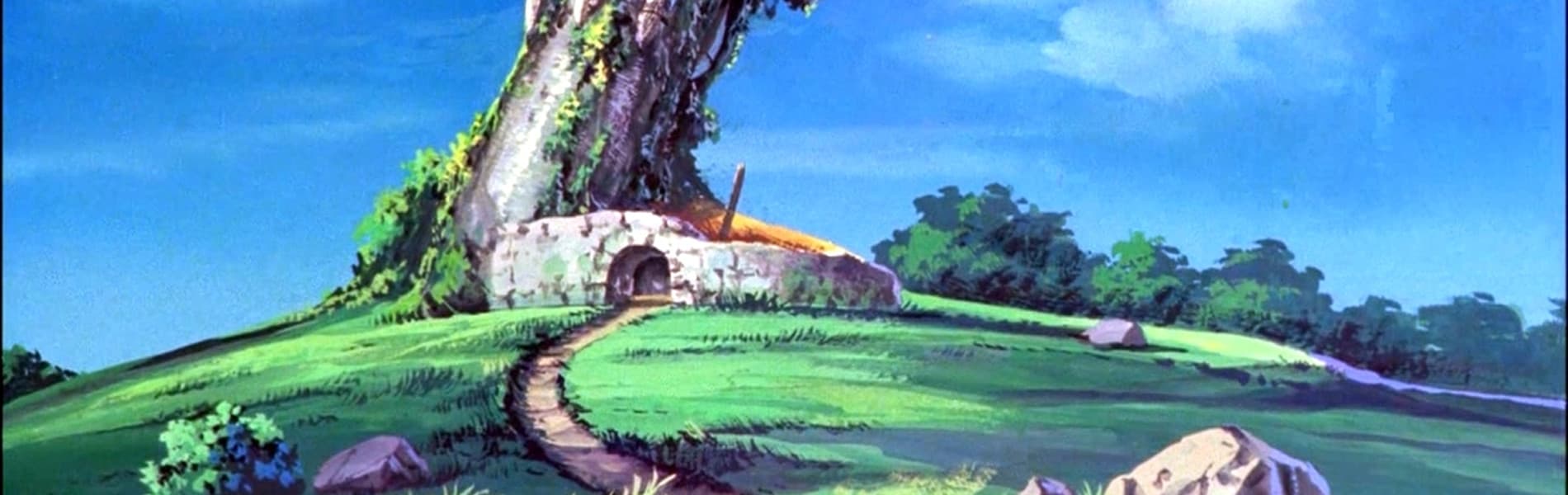
It’s in this that Future Boy Conan thrives. There are some moments too dark for the show to balance out with humor or slapstick, and it’s here that another Miyazaki hallmark comes into play: nature, and in the specific case of Conan, nature both in contrast and in unity with how humanity moves forward after the world resets. Two of the main locations of the story — aside from the ocean that takes up most of the earth’s surface and the various ships that sail on it, if those count — are Lana’s home, High Harbor, and Industria. Miyazaki didn’t want the dynamic between the two powers to be viewed as an allegory for North America and the Soviet Union, and while you could probably find those themes in Conan if you looked hard enough, his environmentalism is what shines through. In nearly every scene that takes place in High Harbor, Miyazaki always makes sure to include and enunciate the natural landscapes, like the canyon where Conan’s best friend Jimsy has a scuffle with a boar or the bougainvillea covering the side of an old building. Industria, however, is defined by its cold, man-made structures, like a cell block made entirely out of dark stone and metal or the endless, identical hallways looping through the massive Triangle Tower.
Of course, these themes aren’t the main focus of Conan, and Miyazaki knows this. Like most pieces of entertainment geared towards a young audience, there’s always a sense of adventure coursing through the show’s veins, and it gets away with such a boyish tone because of its gorgeously animated dystopian setting — aided by GKIDS’ revelatory 4K restoration — and how consistently paced its romp through it is. Each episode brings continuous amounts of thrilling twists, action, and cliffhangers, but it always bows to the beauty of the natural world and its endless waters and landscapes. Part of what makes this show click with me so hard, though, is undoubtedly the retrofurist aesthetic prevalent in all of its dazzling designs, and there isn’t much else to say about that; I’m just a massive sucker for all forms of artwork that fall under that umbrella.
It feels criminal to just now be discovering such a monumental piece of animation, especially one that has visibly influenced so many beloved anime, but above all of the nostalgic vibes and sensational world-building, Future Boy Conan is just a damn fun show. It’s a Hayao Miyazaki work in the greatest way imaginable, and I can’t wait to dive back into it again and again.
9 out of 9 users liked this review