In addition, this review was written in a style and a voice which I wouldn't use in my current-day writing. If you're curious to read—what I consider to be, at least—my more thoughtfully and precisely articulated work, please check out some of my newer reviews or my list notes.
I'm leaving this review itself untouched, though–both for posterity's sake as well as a reflection of the fact that the writing you see below is what readers like yourself had judged its merit on over the years.
"I hate myself. I can't be in love with someone who says they love something I hate, right?"
━━━
Bloom Into You posits messages and asks viewers questions that seem simple, and can be answered simply, but the depth of such concepts goes far deeper than what initially meets the eye. It explores romance through an approach of the human condition and what it truly means to both love as well as be loved, through an incredibly introspective and vulnerable depiction of its two mains, Yuu and Touko. This anime breaks down love in all the forms it can take, and how it can manifest itself in entirely unique ways which are dependent on every individual and their sociocultural and familial context.
The primary and most obvious way that this anime "subverts" traditional expectations of love is that it's a yuri - romantic love between women. I'm hesitant to use the word "subvert" here, as the contemporary Western social context no longer glorifies heteronormativity to the point where homosexuality is entirely considered morally deviant. Nevertheless, stereotypes and lived injustices for same-sex relationships remain embedded in the social consciousness even today.
Building on this, Bloom Into You uses the concept of yuri romance as subversion in a narratively and thematically significant manner, as a "blanket" that is generally representative of the more philosophical and more introspective aspects of love that are analyzed later in the story.
The story positions yuri relationships as out of the ordinary through subtle microaggressions, such as Yuu's family sarcastically remarking that their daughter has brought home a "girlfriend," or that Saeki's (a side character) sexual orientation and preference was "just a phase." It's these microaggressions that set up the narrative context which frames heteronormative connotations of love and romantic relationships as normal - boy meets girl, one asks the other out, they start dating, maybe they break up, or maybe they get married.
What's most important and what this anime's premise wishes to remind the audience of is that society's perceptions of "proper" love is heterosexual, with linearly defined steps, emotions, and processes. Using this premise, Bloom Into You then dives deeper into this "linear definition" of love primarily through the yuri aspect of the anime, but then progresses to the point where Yuu and Touko's sexual orientations are no longer significant to the overall narrative.
Yuu is romantically and sexually confused. In her own (paraphrased) words, she's never felt a love that made her heart flutter, she's never had a crush on a boy, yet she yearns for the love that is depicted in the fictional works she's consumed such as anime and manga. That last point especially circles back to the aforementioned societal depictions of love that frames the world of Bloom Into You - not necessarily the heterosexual aspect, but the "linear" aspect especially. She longs for a love that grips her heart and sweeps her off her feet at first sight; one that lives up to her perception of love as co-constructed by the wider social and societal context.
But because she's never felt any of these romanticized or glorified connotations of love towards any boys, she thinks that her sexual preference is for women. So imagine her surprise when her first romantically intimate encounter with a girl (Touko) that by all means is "perfect" in any way, she feels nothing. Well, maybe not nothing, but the point is that - all of these preconceived notions of love? Where your heart erupts out of your chest and you're head over heels for that special someone? Yuu feels none of this towards Touko.
She doesn't know how to feel; she just knows that once again, she has to continue searching for a love that lives up to everything she made it out to be.
But where this anime really shines is how Touko continues to advance the narrative and thematic context through her own self-discovery, which at the same time, advances Yuu's own self-discovery and helps her break down the pillars of love that she considers as essential and central to an acceptable and worthy romantic relationship. Much unlike Yuu, Touko absolutely is in love, knows what she wants, and isn't afraid to communicate and step out of her comfort zone to achieve it. She is the antithesis of nearly everything Yuu believes about love.
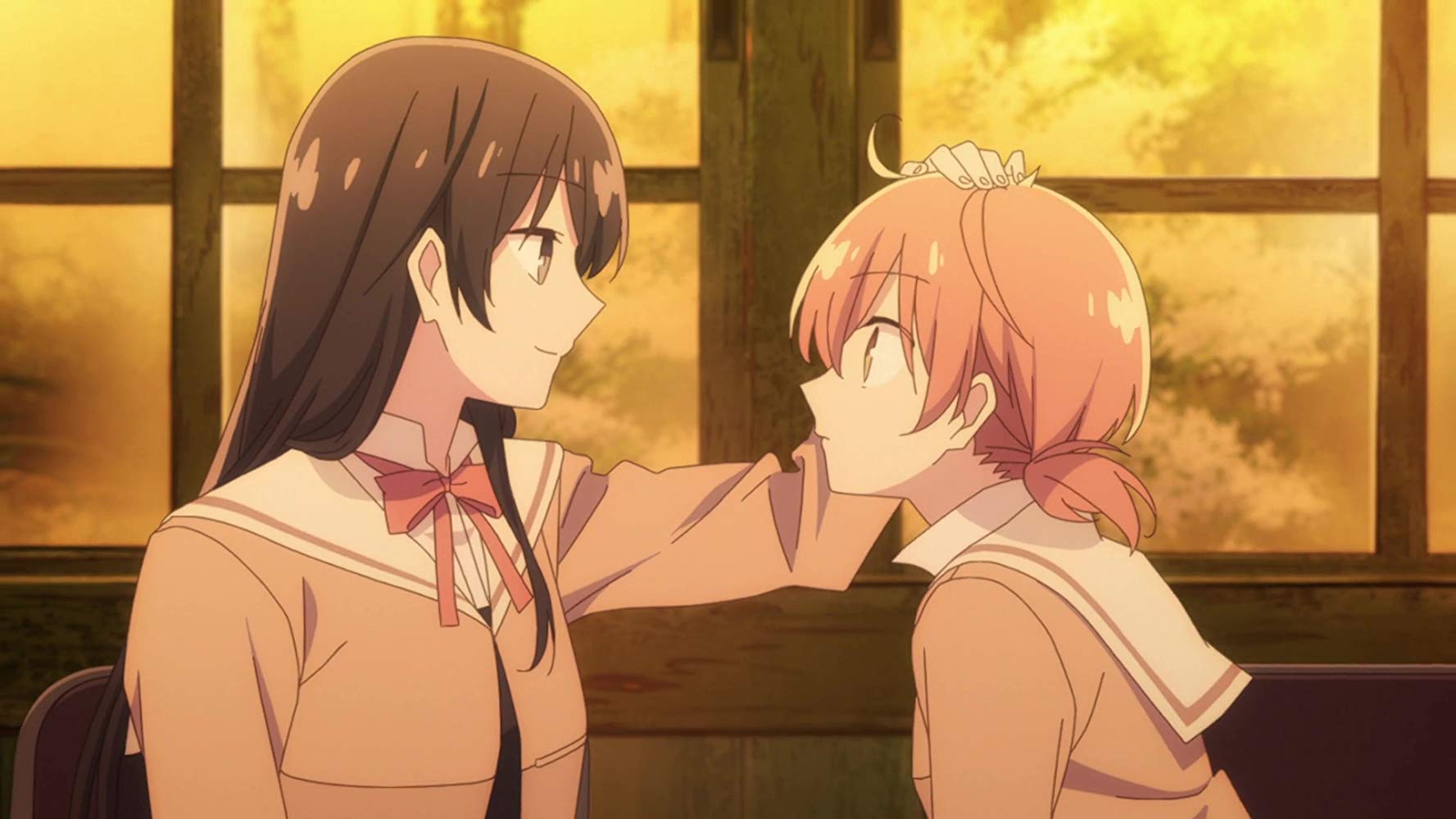
Through Touko's and Yuu's relationship with each other and how their emotions manifest, the viewer is able to see just how complicated love can truly be, and how experiences of love that divert from societal expectations can feel unfamiliar and strange, despite not being "good" or "bad" on their own merits. Yuu and Touko demonstrate the security of being loved juxtaposed with the insecurity that love can harbour, the ease you feel when you love someone yet the desire to crave more, and the guilt that may occur when you attempt to explore these conflicting feelings for the first time.
It's an understatement to say that Yuu and Touko's relationship is simply genuine and nuanced. It's incredibly vulnerable and introspective, and their dynamic implores the viewer to reconsider the how they as individuals — as well as how humans as a whole — have come to conceptualize this ever-encompassing idea of love.
Identity is another huge focus in Bloom Into You. How you see yourself versus how you really are. How you think others view you versus how others really view you. All of these play into themes of self-confidence, self-discovery, and the idea of loving yourself as others love you. The concept of the "true self" is never constant, it changes depending on the beholder.
It is up to us to reconcile the fickleness and fluidity that is our identities and our love. This is yet another way this anime breaks down sociocultural connotations of love, as we're constantly taught that love is a constant; that fickle emotions are incompatible with true and unwavering love. Yet, Yuu and Touko demonstrate that love can take form in any way or manner, and that it is a journey that is both constructed and explored by those privileged enough to find themselves in a loving relationship.
All this being said, I don't think Bloom Into You (or at least the adaptation) is perfect. There is one critique I have, and it's unfortunately a big one — it ends in a very poor spot, and essentially forces viewers to read the manga if they want a conclusive ending.
The place at which it ends is the fault of the anime adaptation itself, rather than a flaw against the source narrative as a whole. Therefore, to criticize its story is a bit disingenuous, but to say that the adaptation didn't bungle the ending is also misleading. I think the anime's ending is a real shame, because pretty much everything else about this show is seriously phenomenal.
The last few parts were kept purposefully more vague than the rest as I don't want to go too much into spoilers. But as for my overall thoughts on this anime, as mentioned in my first sentence, Bloom Into You is a surprisingly philosophical work that challenges everything viewers had built up love and identity to be. Save for the rather ambiguous ending which unfortunately knocks it down a considerable peg, it's some of the most vulnerable and compelling storytelling I've ever seen.
This show is a must-watch for anyone that is able to get past the initial premise of yuri love, because Bloom Into You evolves into something far more complex and introspective than a simple premise of girls love that only exists to be different. I highly recommend continuing with the manga once you've given this show a shot — I promise you won't regret it.