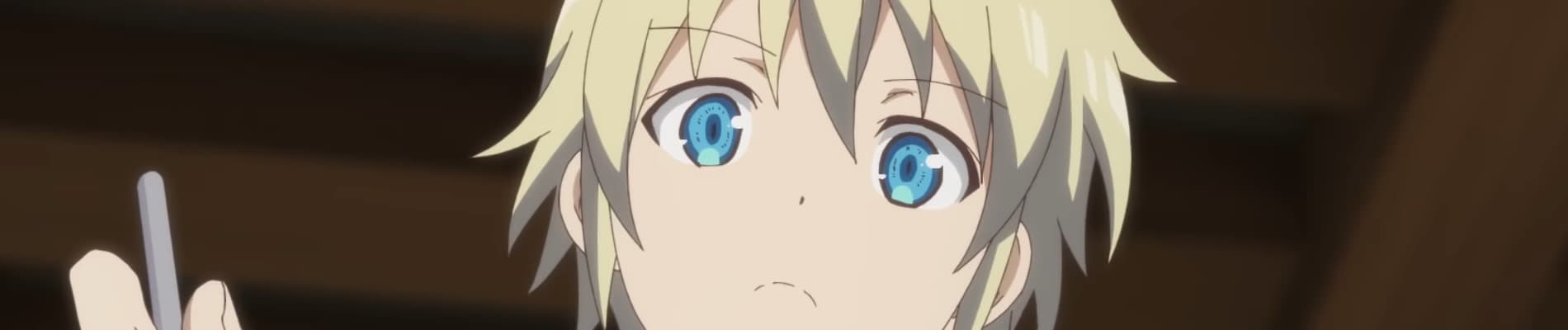
Isekai Yakkyoku, or Parallel World Pharmacy (as I will refer to it for the remainder of this review), proved to be an enjoyable enough watch, if not lacking in some amount of substance. I doubt it will prove to be considered a great work by any means, but if you happen to be in the market for an Isekai anime that provides a knowledgeable protagonist changing the world they enter, then Parallel World Pharmacy should satiate you nicely.
As with many anime in the Isekai genre, we join our protagonist just prior to his untimely demise. This is not a particularly outstanding fact, but it is a common enough trope that I don't count the cliché against it. Beforehand, however, we are provided details about his life up to this point in various methods. I was particularly pleased by the fact that many details were not outright told through dialogue, but rather shown in his actions and in visual cues.
After our protagonist's introduction, there are a decent handful of supporting characters introduced in various ways and with various roles in relation to his work in this new world. Of particular note would be his new parallel father figure, Bruno de Médicis.
As a character, Bruno has a competence and particular shrewdness that I found refreshing for a relative of an Isekai protagonist. His general intelligence and dedication to both his position and his family are admirable, and we are shown that he is not without flaw, especially in his former treatment of his son, who our protagonist now inhabits.
In contrast, I found the character of Camus de Sade to be entirely lackluster and single-noted. It felt as though this heavily-foreshadowed antagonist entered the scene without any pomp or circumstance, and he was removed from view just as quickly as he was introduced. This particular point leads into my criticisms regarding the plot as a whole.
While I appreciated Parallel World Pharmacy's ability to provide a competent protagonist able to change the world through his previous knowledge, and I enjoyed the progression of his goals, the sunset episodes of the series felt not only rushed but entirely inexplicable.
Despite hefty foreshadowing beforehand, our protagonist has no interaction with the primary antagonist until the final episode. This could be fine in of itself were it not followed up with one of the most anticlimactic victories I have experienced from an anime.
Because I found the plot enjoyable and comprehensible throughout the ten/eleven episodes that proceeded this supposed climax, I won't count this slight too heavily against Parallel World Pharmacy, but I will say that I found myself entirely disappointed afterwards.
In terms of artistic merit and quality, Parallel World Pharmacy could be considered passable or average. I didn't find any one scene to be particularly breathtaking or beautiful, but the general effectiveness of the art didn't cause me to grimace. I have very little to say in this category due to the simple blandness of it all.
Similar to the visual quality, the animation of the series also proved to be passable and average. I believe I am actually being fairly generous in this category, considering the amount of scenes represented by a character standing stock still as a camera pans over them.
The Japanese voice actors performed their work adequately, lending a decent enough talent to their characters. Additionally, the use of sound effects and score did not detract from the series, and often assisted in accenting a scene from time-to-time.
I had a decent enough time watching Parallel World Pharmacy, but I would not blame someone if they came out of it with a lower opinion of it than I did. I have a personal fondness for the Isekai genre, and I also tend to enjoy the Slice-of-Life genre that this series depicted for much of its runtime. I don't believe in any way that this anime is for everyone, but, as I said before -- if you're in the market for a decent enough Isekai with a knowledgeable protagonist, you could certainly do worse than this.
27 out of 29 users liked this review