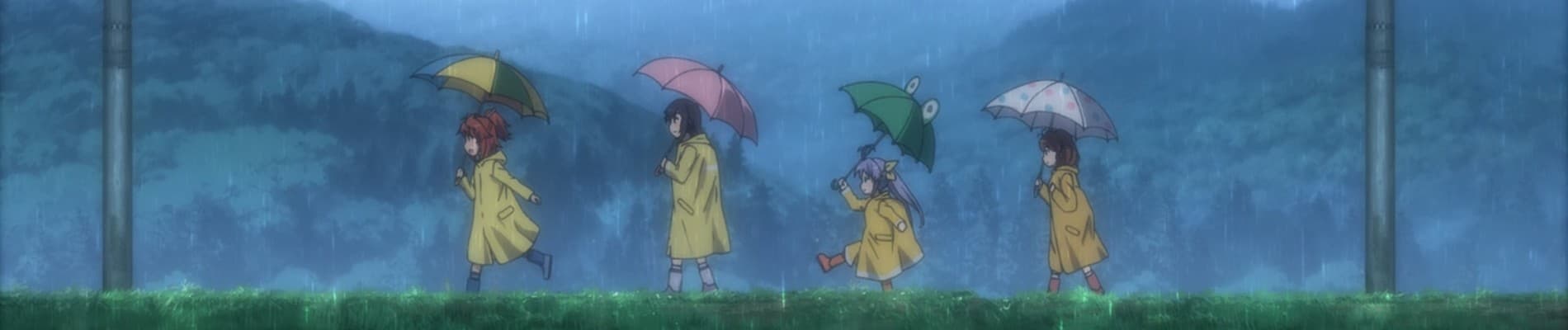
Non Non Biyori
a review by pseudo
a review by pseudo

I don’t know about you, but I grew up in an urban environment. Maybe not bustlingly dense like Tokyo or Hong Kong, but I live in a metropolitan region with more than two and a half million inhabitants. I’m used to concrete jungles, bumper-to-bumper traffic, packed trains and buses, large lecture halls, open offices, and everything in between that comes with living in a large city. I could never imagine living anywhere other than in an urban region. And with just over half of the world’s eight billion people(!) also living in cities, I’m far from the only person that feels this way.
Enter Asahigaoka, the quaint abode where this series resides, a humble farming village in Japan’s countryside. Gone are the comforts of restaurants, convenience stores, malls, and most amenities, public or private. In fact, you don’t even get cell service unless you’re in very specific spots of the town. Its population is never explicitly stated, but I would wager it’s in the low-to-mid hundreds at the very highest.
All of this is to say — the environment and setting of Non Non Biyori is a far cry from the booming city centers of most. At the very least, it was for me. And yet, a profoundly tangible sense of bliss and comfort that can’t be put into words is realized with each and every single episode. It’s a very human phenomenon to grow attached to personal places of significance, but for most, it understandably takes years of lived experience and memories to form this fond attachment.
Non Non Biyori effortlessly manages to create this feeling and these experiences in just 36 total episodes — or with ~21 minutes of runtime per, just under thirteen hours of total series time. It fosters an intimate familiarity with Asahigaoka that makes you feel right at home — a bittersweet nostalgia for a fictitious village that’s nevertheless intimately imbued. It is not merely an attachment to familiarity and the time we take for granted which generates these human catharses — this series reminds us of all the things that make the concept of “place” so incredibly special for us.
This anime is more than just the setting it’s based in, the characters that live in it, or even the time that passes it by. So if I haven’t already convinced you, here’s everything that makes Non Non Biyori so special.
This is a concept deeply embedded into Japanese literary social consciousness, and it's a necessary frame of reference to know in order to fully articulate this series' thematic breadth. In essence, 物の哀れ (mono no aware) represents the transience of time, the impermanence of human life, and the gentle yet bittersweet acceptance of this fact. This is the heartbeat of Non Non Biyori — what makes it tick, and what lends its strengths the substance which transforms it from a quotidian slice-of-life to a profound depiction of place-driven attachment and the wistful cognizance of the fleeting nature of life.

All media in general seeks to establish a sense of place; it’s necessary to even begin to consume literary fiction and suspend disbelief — that much is implicit. But amongst the backdrop of mono no aware, Non Non Biyori functions as a much more focused and deliberate deep dive into "place" as a concept, and as aforementioned, this is the gravy of what this show has to offer.
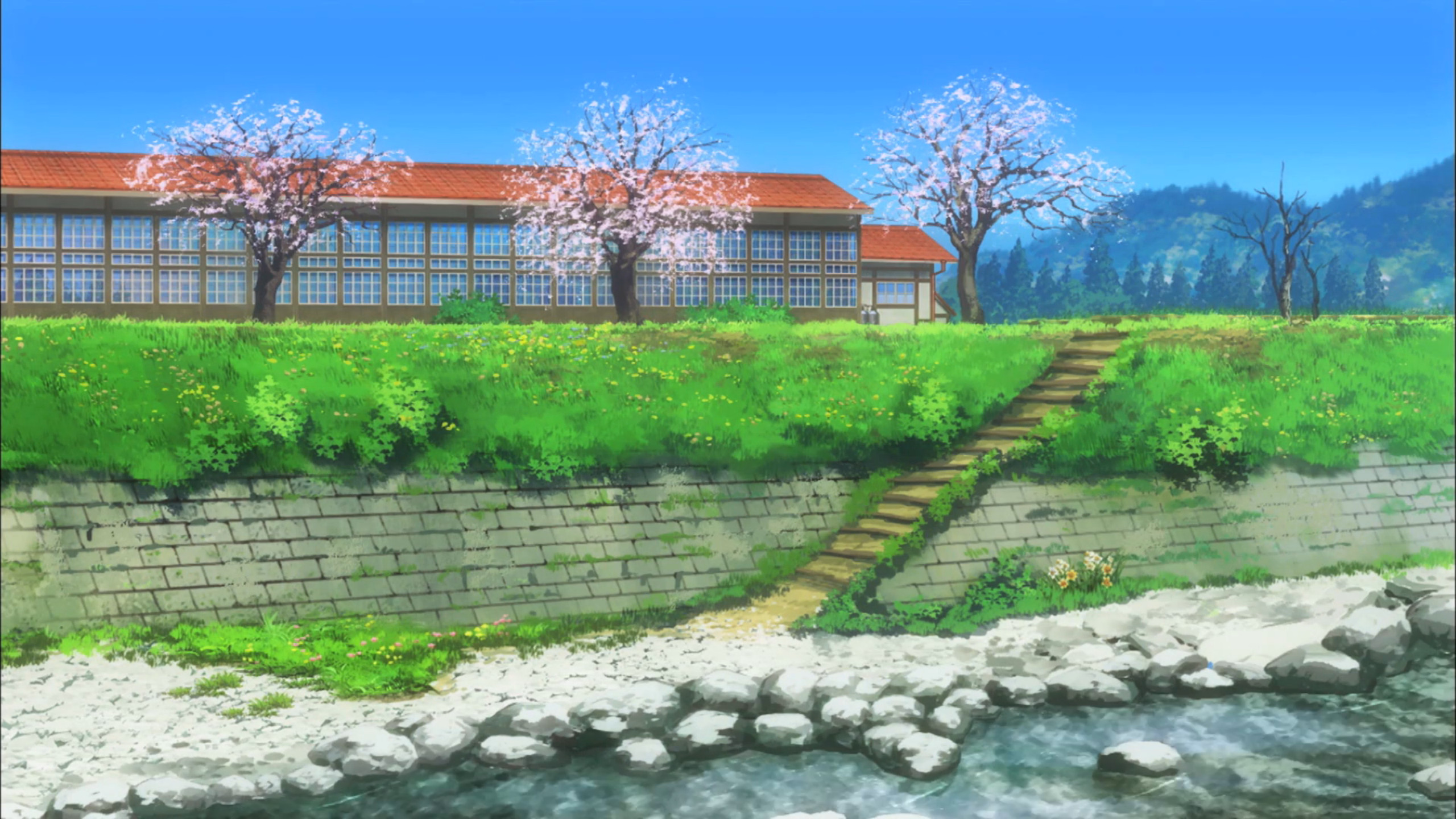
Throughout the course of its three seasons, you’re given ample time to witness the environment and setting of Asahigaoka — all the nooks and crannies, the mountains and the trees, the water and the pavement. These representations of place can be as critical as the single train line that takes you out of the village, or as charming and modest as a water well deep in the fields of a farm, a small, unpaved path that cuts between streets, or the hallway of Asahigaoka Branch School that shows its age and is poorly maintained.
Intertwined with these intimate depictions of Non Non Biyori's hometown, the viewer comes to feel the time that’s passed whenever you’re greeted with scenery of this small village. The seasons change, and life moves forward. The snow outside the classroom window. The aged produce sitting by the side of the road, where purchases are made by good-will donation. Nostalgia necessitates an emotional hook — what better way to create such than the simple transience of the creature comforts we take for granted?
It’s these quaint depictions of Asahigaoka, combined with this aforementioned thematic impermanence of time and life, that is Non Non Biyori. This town is spatially constrained, yet its potential is limitless — and it will pass us by irrespective of whether or not we chase after it. Why not make the most of what's around us?
Every day, the world we find ourselves in changes a little bit. There’s an exciting prospect to that, but there’s also uncomfortable undertones of sadness and longing; saying farewell to what we've always had the pleasure to say "hello" to. Non Non Biyori does exceptionally well in beautifully using the transience of time to build on very human and very fleeting emotions, and imbues these feelings into its sense of place. Not everyone is able to relate to having to walk through unpaved roads and endless fields of grass to get to school, but everyone can relate to their routines and environment changing, bit by bit, as a natural consequence of time.

It’s no secret that Non Non Biyori’s main ensemble are young. While various college-aged, working-aged, and parent-aged characters round out the cast, the oldest character within the main four is a second-year middle school student. This equates to around 13-14 years old.
I want you to reminisce for a bit about how you lived life when you were this age; and perhaps even younger, as the youngest in the main cast is about 6-7. We tend to be very impressionable, seeing the good in everything, and taking this radiant perspective for granted. It’s easy to get jaded as life goes on and responsibilities catch up to us, but this anime functions as a heartfelt reminder — it wasn’t always this way, nor does it have to be.
As I’ve touched on above, Asahigaoka is an extremely small town with little to offer in terms of entertainment or leisure. There are no public facilities like parks or beaches, and there are absolutely zero big-box businesses or shops — seemingly the only store in the village throughout the entire show’s run is a mom-and-pop candy store. Don’t even dream about finding a mall to hang out at, or a town square to relax in. All of the conveniences of city life that we take for granted? They’re nowhere to be found in this show’s hometown.
And yet, the characters of Non Non Biyori unlock an astonishingly infectious energy in a place pretty much devoid of conventionally experiential prospects. There's no go-karting or mountain hiking to chase after — there doesn't have to be. Life is an experience; every day offers that very opportunity, and at the end of those days, it's what you and your outlook make of it. The cast's endearing youthful adventures, endless curiosity, and earnest approach to day-to-day life means that even the most mundane of moments have an organic sense of excitement and comfort to them that betrays any feelings of complacency, boredom, or apathy.
Through this anime and the adventures of the main ensemble, we’re reminded of the fulfillment and satisfaction to be found in the everyday — so long as we have the right heart to seek it out. Non Non Biyori shows us that there’s warmth to be had through just simply living, rejuvenating that youthful optimism to enjoy every day as a chance to see and do something new.

Last but most certainly not least, this is what I consider the central pathos of this series, and what is the culmination of all the previously mentioned overarching themes. Above all else, Non Non Biyori creates an appreciation for living in the moment. To accept the transient nature of time and place, yet forever cherishing the present all the same. Because with every episode and every scene, all of its characters are doing just that — nothing more, and nothing less. That's all this series needs, and nothing that it doesn't. A beautiful simplicity that has the privilege of eluding tidy description.
Such an exuberant and excitable childhood most certainly won’t last forever. The streets and scenery you once saw with overflowing enthusiasm may one day fade. The way you see the world will one day change, and will continue changing for as long as you are. Non Non Biyori persists and persists, wearing its heart on its sleeve in telling the viewer that all of this is... okay. It's all going to be just fine — this current moment certainly is, and so too will the multitudes more to come. It’s an exceedingly simple message, but one that is filled with so much love, care, and gratitude for the little things in life.
As expected in a slice-of-life anime, the cast of Non Non Biyori aren’t doing anything world-changing. They’re going to school, playing and hanging out with each other, exploring Asahigaoka for the hundredth time, and maybe even just sitting around just relaxing. But what makes all of what life has to offer for our main four so special is that they choose to view it as such. It might not be world-changing, but the right outlook is life-changing. The poignant silences between dialogue, the serene aspect-to-aspect transitions, the episodic nature of the show; everything about Non Non Biyori all centers on this incredibly earnest idea to live life to the fullest, no matter what it has to offer. It really is just that, but the journey that this show takes you on to convince you of the power of this message is one that resonant, and it's impossible to reject its invitation to imbue this message inside your heart.
I could go on and on and on and on — for hours and days — about all of the various reasons I love this anime so much, and I’ve tried to articulate them in a discursively concise manner. But try as I might, I'll have to emphasize that you, the reader, can only truly relate to this praise and witness these intangibles for yourself by watching this beautiful series.
This review, of course, was aimed at getting you to watch this series that I love dearly, but having finished it and reading everything back, it is above all else my love letter to Non Non Biyori and why I will forever cherish it. I can only hope that some of my words and feelings resonated with you, and maybe you’ll pick up this amazing show as a result.
Thank you, Non Non Biyori, from the bottom of my infinitely fulfilled and full heart ❤️

96.5 out of 98 users liked this review
