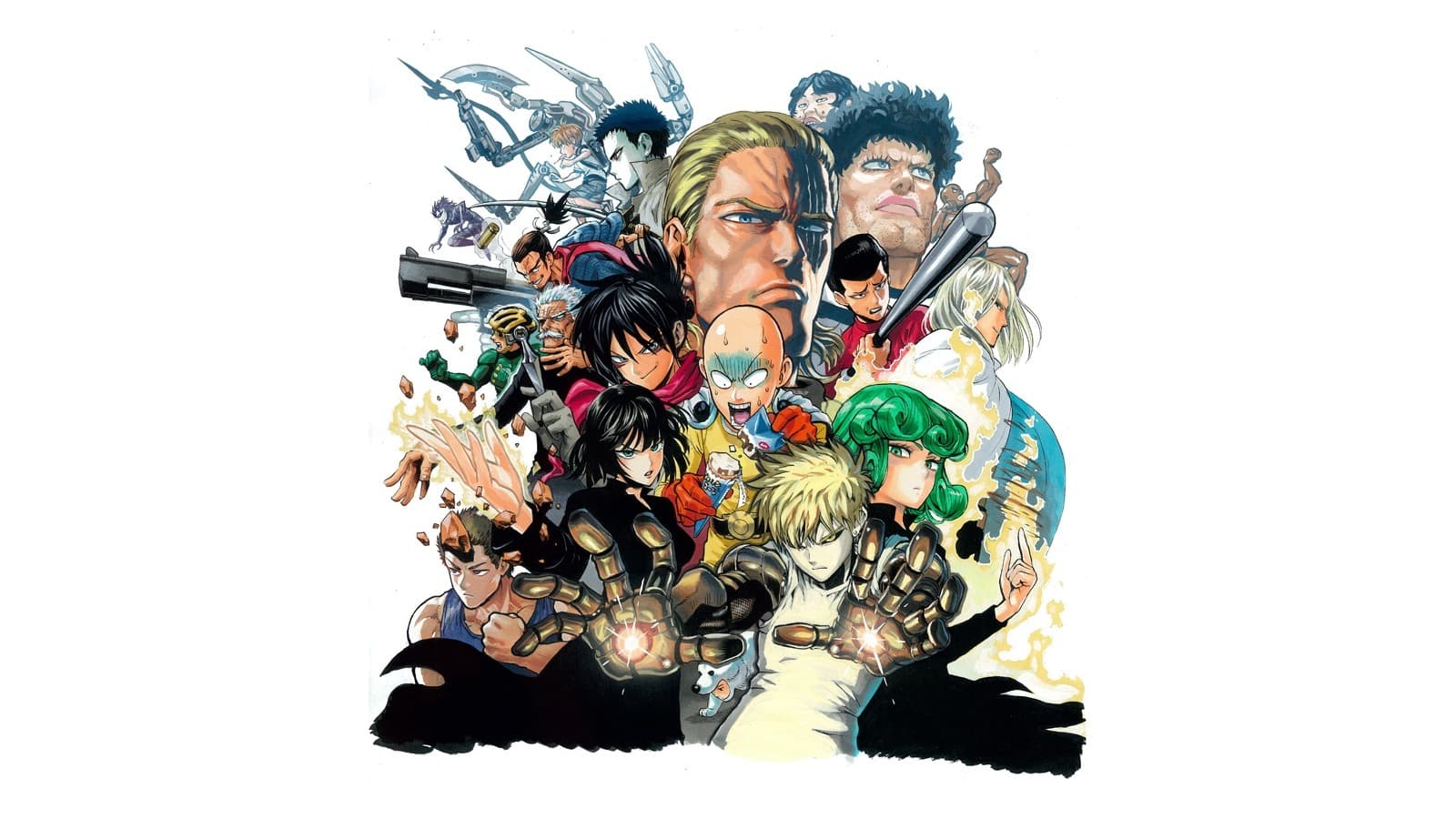
So it’s a complete 180 from existing Shonen action manga?
ONE: Which makes it fun for people who have already read lots of those typical Shonen manga. It’s like they’ve run the first lap, and this is their second time around.
Murata: Yeah, it’s really exciting for Shonen manga aficionados.
ONE: I also love it when a series creates friction between drama and humor. With One-Punch Man I wanted to try doing that through the worldview itself, rather than through specific plot points. The series is set in a dangerous, monster-infested world, but since Saitama’s there you don’t really notice just how bleak the world is. I think it’s that friction between Saitama and the rest of the world that makes things interesting.
-- ONE, ONE/Murata 2015 Joint Interview, http://opmcityz.blogspot.com/2016/04/onemurata-2015-joint-interview.html
NO SHONEN PLS, WE’RE SEINEN
ONE has studied and writes shonen well, so when he picks up the language and framing of a shonen series for One Punch Man, it’s no wonder that the audience approaches it as such. In particular, folk think of it as a battle shonen. And OPM is a different story, hence leading to a lot of dissonance. I don’t wonder at the number of questions about Saitama – the idea of him just being a regular nobody who used effort alone to become impossibly strong is incredible. People are sure that it’s going to turn out somewhere, at some point, that Saitama isn’t different after all (maybe Blast is his real dad, maybe there was one special monster he ate, maybe, maybe…). And now ONE has doubled down with his disciple. If Saitama is a nobody, then Genos has no body with which to be a nobody. And who has the nonsense to aspire to be impossibly strong too. They’re at the centre of a world with much more ‘normal’ shonen like characters. Which ONE then uses to tell a weird story that is in turns dark and funny, fantastic and human.
ONE has an interesting case of authorial control over audience response. ONE does understand how shonen stories frame character progress – he does it beautifully for Garou – and so he understands how to break them. Because he frames Gouketsu in the same terms as the Deep Sea King, it creates a false equivalence between the two monsters and it makes the audience feel as if Genos hasn’t made much progress. Even though, objectively, that’s untrue.
It’s no mistake for ONE either. Let’s wind back all the way to G-4, a much more dangerous foe than the Deep Sea King. If you’re using the shonen framework, then when a character overcomes what is for them a major hurdle, the story holds a micro party to tell the audience. The nature of the challenge to be overcome is pointed out, clear links are made between what the character used to be like in the past and the choices they have to make now, and the fact that they’ve overcome that challenge is stated, often by a third party. e.g. “Uncle is growing stronger by the minute!" ONE does not do a single one of those things with G-4. He just presents what happens. And so the fact that this is a watershed moment for Genos blows right past the audience. It’s the point at which he consciously cuts dependence on Saitama to bail him out, when he stops dropping his guard, when he gets to grips with what he needs to do to overcome demon-level monsters. Even though this is a monster that’s more dangerous than the DSK, being smarter, being impervious to flame weapons while having deadly range weapons of its own, and in a less controlled environment. [And for people stuck in 2015, the DSK was the last demon-level monster Genos lost to and the last time he dropped his guard]
So when Gouketsu comes along, and gets the same treatment as being a foreboding threat that the DSK got, it reinforces the idea that nothing has changed. Even though lots has. ….and then Gouketsu is dismissed with total contempt, heh heh… Across the story, ONE uses this control of framing beautifully; when to throw that micro party (”thanks! Now I know that firearms can no longer affect me!”), when to either over-emphasise and de-emphasise events, and watching him wrench audience responses 180 in the space of a chapter is quite something!
17.5 out of 19 users liked this review