
___
In addition, this review was written in a style and a voice which I wouldn't use in my current-day writing. If you're curious to read—what I consider to be, at least—my more thoughtfully and precisely articulated work, please check out some of my newer reviews or my list notes.
I'm leaving this review itself untouched, though–both for posterity's sake as well as a reflection of the fact that the writing you see below is what readers like yourself had judged its merit on over the years.

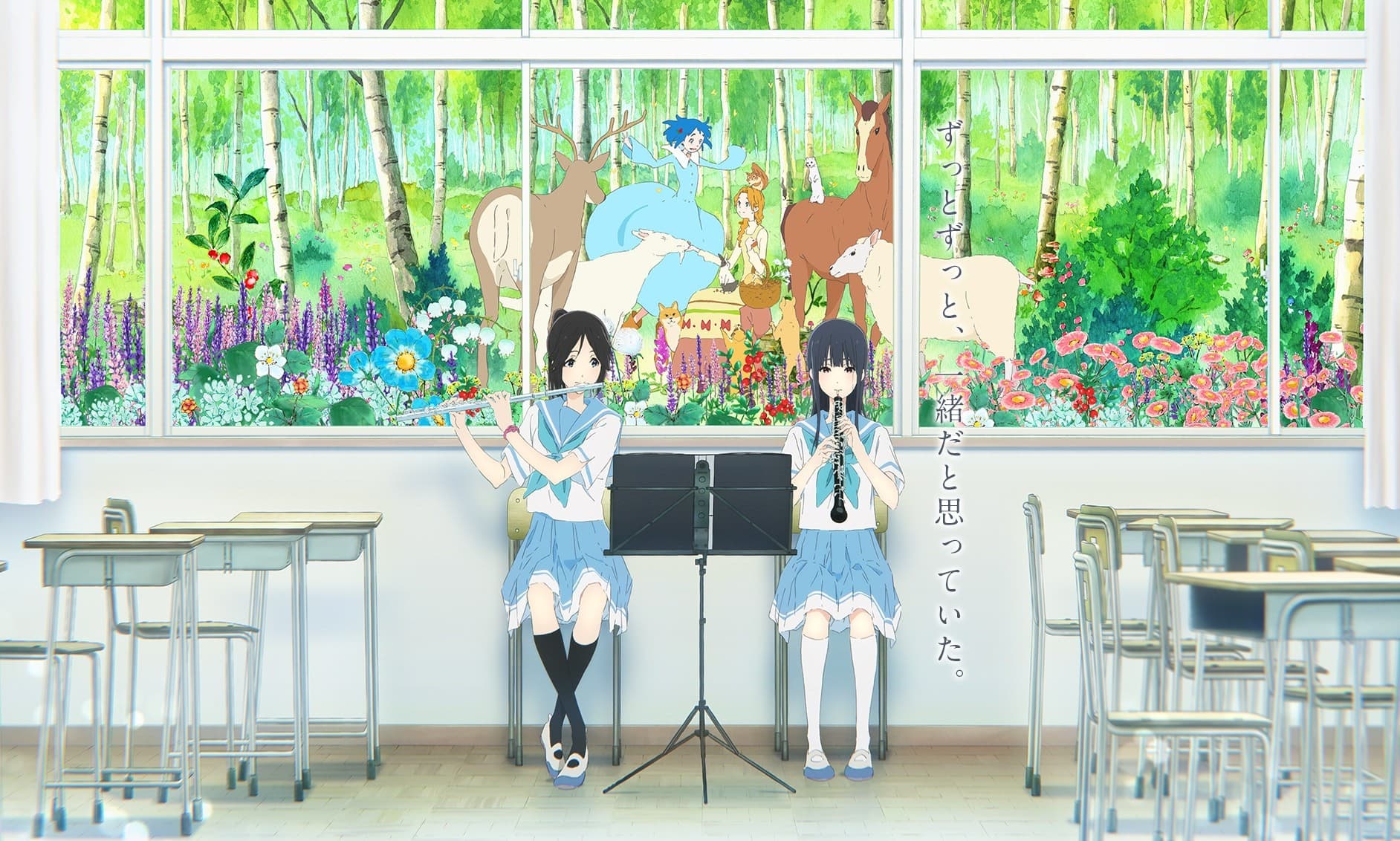
What makes Liz and the Blue Bird (henceforth shortened to Liz) so special is everything that its parent story is not. This isn’t to say that Hibike! Euphonium wasn't amazing in its own right, but I think that Liz offers a bit more universality in its storytelling and character development; it tells an endlessly grounded and earnest tale of human connection and the impact we can have on each other’s lives.
If you’ve seen Hibike, you’ll already know the dynamic between the two main leads, Nozomi and Mizore. But what I think is absolutely incredible is that this dynamic, which was built up over the course of multiple episodes of development with an entire season of backstory to contextualize it, is organically established in the opening sequence of this movie, and holds its own weight as a distinct story (well, Nozomi and Mizore aren’t the focus of the actual opening sequence, but I digress). A prior viewing of Hibike might enhance one’s outlook on this film, but it is most certainly not necessary.
This sequence is where Liz hooks you and never lets go. Anyone familiar with A Silent Voice (which is most of us) shouldn’t be surprised by the jaw-dropping production value and audiovisual masterclass that Naoko Yamada and Kensuke Ushio squeeze out of every frame; yet this duo, as well as the entire rest of the production staff, remind you of the incredible feast of creativity and novelty offered by each and every one of their works.
You’re presented with a pristine animation style and luscious colour palette that deviates significantly from the parent series, and for good reason. Hibike possesses rather dramatic flair, exciting musical climaxes, grueling personal and interpersonal development, and tells its tale through high-stakes, highly rewarding characterization. Meanwhile, it is immediately clear that Liz is much more subdued in its storytelling, with purposeful, quaint absences of dialogue and action that lets the divinely diegetic OST do the talking. Quite appropriate for a music anime, but the band and performances take a considerable backseat throughout this film.

After all, the main focus of Liz, and what its meticulously crafted first few minutes portray wonderfully, is that Nozomi and Mizore take center stage. While they are practicing and working towards a performance duet together, it’s what this song embodies that drives the rest of this film. It’s abundantly clear right from the get go (as demonstrated by the actual opening scene) that the story their performance is based off of is an allegory for their own personal relationship.
Even if you aren’t familiar with Hibike in the slightest, the beginning of this movie takes so much care in organically developing and pacing the two leads that anyone is able to uptake this allegory with ease and see how it defines their dynamic. Even more amazing is the fact that through this choice of storytelling, it is also made abundantly clear as to the direction that this movie will go, and it is all the more special that KyoAni are able to maintain your undivided attention regardless.
Naoko Yamada achieves this in many ways. The minimalist art style compared to Hibike lends itself to subtle details in the physical movement of the characters that advance the narrative far more than most other directors dare to rely on. The flaring of nostrils, the saccadic eye movements, the lowering of shoulders, the forlorn cheekbones as a result of a halfhearted smile; it’s all there, if you're willing to seek it out. If you’re looking for expositional storytelling through dialogue and plot development, you’re not going to find it here. The devil is in the details, and none are more demonic than Kyoto Animation.
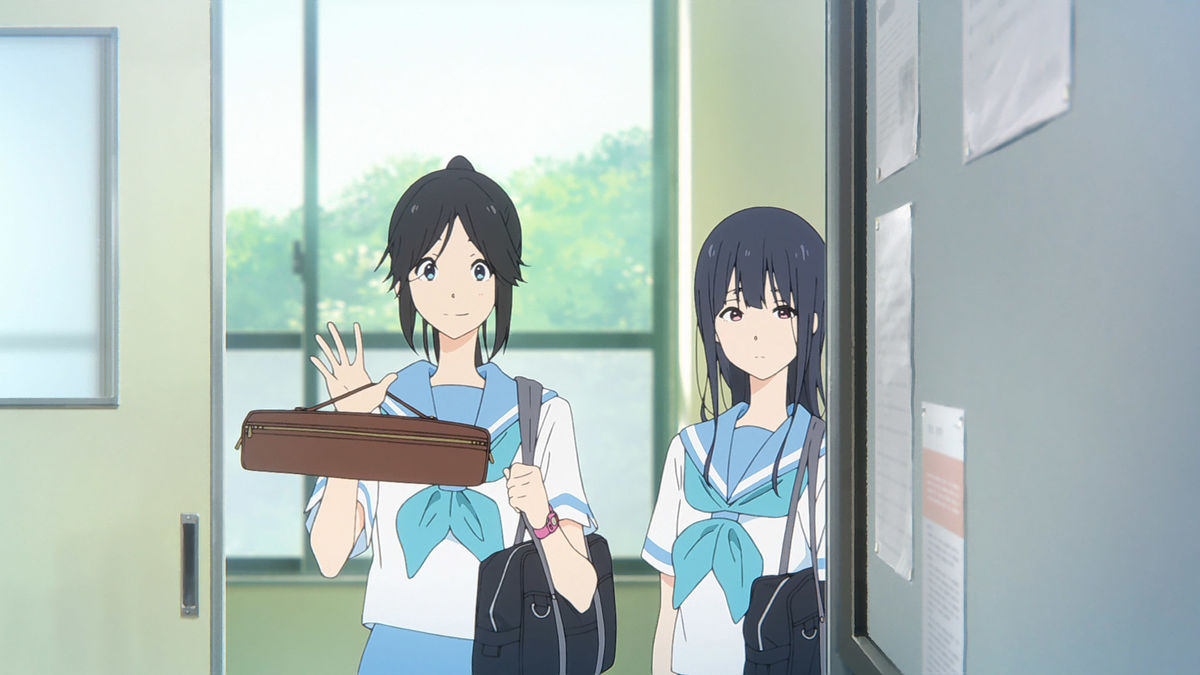
What this movie achieves (while keeping this section as spoiler-free as possible) isn’t a breathtaking musical performance, or a triumph over hardship and adversity, or even the strengthening of bonds. Because in fact, it’s sort of the opposite. Liz embraces transience and embodies the fleeting nature of human relationships. While this movie is about letting go, it’s not about loss, or at least, not in the traditional sense.
There’s so much to be gained by journeying through life with others by your side, but there comes a point where a path is best walked alone. It’s strange, we’re social creatures, but we also have an inalienable sense of individuality that can define our lives at critical moments. Liz, and by extension, KyoAni, take us on a journey through the turning point of Nozomi and Mizore’s lives. In so doing, they challenge us to rise up to the occasion ourselves. To remember the lessons gained through deeply fulfilling friendships and connections, but also to learn to let go when our heart wants to take its own path.

All of this is to say that Liz is a significant departure from Hibike in many ways, from its tonal atmosphere, to its audiovisual flair, and even its character development. Liz is its own standalone work, one where the synchronicity of a band is irrelevant, where the high-stakes environment of performances are absent, and where the stress and pressure of practice are only a red herring for what truly lies behind the curtain.
Everyone has unfortunately dealt with the pain of loss and the regret of fleeting relationships. That’s just how life goes, and this movie does incredibly well to flip the script on its head and not only accepts, but embraces a parting farewell. It's heartbreakingly human and poignant, yet infinitely fulfilling. To let go of something means you had it to begin with, and at the same time, to be saddened by that goodbye means that what you had is forever worth cherishing.