####This review contains spoilers.
The year is 1981. There is no Studio Ghibli, just yet. Hayao Miyazaki has directed one film, The Castle of Cagliostro. It won an award but failed to do well at the box office. Miyazaki, however, is approached by Toshio Suzuki, editor of the Animage magazine, with an offer to write a manga: Nausicaä of the Valley of the Wind. He would be inspired by an event 25 years before…
The year is 1956. In a small coastal town in the south of Japan, something strange is happening. Residents of Minamata notice local cats acting strange, spinning in circles and falling into the sea. Residents called it a dance. But they were convulsions. The death throes of a poising caused by an environmental disaster. For the past 24 years, the Chisso Corporation’s chemical factory had been dumping industrial wastewater in the bay. The mercury present in the waste entered into the fish and shellfish. And what started with the cats, soon spread to the people of the town. Over 2000 people died of what would become known as Minamata disease. The environment’s twisted way of fighting back against the damage done to it.
Jumping back forward; the year is 1980. Ronald Reagan has just won the presidential election in the US. His politics would reshape the fabric of America. Two years later, Yasuhiro Nakasone would become the Prime Minister of Japan. The two men would share a close relationship, deepened by their very similar strain of politics. Nakasone would revitalise Japanese nationalism, seeking to position the formally pacifist country as a bulwark against communism. To the cries from his critics who labelled him a dangerous militarist he responded “a nation must shed any sense of ignominy and move forward seeking glory.”
The year is 1983. Miyazaki is permitted to direct an adaption of his manga. Working with Isao Takahata, the film would take nine months to complete. In 1984 it is released to enormous critical acclaim. And the year after that Miyazaki, Takahata and Suzuki found Studio Ghibli.
In this context, Nausicaä of the Valley of the Wind stands as an incredibly important film. Its environmentalist and anti-war themes yell loudly into a world that was angry and afraid.
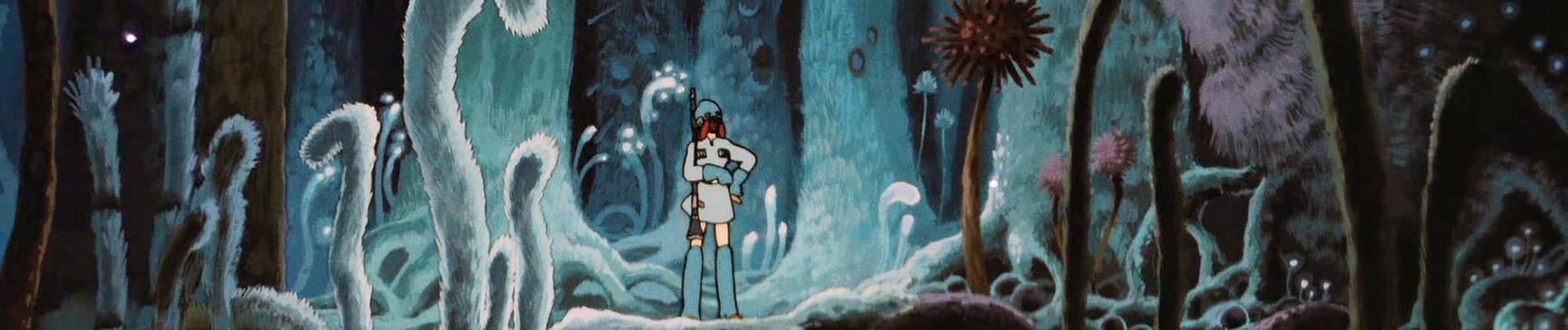
Nausicaä of the Valley of the Wind presents a world a thousand years after it was ravaged by industrialism and war. The remains of this period have manifested a hostile scourge to the remaining humanity; the Sea of Decay. Despite it being the great threat to the people of this world, Miyazaki immediately shows us the Sea of Decay through the eyes of Nausicaä, who with fascination and admiration explores the alien jungle. Miyazaki uses giant insects for the monsters of this forest - evoking a repulsion from us that is quickly subdued as Nausicaä is enamoured by their beauty. No longer frightened of the giant cicada-like shell of the Ohm, we understand the Sea of Decay from the eyes of Nausicaä. It may be a threat, but it is not evil.
It is only after this that we are shown how the Sea of Decay is dangerous. An Ohm, literally red with rage, charges on a lone rider (who we later learn is Yupa). Fearing for his life he fires upon it. Yet Nausicaä, unafraid of the creature, is able to calm the beast. Through this, we are immediately introduced to a recurring and important theme of the film, the power of fear and anger. The theme is repeated with our introduction to the little fox-squirrel, Toeto, who bites Nausicaä out of fear, but calms when it realises she is not a danger.
And this theme is reinforced further still following the Torumekian invasion. Seeing her father dead, Nausicaä attacks the Torumekian soldiers and is only stopped when she stabs Yupa. As his blood drips down her blade she realises what she has done in her rage. Miyazaki presents this fear and anger, again and again, not just to show their power, but to tell us that humans are not above nature: we too are driven by these emotions. The red of the Ohm’s eyes and the red that runs down Nausicaä’s sword are one and the same.
In fact, every conflict in this film is driven by fear or anger. The Torumekians fear the power of the Great Warrior in the hands of the People of Pejite, so they invade and steal it. They fear the spores of the wasteland, so they rebuild the very creatures that destroyed this world.
Yet just like the fox-squirrel who licked Nausicaä’s hand, the Sea of Decay is a force for good beneath the surface; purifying the water and cleansing the soil. We learn that the wasteland is twisted by the pollution of humanity. We’re shown that it is only driven to rage by the aggression of mankind. Miyazaki presents a form of nature that has teeth that bite back at humanity’s hubris. Yet he doesn’t suggest for a moment that nature is evil, he shows how reliant the people of the world are on it, while never letting us forget the damage they have done to it.
His response, then, to his prime minister, who was beating the drums of war, and to the industrialists, who poisoned Japan’s bays, is to present a hero who is not afraid and is not angry. She does not fight against the warmongers. She looks for peace. She looks for harmony.
The legacy of this film is enormous. With the creation of Studio Ghibli the following year, three men and a team of animators would go on to create some of the greatest animations ever made. Nausicaä of the Valley of the Wind also began Miyazaki’s relationship with composer Joe Hisaishi, whose spectacular mix of synthesiser and classical orchestration here made for an unforgettable soundtrack. Quite unlike his later work for Ghibli, which I would describe as more timeless, the score for this film feels very of its day, but not for worse at all.
In 1997, Miyazaki would revisit the themes of this film in Princess Mononoke. In my eyes, he masters them there too, providing for a much more compelling and exhilarating story. But that is a topic for another time.
Instead, I will conclude with a very depressing last piece of history. Two years after this film’s release, in 1986, the Chernobyl disaster occurred in Ukraine. The parallels between the imagery of this film and the scenes of Chernobyl are hard to ignore. From the masks worn by the characters to the snow-like toxins falling from the sky like fallout.
And now, as we approach the film’s 40th anniversary, we are still facing an environmental disaster of an unfathomable magnitude. Bush fires ravage countrysides. Floods leave thousands stranded. Droughts threaten the lives of many more. It will only get worse. Because we are yet to understand our own hubris. We can all learn from the compassion and bravery of Nausicaä, the Princess of the Valley of the Wind.
28 out of 30 users liked this review