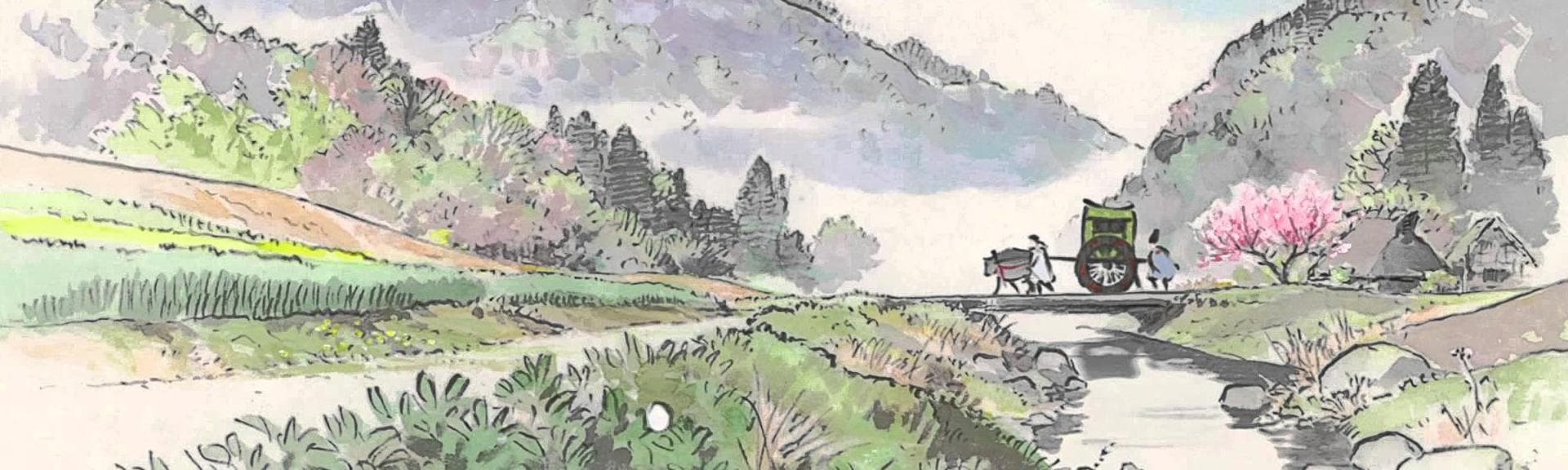


In the first arc of the series, the atmosphere is based on the outskirts of common society, in a village astray from the capital. Kaguya is originally found in a bamboo chute with parents who love her at first sight, and raise her to be an exultant girl who embodies the purity of nature. A girl who can accept everything bombastically and is engrossed with what modernity would define as filth. In every speckle of dirt, she finds her one true place and comfort she could never find anywhere else. In nature, she is truly free and unable to be separated from the unaltered cosmos of life.
Kaguya's father knows she is an extraordinary girl, and in the same bamboo chute where she was originally discovered he discovers a hefty amount of gold as well as many bold robes which signify royalty. He views this as a sign to give his princess what he thinks she deserves - nobility, which is ironic considering her original name is princess before later being named Kaguya. Then within a day, right after Kaguya swearing her love to her place in the slums to her childhood friend Sutamaru, and to never leave, she is stripped to the capital and given a life full of luxury, just as her father desired for his little princess.
Of course, just as with everything else, Kaguya is elated to be in her new mansion with many more places to explore and find her happiness in. That is until slowly throughout the years, the freedom she embodies is held down and trapped, with no chance of return. In this, Kaguya is put through a multitude of forms of suffering. She is stripped away of the things she loves most (friends + nature), berated for her individuality which goes against common happiness, she is objectified by hordes of men just due to her being known as a "treasure", and not even allowed to step foot at the party meant to celebrate her being named Kaguya. No matter what she does, she can not escape her role in society as a princess. Even when she visits the cherry blossoms and finally feels free for the first time in years, one small error of bumping into a baby happens and even people in the nature treat her like authority. After this happens, Kaguya is speechless and watches the mother and her children go along with their life in normality, and drowns in feelings of sorrow that she will never be free in her normal life again.
Throughout this after rejecting many suitors, seeing Sutamaru get beat up because of her, and someone even dying in a conquest for her, she slowly gives up on life. Even to the point of destroying the garden she fostered, which was the one reminder of her true home and happiness. She feels fake due to everyone forcing her to conform and as if she can't escape her destiny. In return for her years for endless suffering, she asks to be saved, which is where it is revealed that she actually belongs to the moon. She is informed that she will be rescued on December 15th, and realizes that means she will be stripped from the world she loves oh so much.
As previously mentioned, Kaguya is someone who fosters a pure and outstanding love for the world like no one else around her. Throughout the next few days, all she does is stare at the moon. After her mom and dad showing massive concern, she starts crying down in a frenzy about how she never wants to leave. How badly she wants to remain with them and be able to be one with nature. How much she regrets ever wishing for something like that. In a search for happiness, she ends up going back to her home town with her mother and feeling more free than she had in a long time.
Whilst at her old village, fate brings her and Sutamaru together and feelings of feeling chained down ruminate from both of them. Together, they try to escape their obligations of the life they've been trapped into by running away. In this moment the two run around, sprint, talk, and fly just as they did when they were children. This is until the moon starts to come out, and they are separated. Here, impermanence is explored by illustrating that even the smallest moments as long as there is love, can result in an extreme happiness. If people accept what is there in front of them and make the best of it with those they love, new found feelings of freedom will arise and something fleeting can turn into one of the most colorful moments of life. The more of these small moments together can create a vibrancy on everyone's canvas' that illustrate everyone's life itself.
Throughout everything, Kaguya kept persisting and never let go of her love for the earth. Until the end she was her, and even as she was ripped back to the moon she was able to understand the beauties of life just as it is. Kaguya's ending is filled with sorrow as she did everything she could to resist, yet there's a certain beauty on all of the colors she spread till the end, and even more so the notion that comes out of the contrast with her vs. the moon.
Whilst it is mainly the Capital throughout the film that embodies the standard societal construct of happiness (through doing what we're "supposed to," following traditions, glorification of status/authority, a massive stain of selfishness), the moon symbolizes another side of this as well. In the moon, all memories of earth become devoid and no one feels anything in order to keep progressing as a society. This is analogic to modernities continuous hollowness and removal of emotions for success. Kaguya is different from all of this and embodies the other side of society outside of ugliness. There will always be selfishness and revolting emotions in the common populace, but through characters like her parents, Sutamaru, and other members of her childhood friend group, we learn that there is so much more to the world. As long as we all have a home to go back to away from ugliness and conformity, personalized to our individual accords, we can find a new form beauty in life that should never be forsaken.
Kaguya's father represents both polarities. All he wishes is for his princess' happiness, so thinks of giving her the best by SOCIETIES standards and ends up forsaking what's right in front of the family despite already living a content life. His character serves to show the greed of society yet the innocence. Everyone wants the best and does what they can to survive, but they go about it the wrong ways and keep achieving for more even if it's not needed, which leads to a breed of destruction. His character is a foil to Kaguya's definition of happiness and furthers the notion that happiness in a little cave fueled with love and emotions is much better than being robotic through conformity. After all, it's the emotions that make everyone human and life worth it to begin with as showed in the scene where Kaguya contests the definition of princess.