K-ON!
a review by AnimeDweeb
a review by AnimeDweeb
Yup, you've read that right.
Simply watching the early episodes for the first time was enough reason for me to believe that K-On was something special. But for the longest time, I couldn't tell ya' why that is, and I'm not alone with this problem. When discussing this franchise with non-fans, there's often a need to acknowledge its status as "a show about nothing." K-On involves an uneventful "non-plot" that plays neatly into the moe aesthetic and the notorious trope of Cute Girls Doing Cute Things (CGDCT). Tame girly antics in place of a substantial narrative make the series a hard sell; I love the show to death but wouldn't know whom to recommend it to within my circle of friends. Whether or not you buy into the moe hype heavily depends on personal taste and what you look for in entertainment. Would you want to spend your precious time with girls who loaf around and drink "motherf^cking tea?" There's no right answer to this question, but there's one stance that matters most: yours. For what it's worth, here's my take: CGDCTs are often not up my alley.
The release of this simple series marked a 2010's turn toward mainstream moe, which saw the introduction of countless CGDCT contemporaries and copycats. With releases such as Yuru Camp, Yuru Yuri, and everything else in between, you'd think K-On 's relevance in a saturated landscape would have been wholly smothered by now. But against all odds, the Houkago Tea Time (HTT) band still rock on and endure as a modern anime classic. I may not be a fan of moe, but I am a fan of K-On. I began this review with the hopes of exploring this contradiction of mine, in the hopes of quantifying the franchise's success in novel ways that both fans and detractors can appreciate. So what makes K-On a cut above the rest? Well, looking at the factors surrounding the anime only yields more questions than answers. The debut director was an untested rookie, the source material was a sketch manga too basic for broadcast TV, and the goofy episodic end product by Kyoto Animation raised a middle finger to viewers expecting a more grounded depiction of life in a school band. By all accounts, K-On was a rebel, doomed to fail from inception. It's a miracle ~~sing time~~ that K-On can function at all, let alone cement itself as an influential smash hit with real staying power. But perhaps these happy accidents are what allow the series to set a gold standard as one of my favorite anime adaptations. In celebration of director Naoko Yamada's illustrious filmography, this two-part review series will be dedicated to addressing all these burning questions, as a guide to all things K-On.
K-On isn't enjoyed through plot points, but experience. This review will occasionally step into mild spoiler territory, but I encourage newcomers to read through to the very end. The kind of experience I tease here may just motivate you to try the show out for yourself. With our lengthy preamble out of the way, here is the story behind the Impossible Moe.

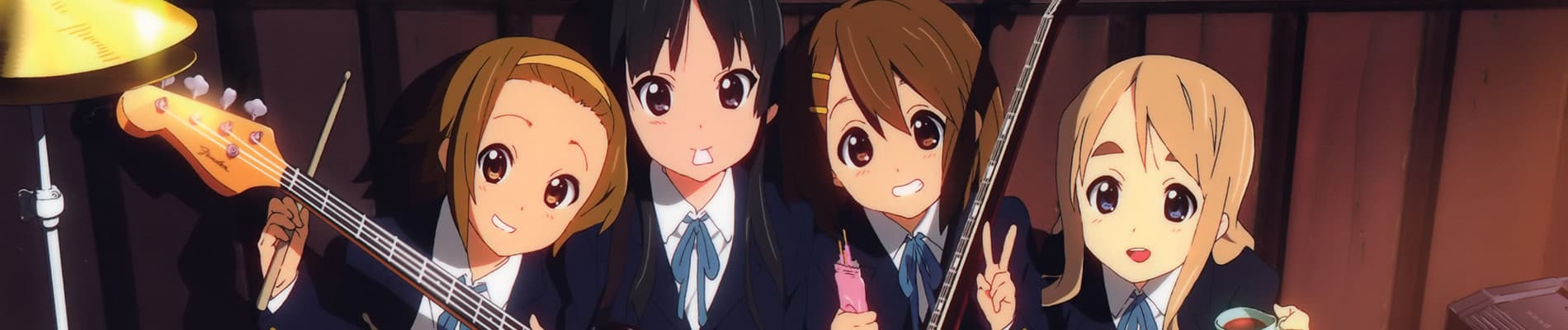
Let's raise the curtain on our band members. HTT's drummer and president, Ritsu, remains bashful both with and without her drumsticks. The energetic tomboy loves her tomfoolery almost as much as her passion for rockin' on with her bandmates. Bassist Mio is the Yin to Ritsu's Yang. Stern, delicate and timid, Mio has a MO of trying out all sorts of new things, even if she starts out shy. The wide-eyed Tsumugi takes Mio's curiosity and runs with it, with an infectious excitement for even the most mundane occurrences. An expert in both the keyboard and tea-making, Mugi is an ever-eager wallflower. Secondary guitarist Azusa joins HTT in her second-year. Her serious attitude brings a much-needed balance to her friends' chaotic cuteness, although eventually she herself figures out how to take it easy from time to time. Finally, our front(wo)man and lead guitarist is Yui, the anime embodiment of both being a little confused and having the right spirit. She's a senpai to Azusa and her polar opposite, with a carefree smile that brightens the mood, so long as enough snacks are involved. The ditzy airhead's lack of musical experience would be compensated by her time with the club. And what an experience that'll turn out to be for each of our 5 fast friends! What exactly does life in the HTT look like? Well, you're about to find out.
The typical K-On romp is fully laid out as early as the second installment, which hence acts as a pretty accurate litmus test for your enjoyment of the entire series. After a short conversation that informally introduces the HTT members and their respective personalities, Ep 2 establishes the central conflict: Yui, the band's new guitarist, is learning the instrument for the first time and doesn't own a ~~Giita~~ guitar. The gang makes their way to the neighborhood shopping district to visit a music store. A vibrant red electric guitar catches Yui's eye, and she instantly falls in love with the instrument. Problem? It's a Gibson Pre-'08 Les Paul Standard, an iconic guitar adored by hardcore rock musicians and one of the least beginner-friendly models for a high-schooler in a light music club. Our band set their sights on helping Yui earn enough to afford her dream guitar. The second act of the episode then follows several minutes of the girls doing possibly the most boring part-time job that comes to mind: counting traffic in a small Kyoto suburb. Yui then realizes that buying the Les Paul is probably a bad idea, and decides to get a more beginner-friendly model that better suits her budget, so that the band can play music together as quickly as possible. Everyone returns to the store with some decent cash, but discovers that Yui's still inexplicably drawn to the Les Paul. Mugi then steps up to the store owner and haggles the price down by a whopping $2000. As it turns out, Mugi's boujee father happens to own both the music store and every other outlet within the business chain. The massive discount out of thin air allows Yui and her meager $500 to purchase an impractical instrument, a few simple jokes with the new guitar ensue, End Scene.
So, there you have it. Such is the K-On experience at first glance, and that alone could be enough to put off some people from peering any further. Narrative complexity and tension are all but absent. Loose irreverence towards the young musicians' lifestyle riles up some audiences; I've seen posters online visibly malding over Yui buying her guitar solely on the basis of it "looking cute." The show's array of inconsequential sketches and silly running jokes have a decent shot at making up for the series' uneventfulness, but K-On isn't exactly hilarious to the same degree as other recognized anime comedies. If you feel that most or all of these points are gonna be massive minuses in your book, then you're likely not gonna enjoy what K-On has to offer. These "issues" are simply part of the franchise's identity, and there are still a great deal of creative choices employed to elevate the experience above and beyond a vast majority of more orthodox narratives. I cannot guarantee that you'll be able to appreciate K-On 's brilliance firsthand, but the least I can do is justify why it warrants such a legendary legacy. It's time to explore how K-On makes magic out of mediocrity.
Before Kyoto Animation's flagship series, we had Kakifly's small comic release. The mangaka published K-On to minimal fanfare in 2007. Back then, K-On was just OK.
The HTT quartet first appeared within the panels of a 4-koma: a popular manga format characterized by its simple layout pattern of 4 symmetrical rectangle frames. In the same vein as Garfield and other newspaper comic strips, the rigid 4-koma structure enables creators to churn out short, reliable bursts of entertainment. However, such reliability comes with heavy restraints on the kinds of stories one can tell. The tiny boxes of 4-koma panels lack the space to communicate backgrounds, depth, scale and motion. Frame composition is almost always limited to medium shots of characters as a result. A greater storytelling onus is placed on dialogue and facial expressions, because those are just about the only elements artists can afford to squeeze into each frame. Since the entire story experience hinges on those two factors, K-On and many fellow 4-koma contemporaries gravitate towards gags and character comedy as their primary sources of entertainment.
Of course, there are outliers left unaddressed in my brief explanation, and I highly recommend reading this post for a more detailed discussion on the 4-koma format. But by and large, these creative restrictions define this comic-strip formula, and K-On is no exception. The appeal of Kakifly's rendition of the series stems from situational humor and fun character interactions. Yui, Mugi, Ritsu, Mio and Azusa bouncing off each other made for consistently charming reads. Kakifly's greatest innovation here is characterization, accompanied with a healthy dose of moe on the side. There isn't much more to it than that. As we've discussed, the series' rigid DNA wasn't built to accommodate much else storywise. K-On is read for reasons similar to one aforementioned Lasagna Cat — it's charismatic and kinda funny. There have definitely been more insubstantial source materials adapted for the silver screen. But judging from the details brought up so far, we have no reason to hold the series in such a beloved regard today. Yet, here we are. Whereas Kakifly first introduced K-On into the world, it was arguably Kyoto Animation who fully brought K-On to life. Back then the strong SoL track record of the studio might have sounded reassuring, but the same couldn't be said of the project's unlikely chief director.
We're not here to talk about Naoko Yamada. At least, not the one we know and love today. Instead, we'll be turning our attention to a young woman from Gunma prefecture. She grew up with a strong affinity for art, as evidenced in her history of oil painting and her surprisingly wide, Western range of film influences as a cinephile. High school and university life dampened the painter's passion for art. Looking to reignite that interest after completing her studies, the young Yamada would follow a gut feeling, eventually applying for a role as an animator at KyoAni. Throughout this early phase at the studio, Yamada had slow, unremarkable starts that were quickly overcome by virtue of being a fast learner. Under the careful supervision of animation veterans, she was given numerous opportunities to hone her skills, resulting in an unprecedented rise up the industry ranks. In-betweens for Inuyasha preceded roles in storyboarding and key animation for a handful of years. Her next milestone came when directing CLANNAD 's episode 17, an outing which showcased potential without necessarily blowing everyone's minds. This was goodness shy from greatness, and yet another turning point in Yamada's career trajectory was perhaps coming all too fast. With work already cut out for her as an episode director on numerous episodes of CLANNAD: After Story , KyoAni's loose cannon was unexpectedly thrust into the task of helming her very first anime. The title of Chief Director would prove to carry a hefty burden, with the naturally hands-on artist forced to tweak her methodology and split her attention over the course of an entire project. Further complicating matters is how little Yamada had to work with; TBS was pitching K-On 's anime adaptation as far back as '08, when Kakifly had published just ONE volume of the manga! An unrefined rookie artist, almost as immature in expertise as the temperament of the 5 high school girls she was commissioned to animate within the confines of an up-and-coming non-story franchise better suited for newspaper comic strips than the silver screen — was Yamada up for the challenge?
Some fans of the K-On anime might recommend giving the manga a try, but to my knowledge not a single person who has seen both would prefer the manga over the anime. It sounds contrary to the traditional narrative of "manga better" — impossible, perhaps — yet this almost certainly holds true for K-On. To neatly demonstrate why this is the case, please humor me with a small exercise. I would like you, dear reader, to take a gander and guess what percentage of the series contains content exclusive to the anime. 4.20%? How 'bout a full 10%? 15%? Pick a number, and then click below for the answer.
Before that statistic freaks you out too much, there's a caveat that needs ironing out. The calculations are skewed to favor original elements, rather than completely original content. So in this case, smaller changes like shot composition or altered sections of dialogue would all constitute originality, provided they explicitly deviate from the manga. Whether or not you agree with the metric chosen for this test, the sheer size of this figure is too significant to ignore. What this number puts into perspective are the lengths Yamada's team went to flesh out their story for a new medium, while remaining faithful to the spirit of the source. Rather than think outside of the box, Yamada was more content with thinking within and building upon the manga's space. This results in a natural, "no-brainer" experience that most viewers couldn't imagine turning out differently.
Now that we've finally established the massive feat that KyoAni achieved, let's explore the various ways it was pulled off. Reiko Yoshida and Naoko Yamada's career-defining teamup would turn out to be the first of many. The lead scriptwriter was motivated by the volume of the director's ambition, and the pair worked in-sync to nail a combined vision of a feminine moe aesthetic. K-On 's trademark characterization exploded under Yamada's watchful eye, encouraging a deeper fixation on each girl's depictions. Certain narrative tangents Yoshida introduces feel like powerful non-negotiables that surprisingly don't occur in Kakifly's sketch comedy, thereby deepening the relationships audiences hold with these beloved characters. Also breaking the 4-koma barrier were the readily entertaining visuals. The series premiere, the only episode Yamada directs in S1, gives us a good glimpse of what viewers could expect from the starlet director's future body of work. Lively storyboards, detailed backgrounds and shot pacing give a sense of warm familiarity to the CGDCT schtick. On-screen playfulness offset mundanity and maintained an aloof tone, and Yukiko Horiguchi's contributions in this department cannot go understated. Horiguchi's simple yet endearing outlines accommodated lightly-exaggerated, cute chibi cutaways while still retaining the characters' innocent, down-to-earth appeal. The biggest stylistic deviations came courtesy of Yamada's mentors at the studio: Taichi Ishidate, Tatsuya Ishihara and Noriko Takao. Her colleagues enabled K-On to shine in both comedic and dramatic capacity. Standout scenes include a '90s-inspired music video sequence, a "tragic" emo backstory of the HTT club advisor's dark past, a dreamlike fireworks display and, of course, the band's music performances. HTT's music sensibilities are… an acquired taste, and S1's tracks are admittedly rough on the edges. But I still find myself appreciating them as sweet songs befitting of the keion (light music) label. I totally buy that these kids are waxing diabetic lyrical prose on ballpoint pens and handwritten letters to a first crush, and Ishihara's meticulous direction of these electrifying live performances is an absolute joy to watch.
Under extraordinarily difficult circumstances, K-On 's first season is an awesome improbability, but might not come away as a perfect experience. The eye candy has aged pretty gracefully into the 2020s, but Yamada's lack of time and focus does show in storyboards that are occasionally sparse. While the second season soundly addresses these visual issues, the plotless script remains a constant. Some unfocused episodes go along by freewheeling between 4-koma sketches — a far cry from the cohesive thematic tour de forces Yamada would release in her present-day prime. The series structure places a strong emphasis on hitting HTT's milestones, and this choice makes 2 whole years of the band's highschool years go by in a largely insignificant flash. In the absence of substantial story, HTT's constant characterization may morph into the opposite of endearing for some viewers. But all things considered, S1 is an impressive debut for a series director only just tapping into her artistic individuality, even without taking into account the bizarre production predicament this adaptation was conceived in.
Earlier in this first half of my K-On review series, we took a brief look at one episode's synopsis. To round this chapter out, I'm going to summarize another installment — one of my favorite episodes — in light of everything we've discussed. Episode 9, titled "New Club Member," marks viewers' first proper encounter with Azusa. As a musician on the serious side, she was moved by HTT's freshmen welcoming concert in the episode prior and decided to enroll as the band's 5th member. But all is not as it seems away from the spotlight, and behind-the-scenes her wacky upperclassmen almost immediately leave an underwhelming early impression. Azusa unexpectedly finds herself playing both the straightman and adorable kouhai to the rest of the tightly-knit group, who have entered their sophomore year more goofy than ever. Yui and the OG members are overjoyed at Azusa's arrival, but realize the need to act more responsibly beyond their overindulgent comfort zone. Meanwhile, Azusa spends the episode getting caught up in HTT's antics and mismatched expectations, with the relaxed nature of the club at odds with her personal standards of musicianship. Ep 9 is a fantastic episode which introduces a character designed to liven the existing character dynamics of the show, all while reaffirming to the audience why K-On works. Characterization crucially remains at an all-time high, and comedic scenes play out laughably well. But what makes Yoshida's script engaging lies in the episode's final stretch — a section that doesn't show up in Kakifly's version. The tone takes a palpable turn from silly to serious. Azusa begins toying with the idea of joining another after-school band, and skips club sessions in order to visit nightlife band performances at live houses. The acts that perform are certainly better musicians, yet failed to capture the magic of HTT's freshman concert. The next day, she expresses her confusion to her senpais, who then decide to give her an encore of that setlist. And as Yui strums an opening riff, the band and this timeless anime start to make sense to both Azusa and the audience. Music isn't the point of either HTT or the show as a whole, but perhaps the merit of both is far greater.
Characterization, detailed production, audiovisual storytelling and creative adaptation are all reasons why this series is far above-average. But we've yet to fully explain why K-On is impossible. Fun characters are consistently enjoyable to watch, but cannot escape the CGDCT subgenre that hangs over the series. Smart adaptation provides distinct layers worth appreciating, but is forbidden from fundamentally changing the function K-On serves. Insert songs gradually improve with each performance to showcase our budding musicians' abilities (with certain tracks making my heart go doki-doki ,) but the average viewer of today is not likely to listen to these light music ditties isolated from the show that spawned them. Purposeful screenplay choices elevate a mediocre idea, but can't fully distract from the unavoidable fact that K-On actively wants to be mid. Why is that, and where does the show truly excel? What did Azusa hear in Yui's song? This is a sitcom without the best situational comedy, and individuals that are admittedly unremarkable by themselves. But bring these girls together, and K-On winds up standing on a league of its own, with its second season sitting squarely at the top of the Slice of Life genre. Stay tuned. 8/10~
Oh, and if you happen to like my verbose rants, feel free to check out my other reviews for seasons past and present. I also frequently post writeups under my list updates, so definitely take a peek if you'd like to see me mald over anime as they hit the airwaves. Peace~
69 out of 74 users liked this review
