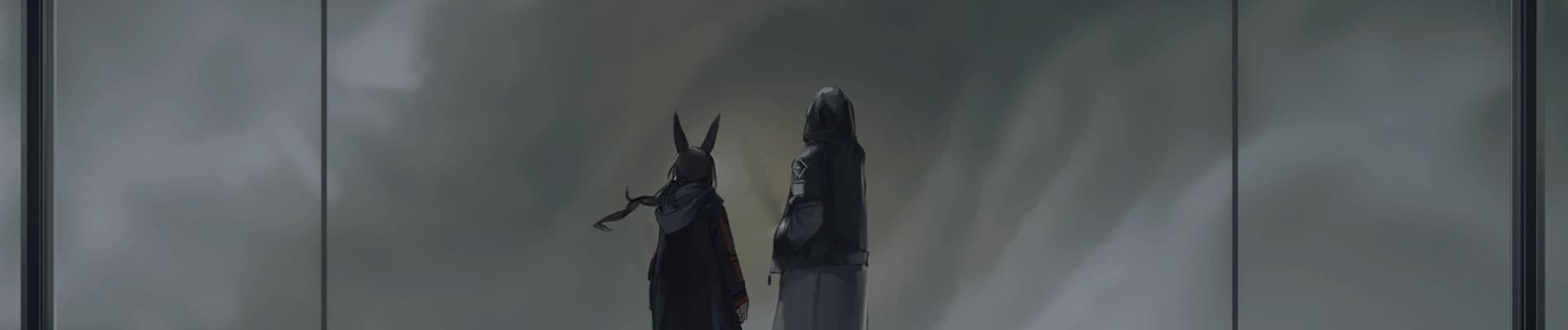


The first episode of Arknights starts with a character we don't know yet, referring to our unknown protagonist. But given a few seconds after its beginning, your appreciation for him is notorious, which can cause us a feeling of comfort and tranquility in front of those unknown characters, knowing that they are not there to hurt you.
But this feeling is soon altered when we see the change in behavior of the characters at the mention of the name Reunion, which quickly generates dislike for the group, even not knowing the background, its essence.

This is the core of these moments, first we are quickly introduced to a familiar group of the protagonist's characters who are antagonized by yet another mysterious force.
It is in this way that we are introduced to the world of Arknights during the anime, not much different from what we see in the game, despite the fact that even in this first episode, it does not raise hooks for the presentation of future characters, such as Kal'tsit who is already mentioned at the beginning. of the game at that time.
 > I must even say that all this initial rescue of the Doctor was much more busy within the game, full of battle, while in the anime it is something more rushed, but of course, unlike the game, he does not have time to waste showing occasional conflicts between Rhodes and the Reunion.
In this initial scene sequence, we see Amiya's group consciously avoiding this antagonistic group that is Reunion, the sequence is excellent, because at no point is it said that they are the antagonists, although the characterization of the group's design can bring us even more of that feeling, you know just by the way the characters behave and act towards them.
The so famous "Show, Don't Tell" inside Arknights, and I don't just mean the anime, but also inside the game, the original work, is one of the strongest elements that the writing of both mediums dominate. The work knows very well how to soften its exposure and distribute information.
It is always within the first few pages of a script, or minutes of screen time, that a reader judges a writer's skill simply by noting how he handles exposition. Of course, a well-done exposition does not guarantee a great story, just as a poorly done exposition does not guarantee a terrible story, but it does tell us whether the writer knows the art of screenwriting. Skill in exposure means making it invisible. As the story progresses, the audience absorbs everything they need to know effortlessly, even subconsciously.

See how the scenes between Amiya and the Doctor are honest and natural scenes in which human beings talk and behave honestly and naturally within each other's life situation, and at the same time that this occurs, it indirectly conveys the necessary facts to we follow the story.
Information about Reunion, Ursus, Oripatia, Originum, Chernoborg. Even the off-screen moments, where advertisements are cut, there are descriptions that provide even more information for those who are more attentive. The anime uses the most subtle means for its information, it obviously requires the viewers' attention to what is being told.

Exposure is not something you leave out of a script or want to avoid altogether, exposure is necessary for the audience to place themselves in the world in which the work takes place and gain information as well as the characters.
Whether an exhibition is demerit or merit depends on the subtlety with which it is worked. Again the famous saying “Show, Don't Tell” is the key. Never force words into the characters' mouths to tell the audience about the world, history, or people. It is very important to observe the entire scene in order to evaluate an exhibition. No matter what the work is, it will always have several exhibitions in its composition, those who observe the exhibition and criticize it for existing are those who don't understand anything they are claiming to know, you can ignore them.

Our protagonist, Doctor, who refers to our character within the mobile game, suffers from amnesia. And with that quick notion and realizing that the game is about a fantasy world, many could see this as just a cliché plot device so that the writer can do his worldbuilding more naturally. This plot device is not uncommon and closely resembles the plot device Isekai use.
But that's what I usually say in all my reviews, there are no inherently bad elements in writing, it all depends on how these elements will be worked on. And the case of the protagonist's amnesia is an important element for the character and for the plot, it contains an important dramatization for the whole course of the story, far from being just another lazy artifice of writers to build the world. Although this drama is present, it is more observable later in the game.
 > Much of this dramatization made up of the Doctor's memoirs is thanks to characters who knew him in the past, such as Kal'tsit, W, etc.
I like the introduction to the world that Arknights: Prelude of Dawn provides.
Initially we already have a whole suspense / mystery in relation to the protagonist himself, Amiya and her group, a possible antagonistic force known as Reunion.
What most entices you into the world of Arknights, in the first few minutes, is easily the mystery of basically "WHAT THE HELL IS HAPPENING??"
Mystery means gaining interest through curiosity alone.
We are caught by the mystery of wanting to understand the situation and therefore we are filled with curiosity about it, and because of this we are anxious for more and more information to understand all that complex world. But the work does the job of continuing to instigate us by giving us little information in a subtle way several times.

The issue of the Doctor's amnesia at the beginning is not even used to expose the other characters and the world, it is used to leverage the character and try to bring him some identity, which will later be dramatized within the story. Of course it is also an information control device, it is thanks to this element that Amiya and Dobermaan from the beginning inform us about the most diverse possible issues, with the most obvious exposition being at the end of the first episode, which ends with it. closing a gap of several open ones, wanting us to look forward to the next episode.

Including this is the first facet we see of McGuffin in the work, who is just a plot device that appears in the form of some goal, desired object, or other motivator that the protagonist pursues. In this case, helping to cure the infected, but this is just the tip of the iceberg, since Rhodes' real objective is to end the root of any and all conflicts, that is, to end the spiral of hatred in the world..

The world that Arknights is certainly a sad, dark, incurable, and hate-filled world, not unlike our world in hindsight. Immediately when we wake up in the Doctor's point of view, we are immediately thrown into the dark and colorless atmosphere. The anime has an excellent setting, and as we are dealing with audio visual material, this setting must be taken into account, because it also provides us, the viewers, with information.
And in this world, those who, by chance in life, were infected by a disease become targets of various organizations, governments and others. Their lives were taken not by the disease, but by the way the world sees it, the lie this world believes is that everyone infected is a mistake, and because of this lie, conflicts, wars and monsters are created.

Those we once judged as antagonists are those who previously had their voices silenced and were oppressed, and from the fire of hatred they cultivated through their suffering, they came together for a cause.
The oppressed have a reason to fight, and that moves them forward, what was given to them will be returned, this is the beginning of a war, and only one question remains, is it possible to change those who have already entered this fight head on ? Or rather, is it possible to change this world? This is the question the story wants to answer, its central theme.
Remember I said Mystery means gaining interest through curiosity alone. Suspense, on the other hand, combines curiosity and concern. During a suspense, the characters and we, the audience, move together throughout the narrative, sharing the same knowledge.
Seeing as the characters question the strange actions of the Ursus government, prompting them not to move to help the city of Chernoborg is odd. The work gives a good emphasis on these issues that only increase until the big reveal, but that will only happen in future arcs. Here the work only does the job of presenting these questions and trying to make the viewer think and feel curious about the answer.

In addition to observing how the Ursus media makes a point of lying about the events that are taking place in the city of Chernoborg, in addition to the questions about the infected, we can observe even more of the alienation present in that population and how it is constantly controlled by the government.

Seeing the Doctor being more proactive is a good move within the story, since there is a big media difference between an anime and a Gacha, where the gacha is much more expository because of the format itself, but here we see the Doctor interesting and showing interest in the subjects that make the characters ends up giving us the information. This makes the exposure more subtle.

The expressionism in the features of the characters. Arknights never lacked an excellent story or a good narrative to drive it, in the original, what it lacks most is a visual problem. The characters have almost no expressions, the visual effects are also non-existent. So everything becomes very empty and emotionless, which just detracts from the whole script effort.
An example would be the character saying: "STOP THAT REUNION, HATE WON'T GET ANYTHING!!"
The character screaming trying to convince the other, but his face is like this: '-'
And just to be clear, I'm only referring to this initial arc of the Arknights game, later the game started to invest more in sprites and effects.
Having said all that, it's great to see the characters' expressions and see how they are everything we imagined reading the game's dialogues.


It's obvious why Dobermann has this line, she herself calls Talulah a tyrant within the game, but there's a lot more dialogue than just that. This is unfortunately one of the problems I see within the adaptation, I don't think it gets in the way of the main story line, but it makes it less profound than it should be.


That is, cutting some dialogues for me slightly reduced the whole weight of the plot and this in several moments of the anime.
Honestly, the series lacked much more seriousness to work on everything that the gacha itself proposes to present, I found the rest of the episode's dialogues very shallow and there was a lack of other important dynamics for the characters
See how Misha insists here that Amiya hears the cries of the Reunion infected, something that unfortunately did not happen in the anime.

We didn't get any tension with Skullshatter's appearance, let alone hear an impact of his presence in the scene, at least you'd think he's set apart by his clothes, but nothing major. Which is even funny, because Talulah's presentation in the anime makes you jump out of your chair and tremble in fear of her.

It's sad because even the opening chapters of Arknights aren't the best things, but they manage to convey the tension of the antagonist's presence. Unfortunately, we didn't even have the visual parallel of the character meeting Misha.

I'm comparing the pros and cons of the adaptation, but I see that what I'm scoring is not just the media differences of each one, but their successes and mistakes within the script itself.
For me, the most serious problem in the series was the outsourcing of some episodes, after episode 3, we can see an inconsistency in the characters' traits, this can be mainly seen in episode 4, where this is even more obvious.


Despite the problems I mentioned, Arknights: Prelude Of Dawn manages to be an adaptation made with a lot of love and care for the fans. All elements of the Arknights story, to whatever degree they are, manage to be present there. Since the first EP, the anime has chosen to maintain the setting and reality that is present in the story of the original, a tragic, cold and incurable world.
They kept alive the vision of this world and how people live in it, making it clear that neither Reunion nor Rhodes can be defined as good or evil, after all both have the same goals.
The name of the work has two meanings, in its native language, Chinese, the translation of the name of the game would be something like "ark of tomorrow", while the overall title would be at its beginnings "Arch Knights", but for a better phonetic sense was changed to "Arknights". The ark mentioned in both titles refers to Rhodes Island, a giant vessel that accepts all types of people and seeks to solve the problems of this world in a permanent way, this being an analogy to Noah's ark, a hope in this devastated world of that one day they will be able to recreate it as a better place. After all, that's what the story is about above all, about the hope that can be found in such a dark and sordid world, a story about idealism.

I'm not here to say what the work says or doesn't say, after all, if you haven't noticed, or haven't paid attention, that's not my business.
My objective here was just to summarize the execution of the narrative and demonstrate that it has content and more.
But if for some reason you really don't get it, just read the anime's opening lyrics. Reona did an excellent job there, where she is a fan of the game herself.
I can't afford to give this adaptation a higher rating, not just because of its problems, but because this is the lowest and weakest point of the Arknights story. So although I found the adaptation excellent, I'm afraid I'll have to wait for the continuation of the anime, where the whole Arknights scenario will finally show up.

I am not used to reviewing or analyzing within AniList, for those who want to see more of what I analyze, I have my card on my profile, where you can access my other social networks and enter my Medium, where I wrote a text analyzing Ch'en and Talulah's character arc.
But be warned that the texts will be in Portuguese, after all it is my native language, but it is still possible to use the translator to read and so I recommend it.
Until the next day.
The road is still long.
Because we still have things we need to do. It will be so, until the day we are done." - Ch'en_
__