Macross Plus
a review by bonnorcott
a review by bonnorcott
It’s impossible for me to talk about any Macross entry without comment on its use and portrayal of music. Every single part of the series expands on some aspect of the original’s shockingly nuanced attitudes towards music as an art form and cultural touchstone. In Plus, this is achieved through a contrast between the music of Sharon Apple and the non-diegetic themes of our main human cast. In Macross, music is always an overwhelmingly powerful influential force, but one whose ethical use is always policed by the narrative. Sharon’s music is an irregularity in the canon of Macross, consisting primarily of electronic instrumentation and heavily processed vocals. Her performance is strange to match, mixing imagery of a holographic singer with more abstract depiction of the music, all in stark contrast to Minmay’s stage performances and traditional recordings. There’s a clear moral dilemma presented by this performance, a question of whether or not this kind of singer is natural, or even ethical. We’re presented with a look behind the curtain as we find out that Myung operates Sharon, and, while Sharon initially seems to have adoring fans, her audience in the concert seems almost unsettled at times, utterly enraptured but not cheering or singing along. The show wants to draw attention to this lack of participation, and how the experience is not a communal one, but one where all attention is on the alien allure of this spectacle. This suspicion is entirely justified when Sharon’s music becomes a literal tool of hypnosis later on, and forces the masses to listen to her song, purely for the purpose of manipulation. This music exists as a perversion of the emotions Sharon was exposed to from Myung, and only used to advance her own selfish desires. In the canon of Macross, music used as a tool of manipulation or control only begets violence. Minmay’s songs in SDF, initially a symbol of unity on the Macross and a revelation to the Zentradi, were misused by Earth’s military when the culture shock experienced by the Zentradi was exploited to wipe them out in the war. This misuse led to further violence between the two races, and ultimately a failure to colonise in the way that the UN wanted. In a similar way, Sharon was destined to fall in this narrative, as her music represented nothing but self-interested manipulation.
In stark contrast to this is the way in which Isamu and Guld’s conflict is scored, along with Myung’s theme and the credits theme of the OVA. Every dogfight is accompanied by bombastic pieces played by a symphony orchestra, completely lacking in the synthesised elements used in Sharon’s music. In short, every human in the series is scored with more human textures, creating a dichotomy with the “artificiality” of Sharon. The credits theme “After in the Dark” is also unique in this show, sung partially in English and partially in Zentradi, and with the audible cheers of a huge audience behind it. All three of these aspects represent what music “should be” in the world of Macross, a symbol of unity between the races it brought together, and an expression of ecstasy for huge groups of people, shouting and singing in unison. See Macross 7 for how this series throughline is explored even further! Myung’s main theme is a rearrangement of Myung’s in-universe song, “Voices”, a relic of the time when she had a public passion for singing while friends with Isamu and Guld in high school. Two versions of this song appear in the show, one accompanied by synthesised backing, and one with an acoustic backing. The former shows how Myung now hides her passion behind the persona of Sharon Apple, a real human voice behind the digital avatar, but towards the end, Myung learns to better accept this part of her past, and a version plays accompanied by live instruments. A vital part of Myung’s growth is acknowledging this passion, and singing for herself rather than behind a public mask, similar to Minmay’s eventual character growth.
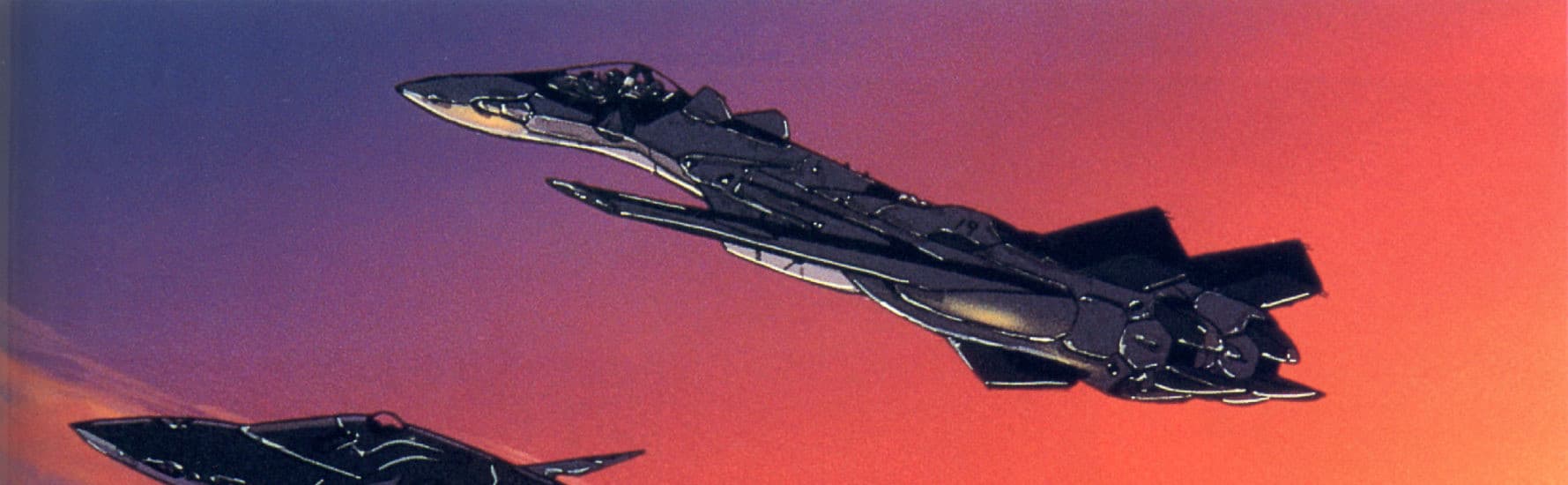
Plus deals primarily with the Earth left behind after SDF Macross, peaceful coexistence is long established with the Zentradi race, and Macross City is developed even further into a stunning technological utopia. SDF strongly established the ability of humanity to thrive and maintain populace and development in the face of disaster, and Plus shows us how humanity has thrived in a time of peace and colonisation. Macross City is at its most visually appealing here, with glimpses into neon city life and beautiful architecture, all alongside swathes of untouched countryside dotted by windmills and clean sources of energy. If ever there was a futuristic anime setting I personally would want to live in, Macross City is likely it. Huge efforts are put into making this city feel like a true technological utopia, powered by clean energy, surrounded by untouched country, and full of detail and technological conveniences. Wisely, the series does not just leave us in some ecomodernist hole where this advancement is unequivocally a good thing, but rather we have an exploration of how this technology can be misused in the wrong hands, and an emphasis on the importance of individuals and open communication. The military see the advancement of AI technology as a potential replacement for pilots like Isamu and Guld, and through both a disaster with Sharon, and the heroism grown out of rivalry between the two pilots, they are proven wrong.
The antagonism between Isamu and Guld is a key part of the show and its relation to the previous Macross entry. In a world post-SDF, a hotshot pilot like Isamu isn’t regarded as a necessary or desired by the military, with Guld’s usually calm disposition seeming to surpass Isamu. Plus presents us with something new in Macross, a Zentradi character actively striving to maintain a rational and collected demeanour, knowing that humans still hold a bias against his race for their warlike origins and background. As such, Guld actively represses his anger at Isamu over a jealous assault towards Myung from their youth. This clear suppression of emotions sets up the final reveal that Guld was the one who assaulted Myung, and buried the memory out of shame for succumbing to rage and attacking a friend. He assigned the blame instead to the ostensibly “immature” and impetuous Isamu. This ties these characters’ dynamic to a theme present in SDF, that of “failed maturity”. Where Misa and Hikaru represented teenagers attempting and failing to form adult relationships, Plus gives us a cast of adults who can’t let go of childish memories of the past. Isamu and Myung kept the truth from Guld for years, while the memory simmered under the surface, even when apart for years. The show wants to express that this isn’t the adult relationship the three think they’ve achieved, but one that leads to rage and violence, and in this case even spawned the malevolence within Sharon Apple. These issues could only be solved by honest discussion, and none open up until Isamu and Guld are faced with death. Their endless posturing and aggression makes them childish regardless of age. Similarly, Myung abandoned singing as just another misguided childhood dream, without realising the real power behind her singing. Again, her attempts to be more mature actually prevented her from growing.
The last thing to add here is an acknowledgement that Plus stands alone in many respects among the sequels, something that can likely be attributed to a very new creative team leading this project, one that would go on from here to gain a hugely widespread reputation on other projects. Macross Plus is the directorial debut of Shinichirou Watanabe, as well as the first anime he worked on with Keiko Nobumoto as scriptwriter, and Yoko Kanno as composer. This is the same team that would go on to work in the same roles on Cowboy Bebop and Wolf’s Rain, among other works attributed to Watanabe, and Plus is the genesis of their work together. This is also the first anime Kanno composed alongside vocalist Mai Yamane, who appears on many of her later soundtracks. Plus is an incredible achievement for this team’s first effort, and in my opinion a vital piece to watch for fans of their other work.
33.5 out of 35 users liked this review
