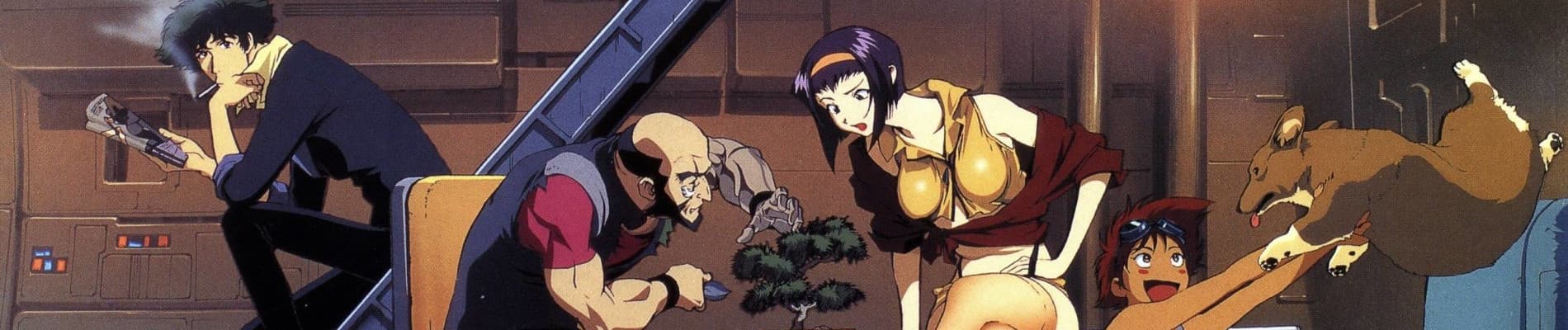
Cowboy Bebop
a review by Calxylian
a review by Calxylian
Take anything about pop culture and western media and audiences will find Cowboy Bebop. It is a series that is difficult to criticize, not because it doesn't have its flaws. However, the series has rabid fans who will continue to defend it until the world ends. It borrows automatically a defense from all kinds of legitimate criticism and is of good quality but relevant in how it influenced western cultural perceptions of anime.
However, it is not enough to revolutionize the audiovisual argument as a breakthrough. When work needs more than superficial qualities to be truly great, then, by and large, the series will provide subtle yet voluminous references and homages. The gun-fu of John Woo, film noir ala The Third Man, the setting of Blade Runner, the gangster colorful tone of Tokyo Drifter, people can call it anything.
The list is still a lot of references either from dialogue or character design. However, it directly copies the plot to the scene to the point of contradicting the series itself. When you see the series packaged in a complete but beautiful package, there is no excuse when creativity is lacking. Generating a masterpiece doesn't produce a masterpiece with Tarantino-style reference examples, it simply doesn't make up the whole of videography.
In fact, Cowboy Bebop is both substance and style, and while the audiovisual is highly regarded, it takes more than anything to become a true masterpiece. While having some of the must-watch audiovisuals for that alone, it's worth noting that the series is one of the few anime that has a level gap, especially in American audiences. In Japan itself, it has its own advantages. However, it differs in almost every different setting, it is well done in most space travel anime.
The series consists of individual stories, not a big deal but there are specific hit or miss. Non-mainstream episodes focus on each character and past characters is good. However, most of every character is practically useless. By considering how each character drives each story, the whole episode, for such one, pays tribute to many tropes. Seeing tropes presented more originally, at least, first impressions from novice viewers are a big problem when only watching the first three episodes. The exposition in such a thing becomes a part of itself but people always ignore it.
Each character prevents the episodic nature of the event in a specific part. Regardless can be a total failure, there is a question in the hole for every character. For example, Faye's past, which is still unclear to the audience, only gives rise to oddities that are unheard of. As is clear, all have rich backscreens but not a few flashbacks present.
Helping to give the series a distinctly nostalgic mood, the motivations, especially of the antagonists are also not the least bit obscure but uninteresting. After all, Cowboy Bebop is all about vibing with it. It is emphasized even more the sound quality that the series uses. It differs from other anime series mainly when it comes to the opening by Seatbelts, a band specially formed to perform music for the series.
The music is a mix of classic rock and jazz, apart from in the first place acts as an odd choice for a sci-fi series. The music works so well in the setting as it reflects the general lackadaisical demeanor that each character adopts.
Cowboy Bebop isn't just a western sci-fi anime with equal seriousness and humor. It has been regarded by many in the anime community as a classic, despite the level of sophistication in both the story and its rare characters that makes it, unlike most modern anime. By being proof that its quality is one of the foremost, it is considered by many as one of the most watched contemporary recommendations whether anime fans themselves or not.
32.5 out of 35 users liked this review
