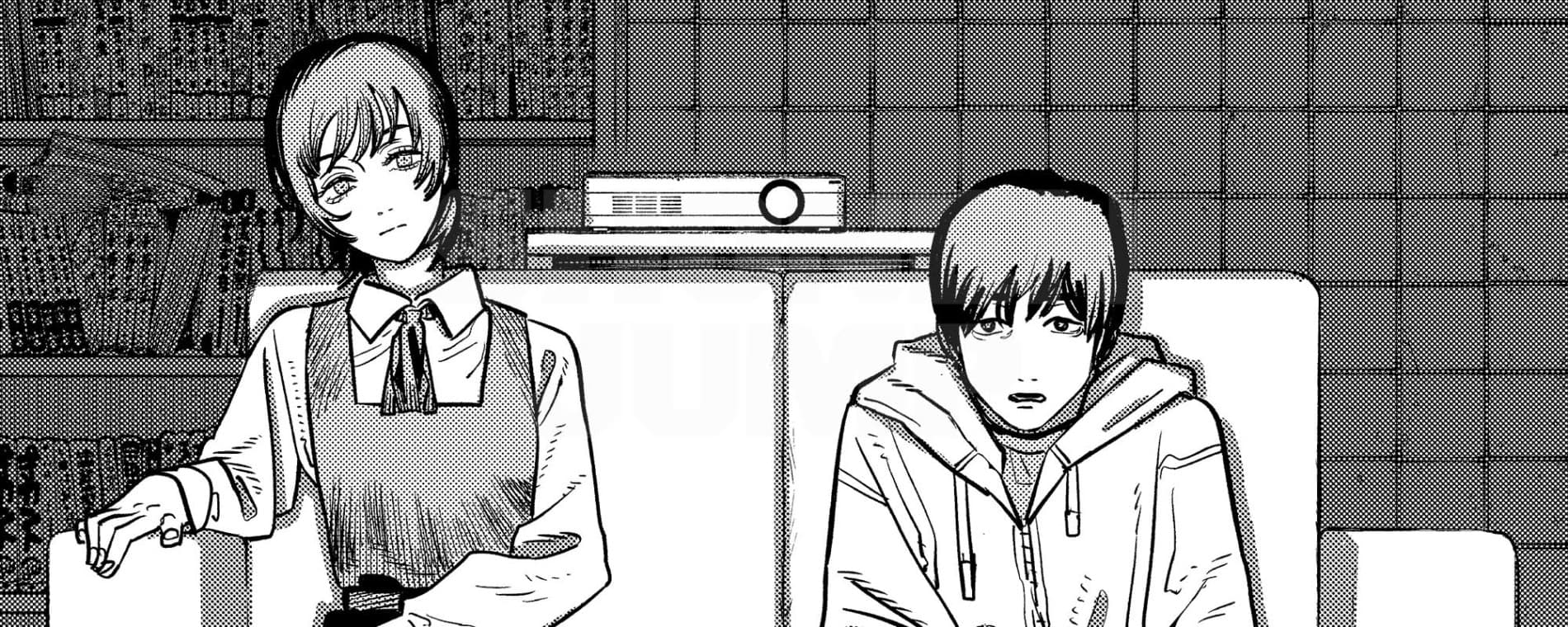
Goodbye, Eri
a review by Struggler125
a review by Struggler125
Spoilers for the entirety of Sayonara Eri and some major spoiler for Chi no Wadachi that is appriopriately marked. I highly recommend to read this text after experiencing Sayonari Eri for yourself.
On one chilly evening, I was in a sour mood. No real reason behind it, just a feeling of melancholy. Maybe it had to do with me having recently moved from my hometown. In moments like these I like to take a walk. It helps me think, and oftentimes lets me clear my head. And on that particular evening, led by a sequence of thoughts I couldn’t possibly explain, I decided to read Sayonara Eri by Tatsumaki Fujimoto. Familiar with the author’s other great creations, namely Chainsaw Man and Fire Punch, I’ve had some idea what I was getting myself into. To be honest, I expected it would be something to remember, as Chainsaw Man was definitely that, but I could’ve never expected such a short manga to have this much of an impact on me. The story starts off with a simple, yet pretty bleak premise. Yuta Ito, the protagonist, is asked by his mother to record her final moments, as she is dying of a terminal illness. Though not really keen on the idea, he honors her wish, makes a movie… and then an explosion happens. That’s the start of this manga. I read it in one sitting, absolutely immersed.

So here I’ll briefly go over the plot - give a recap of sorts to help you better understand what I’m going to say later. Here we go.
Right after the explosion, the movie and Yuta himself gets laughed off by everyone. For him, this was the last straw. Losing all hope, he decides to kill himself jumping from the same hospital his mother died in. Leaving his final message for his father, he makes his way to the rooftop. At the very last moment, he is stopped by a girl named Eri who, after realizing he’s the creator of the movie, immediately takes him to an abandoned building to watch a bunch of movies. Little by little we get to understand her reasons. She’s apparently the only fan of his movie which made her quite upset and embarrassed. She wants Yuta to make another movie, much better than the previous one, a movie that will make everyone bawl their eyes out, to get a revenge of sorts. For that he needs to watch lots and lots of movies to get the hang of what makes a movie great. She is eager to help and offers her guidance in the process. Here starts their friendship. In the next part of the story we see how they spend their time together watching movies and getting to know each other. We learn of some of their quirks, their likes and dislikes and so on. It’s short & sweet and provides welcomed characterization. After some time passes, Yuta comes up with a movie idea. He’s basically going to tell his own story up until now adding a pinch of fantasy to it (and oh yes we're gonna talk about that in more detail). In this version Eri’s a vampire who asked him to shoot the movie because she wants to be in it to not be forgotten. Yet again some time passes and during a casual conversation Eri’s loses consciousness. After that it is made known to us that Eri’s time is also at its end, which was heavily implied by her being at the hospital and her overall portrayal. She requests Yuta to do the same thing his mother asked of him. He is livid, he doesn’t want to, because he knows the pain bound to something like that. But after talking with his father he yields and agrees to film Eri’s request. And so, with Eri’s final moments, we also see the ending of his new movie. This time the room was flooded with tears. A bitter victory.
After that we experience a long time skip. Yuta himself gives a recap of his life after making the movie. He basically never really got over Eri’s death and spent countless hours recutting the footage. He became secluded, dropped out of college, got a job and finally met his future wife and started a family. But he never stopped tinkering with the footage. By his own admission he was happy with his life and wouldn’t mind dying tomorrow. Until another tragedy came upon him. In a tragic accident his whole family ends up dead. Being at a crossroad, he once again decides to end his life in a place he holds dear. Where he and Eri watched movies together. And just like at the beginning, right before his suicide, Eri saves him yet again. Oh yes, she’s alive, it seems (we will also talk about this later). She was indeed a vampire who after death was reborn in a new body, with her memories wiped clean. She helps him understand something very important and yet again saves his life. Content and filled with newly found determination he walks away, leaving only an explosion behind him…
Now, we have a lot to unpack here. But let’s start at the beginning.
One thing that quickly became clear to me is just how much I’ve felt the western influence in this manga. Most of it comes from the author’s passion for cinema, you can feel it permeating most of his work. If Araki Hirohiko uses western music in his work, Fujimoto uses cinema in his. Chainsaw man had many direct movie references and a whole chapter dedicated to going to the cinema. In Fire Punch an important character shoots the protagonist’s journey to make a movie out of it. In Sayonara Eri, cinema and movies are integral to the plot. Not only does this manga use movies and movie making as a way of storytelling, but what we are reading is, in itself- a movie in the making. Fujimoto uses this concept to play with framing and presenting the events in original ways. He himself seems to be a director of his own work, deliberately choosing specific fragments of characters' lives to show or withhold from the audience.
As I mentioned before, one thing that absolutely stands out is how Fujimoto seamlessly mixes standard manga panels with the illusion of camera work. The usage of distortions, blurs, repeated panels, and POVs makes you feel like you’re watching a movie. Distortions are a clever way of portraying Yuta’s negative emotions. Black backgrounds indicate the passage of time. Repeated panels allow for the building of tension and to portray complex emotions. Sometimes scenes are presented as if filmed by a hidden camera, giving the sense of being an uninvited observer. All of that combined with a very clean and detailed artwork comes together to create a visual treat.


Mix that with Yuta’s warped perception of reality caused by his psychological problems and you have a plot setup the author could twist any way he wanted. Which he did, repeatedly.
Choosing how we perceive things is, in fact, a major theme in the manga. Specifically other people. How we see others is merely a fraction of their entire selves. Robert Greene, one of my favorite authors, in his books says to view people as if they were a whole new world, waiting to be explored. Eri represents this idea fully. We only know her as she is shown in Yuta’s movie. She is beautiful, easygoing and is passionate about movies. She can sometimes be crude, but in a playful way. In Yuta’s eyes, she was the one that saved his life. Gave him a reason to go on living. For him, she was someone special. And through him, that’s also how we, the audience, perceive her.


And that is why the short exchange between Yuta and his classmate after her death was so thought provoking. She, on the other hand, focused on wholly different sides of her. In her eyes she was someone who’s hard to get along with, self-absorbed and to be honest, a little of a bitch. She wore glasses, had dental retainers and wasn’t really that good looking. She kept to herself, and didn’t have any real friends. In that manner, one person can be perceived in an infinite amount of ways depending on who you ask. And that got me thinking. I will never know the real Eri. Only the version of her shown to me by someone else. You could say “hey, but that’s every character ever created”. And I would mostly agree, but in this situation the emphasis is made even stronger by the story being presented as a movie made by a single person. In most cases we see the characters from all angles, their good and bad sides. Nobody’s trying to tell us what to think of a character. Here we only see what Yuta wanted to see himself. Would I like Eri through my eyes only? I will never know.


And with that being said, we can now talk about Yuta’s mother. As I mentioned, Yuta has serious mental problems. His suicide attempt was more than enough to know that. But why did he want to kill himself? Was it because his mother died? Well that is obviously the reason I had in mind when I began reading the manga. He has shown us in his movie what great of a mother she was. How much she meant to him. But that’s all that was shown to me at the time. From a skewed perspective of an abused child. He couldn’t handle the cruel reality so with his camera he created his own. A reality in which he had a perfectly normal and happy life; and with his mother’s death - a perfectly good excuse to kill himself. It’s not so much that he had a reason to die, just that he lost his reason to live. In a very twisted way his mother, through a mix of love and abuse made him dependent on her - became his life. A very similar situation happens in another great manga, Chi no Wadachi by Oshimi Shuuzou.

In many stories the death of a close family member is often used as a cheap way of tugging at the heartstrings. It is used precisely because it doesn’t take much skill to pull off and is effective. It takes advantage of our natural instincts. But to use this method as a crutch for something even better? Well that just takes real talent. All of this made the reveal that his mother was abusive feel like a powerful gut punch. I was feeling sorry for Yuta, but after the reveal, for some time I did not know what to feel. And then I realized that the death of his mother was what would ultimately set him on a path to a better life.
This was something I’ve never experienced before. It’s not the only example of the author instilling certain emotions in me. From serene and lethargic scenes of watching movies, to moments of despair and hopelessness, to utter shock caused by carefully crafted twists. His ability to portray everyday events as beautiful and captivating is superb.
Because of those swift changes in tone, you can never really know what will happen, or even what really happen-ed. That concept became more than clear to me when I heard the mother’s last words. From then on I couldn’t be sure how things really are. It keeps you guessing, trying to understand what’s real and what’s not, which definitely plays its part in the ending, about which we will talk later.
Coming back to Yuta’s psychological issues. It is never brought up, nor does it need to be. Fujimoto does god’s work portraying complex emotions with his breathtaking artwork. The range of character’s emotions is praise worthy. Just from looking most of the time I was able to know how someone was feeling. It’s simply amazing having panels upon panels of no dialog yet having the story pushed forward. That’s visual storytelling at its finest.

You know of the “show, don’t tell” rule, don’t you? You’ve probably seen your share of manga where walls of text tire you eyes with needles exposition, or outright telling you what is happening. That is a cardinal sin of any story… and it just makes me sad. And the reason for that is it is simply in no way stimulating. It doesn’t leave any room for imagination, speculation or wonder. I for one enjoy the stories that are left open for interpretation. Or at least allow a little of it. A story where each person can have different takeaways. For me one indication of a good fiction is the fact that I have to work my way up to understand it. But such a story is hard to make, as it requires careful placement of crumbs for you to follow and be able to piece together cohesively. Here the little crumbs are laid thick for picking. On my rereads I’ve noticed many little things: his uncertainty about the death of his mother, that he didn’t really know what to feel about it, his painful expression, a scratch on his arm, which I am more than sure was him cutting himself, his fixation on stray cats. Eri’s peace gesture made by Yuta as the audience was crying over his film. How the pinch of fantasy idea was placed in the dialogue a few times. Eri herself commented on how his movie blurred the line between fact and fiction. The ending itself is spoiled by Yuta himself. The story sometimes feels like a prophecy going towards a predestined end but in a way you would least expect.
Another thing worth mentioning is how the author is successfully playing with your expectations. When I first set my eyes on Eri, I instantly knew she would be what I like to call "the dying girl" trope. A character whose sole purpose is to help the protagonist realize something about himself or his life. Set him on the right path, so to speak. And while this is exactly what happens in the end, the way it happened is unorthodox, to say the least. What I mean is that I enjoyed the parallel between Eri and Yuta’s mother. His mother’s death made him give up, while Eri’s eventually helped him go on living. Right at the beginning, and right at the end, even if the second time she could be just a figment of his imagination. Usually it’s the death itself that really changes the protagonist, but here yet again it just serves as a step-up for the real deal.
Now, let’s talk about the ending. Imagine me clasping and rubbing my hands profusely as I write this. Because the ending is a culmination of everything that has happened till now.
One thing I realized after finishing the manga is how the explosion at the start really set the tone for the rest of the story. When I saw the absolute bafflement on the audience's faces I laughed because I was feeling exactly the same. That’s not the only good thing about it, though. It’s a representation of Yuta’s way of dealing with life. It’s high time I talk about one of my favorite concepts in the manga: “the pinch of fantasy”.

Something integral to the story as well as the ending itself. As I mentioned at the beginning, the explosion instantly caught my attention and made me want to know how the story would unfold. I mean, with something like that at the very beginning, you can expect pretty much anything afterwards. And that's one example of the “pinch of fantasy”. How sprinkling it at the very top can immensely enhance a story. And in the same spirit, life itself. The same way I read this manga to enrich my life, the same way Yuta uses it to cope with his. So why in his movie did he present his mother as a good one? Because this twisted version of reality is the one he wants to be true. And the explosion at the end of the movie might just be his admission that he doesn’t believe it himself. Just as he said it himself. He was angry. He was angry he couldn’t face his mother one final time. He didn't want to accept reality so he just ran from it.
And at the end the opposite happens. Here the explosion symbolizes acceptance. Willingness to move on. Now he finally comes to terms with himself. He chooses to let this pinch of fantasy into his own life. To guide him through hardships. And with a smile on his face he walks away from the explosion that yet again marks a new beginning. And maybe throughout our lives a pinch of fantasy is all we need to keep us going.
But was all of that even real? Was Eri really alive? If her memories were wiped clean, how did she know about the pinch of fantasy thing? Was it mentioned in the movie he made? What’s the significance behind the explosion? All of these are the questions I had after reading. And I think it was meant to be this way. I can only speculate, and that’s exactly what I’m going to do. Just like I said at the beginning, we can’t really trust Yuta as a narrator. He has his issues and he could be just projecting what he wants to see. This would be a logical conclusion for his pinch of fantasy fixation. Throughout his life he added bits and pieces of it to help him cope. Here he could be cranking it up to 11 which results in full on hallucination. He himself came up with the idea that Eri would be a vampire in his movie. So perhaps after countless hours dedicated to recutting it he eventually persuaded himself into believing it.

Because then Eri would still be alive and well. I mean, we are talking about a man literally at the end of his rope. His instincts are kicking in and he’s finding a way to reason for his own survival. Just as he looks at his imminent end he hears the exact line he said right before meeting Eri for the first time. “This world is filled with death”. And just then he sees her. The same Eri he met all these years ago. They talk. She makes him realize the one thing that changes his entire perspective. And something that gave me chills at the very end is how he looked at her while saying goodbye. In my mind this is the definitive proof he knows she’s not real. Just look at that face.

But that’s the whole beauty of it. I think that Eri wasn’t a vampire. You could very well think the opposite. The way we ultimately decide to perceive and remember things is in our hands only.
Here, at the very end I just wanted to share some other thoughts I had.
To be honest, if I wanted to I could go on and on about this manga. For being such a short story, it’s just this filled with value. At the same time I know that sometimes the less said the better. I hope that what you just read gave you some new insight into this masterpiece. Writing this text surely gave some to me. And maybe for a long time I will not come across another story of such splendor, but I’ll be fine, because I have this manga.
27 out of 28 users liked this review
