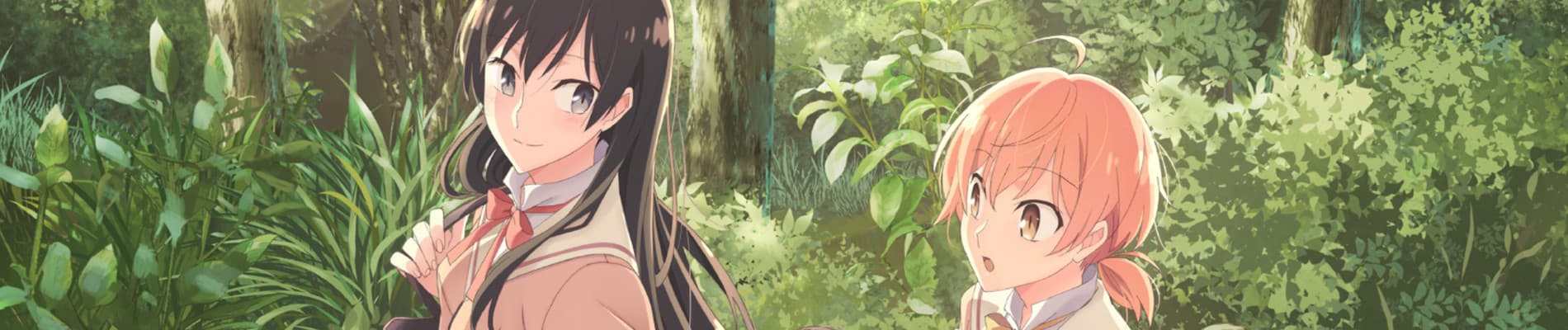
Bloom Into You
a review by RebelPanda
a review by RebelPanda
Bloom Into You is not a romance. Rather, it is a love story about self-realization.
The series follows the titular late bloomer, Yuu Koito, a girl who has never felt love before. Since she was young, she dreamed of falling in love, romanticizing the day when it would happen. Expecting to be swept off her feet, eventually. But that day has never come. Even when someone confesses to her, she feels nothing. This has kept her from fully connecting to her friends and peers. They are far more understanding of what they want romantically. She was alone until she met Tokou Nanami. A girl who had also never experienced love until she met Yuu.
To Yuu’s surprise, Touko suddenly confesses to her. While she does not reciprocate due to her inability to love, she allows Touko to be in love with her. The one condition Touko sets for Yuu is to never love her back. From here on, the tale of self-discovery begins, as each character learns from the other about who they are. At the start of the show, Yuu seems like your typical blank slate protagonist devoid of the ability to love but look further. You’ll see her personality is surprisingly realistic. Yuu is the type of person who cares for others deeply but masks it beneath a veneer of logic and normalcy. She possesses many of the telltale signs of sexual repression. Her loneliness and lack of romantic feelings are just a few examples. Throughout the show, we see her pushing through boundaries she would have previously avoided, gaining more control of her life, reflecting on who she is, and gaining a better understanding of her own identity. This is why labeling Bloom Into You as a romance would be only half true; while it features people in love, it is more complicated than that. Before Yuu can love, she has to face the realization of what she wants, who she is.
Without a doubt, Bloom Into You depicts homosexual youth more realistically than I have seen in any anime before. Highlighting even the most minuscule details that only someone who has experienced firsthand can convey believably. For example, in the first episode, Yuu’s father lets slide a casually homophobic comment about worrying that she isn’t in a relationship with someone of the same sex. After this line comes, the director smash cuts to Yuu in dismay at what he said. The tone sharply changes from moment to moment to great success because of the subtlety to which it is executed.
In comparison to Yuu, Touko is rather different because she knows exactly what she wants and would die before she relinquishes her purpose. Touko wants to love Yuu because she can be vulnerable with her. She wants desperately for Yuu to always be there to comfort her. However, she can’t stand the thought of being loved in return by Yuu because of her own insecurities. Throughout the series, we see her personality pulled apart and analyzed thoroughly. She is rather basic upon first impression, but look further, and there is far more to her than meets the eye. If Yuu were to love her, she would be conflicted because, in her mind, she can’t possibly be loved. She endures an upsetting conflict, but it is incredibly effective in engaging anyone who has experienced similar insecurities.
Overall, these story beats are delivered with an impressive amount of grace and panache. The dialogue feels natural; Yuu’s interactions with her friends are realistic and believable. Most of all, the supporting characters are consistent. They don’t have random lapses in their personalities, and if anything changes, there’s an explanation for it in their lives. For example, suppose a character is acting awkward towards the suggestion of seeing a romance movie. In that case, it’s because they had their heart broken recently and needed a push to mention it to their friends. There’s a layer of depth to everyone that is far greater than what is expected of girls love and anime in general.
This is also the rare explicitly lesbian show that does not fetishize its characters at all. Touko is very clear about her romantic and physical attraction to Yuu; likewise, Yuu is very clear about her lack of ability to love. Both are treated like fully realized people instead of objects. In figuring out themselves and what they mean to each other, they run into a few issues. Nevertheless, their relationship is still built on communication, consent, and respecting boundaries. They’re a likable duo, and it’s easy to get invested in their development. For example, when the first kiss happens non-consensually, it is apologized for immediately, then it never occurs again. The author very deftly avoids, as well as subverts, the Class-S tropes negatively associated with the yuri genre.
Class-S usually refers to yuri that does not allow their characters to get into serious relationships. They are in high school and have time to play around before they marry men when they graduate. The author of Bloom Into You have said on a few occasions that this is not yuri. Instead, it is a story about girls and love. Understandably she wants to distance her story from negative connotations associated with the genre. Notably, this anime features a healthy adult lesbian relationship, showcasing that there is more to being homosexual and female outside of the scandalous high school melodrama. We also see a supporting character who faced the issue of her lesbian relationship being nullified under the pretense that ‘it’s just a phase.’ From this, she develops into a wonderfully nuanced character.
On the production side, Bloom Into You is magnificent. Beautiful visual storytelling, the storyboards convey characters’ inner emotions in engaging ways. It is very visually interesting. There are occasional breathtaking moments of sakuga, but what impresses more is the director’s keen eye for editing to clue us in onto how a character is feeling at any given moment. If emotions are obscured, it is deliberately so. If they are shown, you have to consider every little detail given to the audience. One of the best moments of visual storytelling in the first episode is when a rush of water divides Yuu from her friends; this shot perfectly conveys how her lack of understanding of herself separates her from the average teenager. Aside from just visual metaphors, how the story plays out represents the internal struggles Yuu and Touko face. The play that Touko desperately wants to enact is a tale of a woman without memories who needs to pick a desirable personality for herself, reflecting her insecurity and desire to better herself.
Punctuating each emotional beat are melancholic piano keys loudly implying the turmoils each character is enduring. Each of them is developed consistently enough for the musical accompaniment to feel very deserved. This is contrasted with melodic orchestral pieces to match the upbeat tone of scenes when characters come together and express heartwarming joy. With a talented and experienced composer like Michiru Oshima producing the soundtrack, the show’s audiovisual splendor blends wonderfully with its script.
To say that Bloom Into You took me by surprise would be an understatement. At first, its unusually realistic characters blindsided me; Yuu and Touko are superbly nuanced people. They’re lost in the dark, trying to find their way through a first relationship just as real people in their situation would. The many relevant themes this series tackles give the cast such believability and relatability unlike any other anime in this genre; self-loathing, societal expectations, homophobia, and sexual repression, to name a few. Each theme is delivered respectfully and with subtlety. In the first few episodes, the pacing is relatively slow but always purposefully so, and once it gains speed, it becomes enrapturing.
Without a doubt, Bloom Into You is the best anime I watched from this season, perhaps even the year. It is a masterfully crafted, unforgettable experience that will leave an impact on me for years to come.
58.5 out of 66 users liked this review
