Vinland Saga
a review by RebelPanda
a review by RebelPanda
There is a profound feeling to Vinland Saga. Whether or not the events depicted are entirely accurate, you are watching monumental history unfold. Although it is frustrating at times, it's gripping in the end.
Warrior's pride, loss of innocence, betrayal, and the quest for the biggest bounty: This is what it means to be a Viking in Vinland Saga. In the beginning, our hero Thorfinn was just a kid, and his immaturity is prevalent throughout the series. Slowly—and frustratingly—he grows into a man. His father, the great Viking general, Thors, raised him to be a compassionate person until his untimely death. Stay away from the path of a Viking, never kill, take care of your family. These were the values Thors taught him. When Thors was murdered right before Thorfinn's innocent eyes, none of these values mattered. Instead of growing up, Thorfinn survived his childhood by learning to kill. Years passed, and he became an angst-ridden killing machine.
Enduring the bitter frost of northern Europe was the least of his problems; he needed to prove himself on the battlefield for a chance at revenge. The power that drives him is a hunger to seek revenge against the mercenary leader, Askeladd—this is where Thorfinn shines. His perseverance in the face of impossible odds shows he has real motivation anyone can believe. Thorfinn's frustrating immaturity is intentional, but what kept me caring about his journey was his slow evolution. I told myself that even if he doesn't grow up this season, it will come. His arc is a slow one, but I don't doubt he will improve in later seasons. Thorfinn's immaturity extends to his duels with Askeladd too. He makes the same mistakes over and over. He is desperate to win, yet his anger gets the best of him. Once Thorfinn loses his temper, he waves his sword like a maniac and gives up strategy. As Askeladd points out, he is predictable. Even so, the fights are still very entertaining. Askeladd critiques his fighting techniques and gives him a purpose in life. To grow and one day murder him.
Over time, Askeladd becomes the closest thing Thorfinn has to a father. Witnessing their complicated duality throughout the show is genuinely intriguing. I'll admit it was quite frustrating to see Thorfinn try to kill Askeladd in duels, yet he was always eager to save his life during battles. It allowed their relationship to be dragged on for as long as possible, hindering Thorfinn's growth. Thankfully, Askeladd more of a protagonist of this season. He is the best character by far. He leads his army of mercenaries, but there's more to him than meets the eye. He is the wild card of the cast. He has the most in-depth backstory; throughout the show, his motivations become profoundly nuanced as we learn about him. The strategies he concocts are exciting to see play out—He's a villain, but a clever one. Like Askeladd, the entire cast is from different European countries. Despite this, all of the dialogue gets voiced in Japanese. Usually, I wouldn't be bothered by this at all. It's done in movies/TV all the time. You should expect to suspend your disbelief. It would be unrealistic to expect a TV anime to use multiple languages, but it led to problems. Occasionally people need to translate different languages to form allegiances or communicate with enemies. But they're all speaking Japanese, so it comes off as awkward.
A language barrier is an integral part of war stories between different cultures. The lack of understanding for each other fuels prejudices, which sparks hatred between either side of the battlefield. Vinland Saga misses this entirely—which is hardly a knock against its high-quality production. I wish they would have hired some actors who spoke a little bit of the languages. Norsk, English, Danish, Icelandic, all absent. The script addresses this somewhat by using different Japanese dialects and honorifics between social classes. A better fix would have been to fix mix in certain words or phrases from the existing languages. The language barrier could quickly fix this minor flaw with an English dub.
There are times the violence gets so unrealistic you might mistake it as an ultraviolent schlockfest. It's far more believable than WIT Studio's other blood-soaked action anime like Attack on Titan and less ridiculous than Kabaneri of the Iron Fortress. Dozens of people get chopped in half, decapitated, and dismembered throughout the show. Some of the gore bends the fabric of reality with how absurd it gets. You shouldn't be shocked by it. Instead, you get placed in the bloodthirsty mindsets of the savage killers. Violence is commonplace to Vinland Saga. It's just as thrilling for the Vikings as it is for the audience.
When the giant warrior Thorkell the Tall decapitates five people AND takes down a ship mast with a throw of an axe, I laughed along with him. This anime is aware of how unbelievably violent Vikings were, and it leans into it—and I love it. However, it's not all fun and games. Once you realize that the hands of evil psychos carried out the action you've been enjoying—you start to question your morality too. In stark comparison to the entertaining battles is the real shock factor. Men, women, and children get mercilessly slaughtered in droves. To show a loving family for five minutes only to kill them all right after is horrible, senseless, but yet it is part of the world. At first, it seemed like shock factor, and then I realized it is true to the historical setting. The mass murders were part of history, and Vinland never shies from the truth. It's never afraid to be nihilistic—like in one instance where a sole survivor of a murdered family is left behind to hear the sounds of their kin getting slaughtered. The camera hovers around them until their final moments. Full of despair. You will remember the real lives the Vikings brutally stole. It's horrible being on the side of villains like these.
Most of the screen time in Vinland Saga is either fights, arguments, or dialogue. Politics of power struggles, contemplating morality in war, and conjuring witty strategies. When the script integrates real background information into the story, it shines. In one scene, Askeladd tortures a man while arguing that both sides of the war are savages by detailing their land's history. To prevent the plot from seeming predictable, they use plenty of paranoia-inducing foreshadowing. The script suffers from a common anime adaptation issue where characters over-explain what we can see for ourselves. Manga often describes movement with text; unfortunately, they left these lines in the adaptation. There were many times when fights would be interrupted by cross-cutting to people talking, halting the pace.
Rather than always focusing on the main characters, the script often follows various mercenaries; they discuss their past and future battles and share their opinions on other people. The slow pacing made room for a well-written script, but also for it to meander. Men would banter about heaps of money and women being the meaning of their lives. While a drunken priest would mumble about ale being his only God now. It fit the show so well; none of them had meaning in their lives other than drinking, killing, fucking, then dying a warrior's death. Then Canute entered the show. Rejected by his father, the king, he is sent to war to grow into a man or die trying. His arc writes itself, yet he's one of the most compelling characters. The Vikings mock his firm Christian values. With an earnest dream of creating world peace—spurred by his religion—I found myself rooting for him. The themes are pro-religion; the devils are the Vikings because they've forsaken God, and every Christain is innocent. Compared to the devils, the Christians get led like lambs to a slaughter. We see the story from the devils' perspective; they reject God's path and forsake him for letting horrors happen. Instead, they choose to pave their way in blood. Over time, the themes get discussed by Canute and the priest. They feel more like mouthpieces than well-rounded characters, despite their relevance to the plot. The discussions of morality in Vinland might come off as pretentious and convoluted to some viewers. The art carries much of the weight in making these ankle-deep philosophies feel profound.
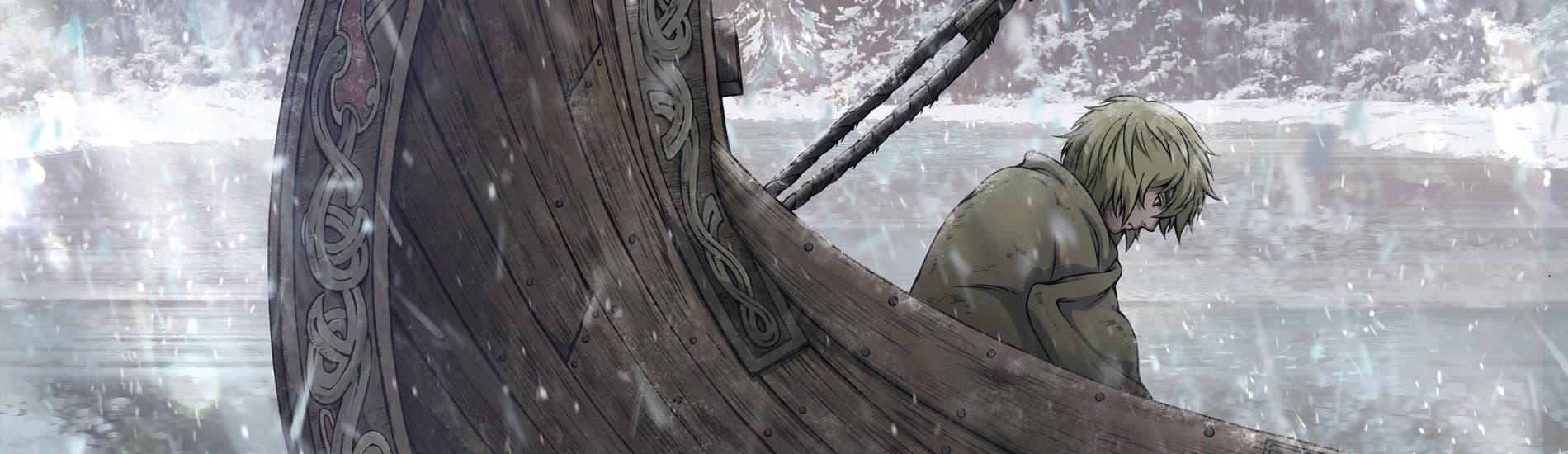
There are moments the art looks manga quality—close-ups drawn with incredible detail to emphasize severity. Deep shadows beneath wrinkles and strained muscles, showing the weathered souls of the characters. Those are the faces you will remember. There are several imaginative storyboards used to convey the conflicting motives between characters. Boundaries separate them, and trees divide them in the frame to symbolize their unspoken hatred. The radiant light of hope shines emanating from behind the compassionate people shines down on the tormented savages below; on the nose perhaps, but powerful nonetheless. The artists drew the backgrounds beautifully. Always the sky is shrouded with clouds, which is why the lighting has a cool hue. Warm red sunsets radiate beautifully just beyond the horizon through white skies, contrasted against the horrible blood splattered across the snow-covered forests redder than ripe tomatoes.
Harsh snowstorms whip across the screen; gorgeous, but sometimes distracting because the CGI weather feels disconnected from the picture. Speaking of which, Vinland's egregious use of CGI is quite unfortunate. The animators rendered cannon fodder soldiers and ships at a low framerate. It is reminiscent of the ugly art used in the schlockfest Inuyashiki—the director's previous adaptation. The use of CGI is not in vain, however. It allowed for 3D dynamic camera movements during fight scenes. Yet, the camera lingers too close to the eyes-searing CGI and for way too long. As for the music, it's okay. Nothing I would seek out on my own, even though it fits the show well. The opening songs are both light metal, closer to metalcore. I love it when anime try something different with their theme songs. As metal songs, they are fine. For WIT Studio's standards, this anime isn't entirely on the level of Attack on Titan or Kabaneri of the Iron Fortress. Thankfully, it has a stronger narrative than both.
After a full season, Vinland Saga has only just begun. If this represents what's to come, I'm thrilled to see where this story goes from here. Perhaps it moved too slowly for a lengthy prologue; nevertheless, it was engaging. With beautifully drawn artwork, a well-realized setting, and creative writing, this adaptation is impressive in many aspects. With this merely being a prologue, a sequel will be promising if it mends this season's flaws. It gets weighed down by reality-bending action sequences, a frustrating main character, cliched plotting, and redundant themes. Although it struggles along the way, it sticks the landing with a fantastic finale. Vinland Saga rises above its flaws to become an authentic piece of Eleventh Century historical fiction.
40.5 out of 46 users liked this review
