BOCCHI THE ROCK!
a review by ZNote
a review by ZNote
At the end of the first episode of Bocchi the Rock!, Kessoku Band has more or less bombed their first performance. Bocchi (née Gotou Hitori), who had been ready to announce her presence to the world as Kessoku Band’s last-minute fill-in guitarist, anxiously retreated into a mango box, hidden within it as the band lurches and stumbles their way through their music. But in the aftermath as her bandmates Nijika and Ryou remark on the atrociousness they just played, Bocchi throws the box off herself and stumbles her way down frame in a fish-eye lens style camera shot. She stands before the two and declares that she’ll muster the courage to talk to her classmates, which Nijika smiles at…and then Bocchi immediately heads out since she’s drained her socially anxious battery for the day, but still resolving to improve herself for their sakes.
▶ VideoIf any scene could encapsulate what makes Bocchi the Rock! such a creatively-rich series, it’s this. This whole sequence is but the tip of the show’s iceberg. There is a chaotic beauty in the show’s reckless abandon, able to radically swing between whatever style it chooses to adopt at any given moment. And within it all, anxiety is presented as both comedic fuel and as a sincere obstacle towards one’s sense of personal development.
But perhaps I’m getting ahead of myself, so let’s step back for a minute: headed by Saitou Keiichirou in the director’s chair, he was afforded the rare opportunity to more or less have any ideas that came to him be given the green light to work their way into the material itself. From a certain perspective, he was the perfect mind to entrust with such freedoms – with small involvement on Heike Monogatari and Wonder Egg Priority as a key animator, along with several larger credits for Sonny Boy, his 2021 was spent with some of the medium’s most artistically-interesting properties. Though each had its own distinctly visual-acoustic identity, the one thread that unifies all these projects is risk. Considering Bocchi the Rock!’s origin as a four-panel manga, he must have realized that great risks would need to be taken to make this project work in anime format.
And it starts with taking the generally-understood limitations of anime and throwing them away, both from the actual animation and the storyboarding standpoint. The show has visual styles aplenty, including the incorporation of live-action sequences, photographs, and deliberately-bad CGI. Evidently, the animators were given such a sandbox to play in that Christmas seemed to come a few months early. The impact of such an idea is that it creates a sense of unpredictability, that the series could reach into a metaphorical bag of tricks to pull out something new, seemingly at random. Whether it rest in stark colors or allowing the camera to step back and allow the depth of space to fill the frame, the off-kilter presentation itself becomes a feature of the viewing experience.
▶ VideoBut a chaotic presentation is simply directionless and eye-candy without something to properly anchor it all. In Bocchi the Rock!, there is no greater person to serve that purpose that the titular Bocchi herself, as we’re brought into the lonelier world she resides in. Even if it can be said that she goes to class and spends a little time with her family, her realm is a small space in the corner of her house, a dark closet home only to her and the small recording equipment and software she has for her YouTube audience under the “guitarhero” moniker. All her aspirations to make friends and become more popular through her guitar playing have hit the impregnable wall of social anxiety she shoulders. As she takes her first steps into the larger world and she dwells on her anxious flights, many are tinged with an underlying dark comedy that punctuates itself with the visual styling. Stark colors, postcard memories-esque stillshots (Dezaki would be proud), and highly-expressive deliveries from Bocchi’s seiyuu Aoyama Yoshino make these moments land with hilarity, be they disbelieving shrieks or quiet laconicism.

Let us not kid ourselves, though; on the immediate surface, this treatment of anxiety appears distasteful. Anxiety is indeed a real problem for some people that, even now, we sometimes do not do the best job of properly navigating as either a conceptual issue or something being experienced in real-time. It’s by far the material’s greatest gamble, and a fumbling at any point may catastrophically collapse the entirety. However, Keiichirou takes great underlying care in how these moments are portrayed. Bocchi is always presented in a sympathetic light; when we laugh at an episode’s joke at her expense or see her wild catastrophizing, there always is a proper counter to any possible maliciousness or sleight, which ironically makes laughter one of the show’s primary vehicles for forming sympathy. The intended path for every gag or event that takes place throughout the series has always been to allow Bocchi’s world to gradually get bigger and more confident, even if her social tendencies or way of seeing doesn’t get remedied right away.
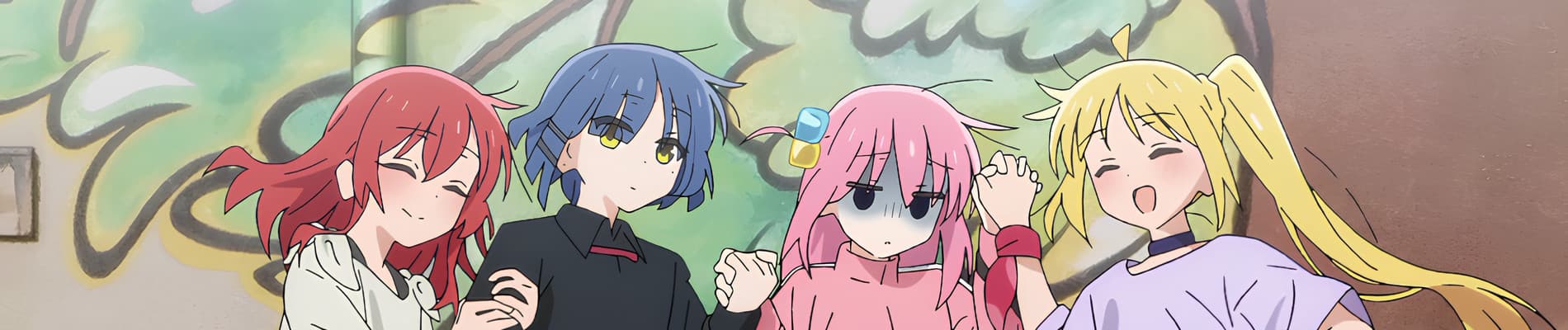
But remedy herself she gradually does, and with the show’s brand of delightfully-chaotic tone, it should come as no surprise that the people who help her on her personal journey are themselves part of a motley crew. Roped into performing at Starry Club with the exaggerative Ryou and the cheerful Nijika, and eventually joined by the bubbly and highly-encouraging Kita, Bocchi is thrust into the deep end of social interaction. She got her wish to be in a band and interact more, but she’s now part of an active group that all have a prior history. Bocchi is the oddball out, especially given that the other three girls have their own personal histories with one another.
Yet it doesn’t matter whether their reasons for being in Kessoku Band are, be they for sentimentality or for pettiness. By every weird measure, the reality is that they came together in the here-and-now, and Bocchi is among them. Each member realizes in their own way that Bocchi needs encouragement of some sort, and all are given an appropriate spotlight to show not only how much Bocchi’s presence in the band is valued, but also that Bocchi herself can overcome the various worries that a band must wrestle with, even under the veneer of comedy. The apprehensions are in and of themselves perfectly understandable and relatable. The fear of performing poorly and having everyone watch you, having your band members replace you, needing to sell tickets for a gig, and the like are all thoughts that most people who have been in or teach the arts (particularly music) inherently wrestle with on a consistent basis. Especially since Bocchi has been within the shell of herself and her own anxieties for so long, it makes the triumphs all the more worth striving for and to see pay off in the end.
And nowhere else is this captured more eloquently than in the performances. When the moments arrive for Bocchi to step on that stage and play the first chord, we see how, even in the incremental ways she has changed, this is not the same Bocchi that we witnessed initially. Similarly, this is not the same Kessoku Band that we first saw that played so poorly. Bocchi has grown, and this is a band that has also grown. Both in and outside of practice, they worked and bonded in tandem. Each has evolved beyond the confines of what they once were, even if the gradual changes undergone don’t completely rewrite who they are now. But with these changes nevertheless visible, one cannot help but smile and want to stand in the crowd with the others, bouncing along or turning the gaze upward to the girl who has started to come into her own.
Beneath all its style, verve, comedy, anxiety-laden dread, and rockin’ music, Bocchi the Rock! is ultimately sweet. Life-affirming and charming, it demonstrates the ability for a skilled director to walk the fine line between having anxiety as a comedic device while also showing that how human it is as well.
Rock on, Bocchi! You won’t be lonely with your guitar on that blue planet forever!

80 out of 85 users liked this review
