BOCCHI THE ROCK!
a review by das
a review by das
*Disclaimer: This is a thematic analysis rather than a classical review, so it may contain SPOILERS, although I have tried to keep them to a minimum. Thanks to @G0dzill2 and especially @ZNote for helping me with parts of this first review of mine!*
While social anxiety is a disorder which affects many millions around the world, there are surprisingly few anime which extensively thematize it. Fortunately, Bocchi the Rock! is an exception to that: not only does it feature a character who is deeply troubled by their social anxiety, but it also does a fantastic job at outlining her everyday troubles with some of the most exaggerated and funniest humor I have ever seen in anime.

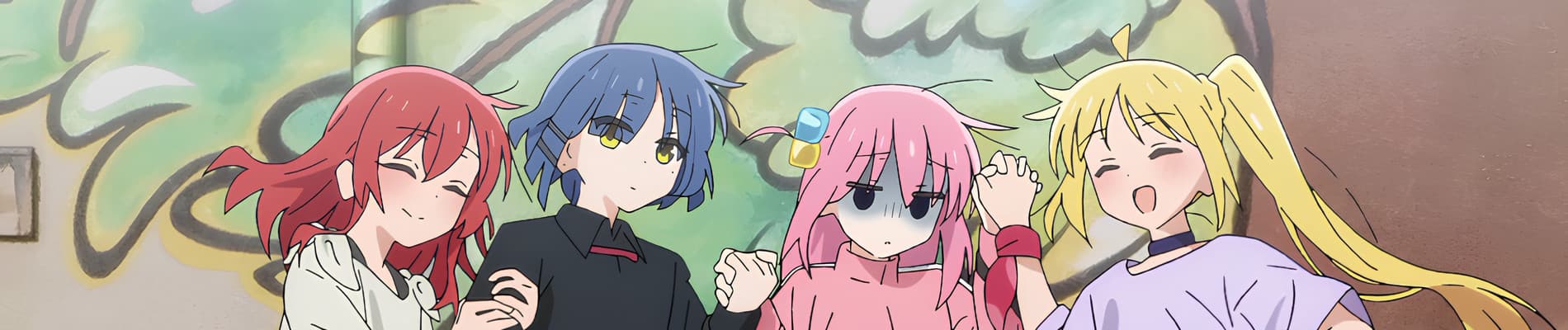
Meet Gotoh Hitori, commonly being referred to as Bocchi, a young high school freshman suffering from social anxiety. Because communicating is very challenging for her, she never had any friends during her adolescence, making her withdraw into her own world. However, it’s not like she wants to be alone: as a middle school freshman, she picked up the guitar to become more popular and socialize. Three years later, she has become incredibly good at the guitar and getting very positive feedback from guitar videos she has been uploading online, but hasn’t managed to make any friends in school. Instead, her exercising the guitar alone caused her to retreat further into her own shell, still being completely inexperienced in social interactions and increasingly scared by past attempts to socialize. As a result of her not being able to react adequately in unfamiliar situations, she avoids them and instead expects others to approach her first. However, despite putting in some effort to be noticed and approached by others, no one does.
But what if someone did?
By pure coincidence, Ijichi Nijika, a student from a different high school, finds Bocchi with her guitar, and asks her to fill in as a supporting guitarist in Nijika’s band. Bocchi, caught completely off guard by this request, agrees, despite being scared by this new challenge. Subsequently, they perform in a live house with the band’s bassist, Yamada Ryo, with whom Nijika is very close with. Although Bocchi is too scared to play her guitar in front of a crowd and can’t play very well due to lack of experience playing in a band, she enjoys this experience and decides to join the band. Kessoku Band, as it’s called, is the perfect opportunity for Bocchi to grow as a person, even though it certainly won’t be easy for her.
As it turns out, Ryo is not only highly skilled at playing the bass, but also very introverted, with Nijika being her only friend. However, unlike Bocchi, she enjoys being alone and doesn’t have trouble interacting with people – even though she tends to be a sadist with an above-it-all attitude. Aside from the last part, she is a great example of how one doesn’t have to be very sociable to become happy, and therefore represents a person Bocchi could strive to become similar to. Even though Ryo has some unique quirks like her unhealthy spending habits or exaggerative nature, she is, as the backbone of the band, a free spirit never fazed by anything, someone both Bocchi and Nijika can rely on, hence why she’s playing the bass.
After a short while, the band gains another member thanks to Bocchi’s efforts: the extremely extroverted Ikuyo Kita from Bocchi’s school, who is keen to join the band to get closer to Ryo. Being a very popular and outgoing person, she’s the polar opposite of Bocchi, but she has one shortcoming – she can’t play her instrument of choice, the guitar. However, she’s a hard worker, and therefore tries to get closer to the skill level of her fellow band members with the help of Bocchi and Ryo. Not only is she the first person who acknowledges Bocchi’s talent, with her praise greatly boosting Bocchi’s morale, but she is also her first student as well as a beacon of positivity for the entire band who never fails to motivate the other members.
However, the band doesn’t simply come into existence, it takes time to establish their identity, for the members to grow closer and practice together. Even though covering existing songs is easier for a new band, Kessoku Band decides quickly that they want to write original songs which aren’t produced to be marketable and don’t just affirm the status quo. Instead, they offer a deep insight into the mind of the lyricist Bocchi, with the lyrics not resonating with many, but potentially deeply touching those with whom they do. Kessoku Band aims to bring together a wide variety of individuals into one sound, from the introverted guitarist Bocchi to the calm bassist Ryo and the outgoing vocalist Kita. This massive variety is part of what makes Kessoku Band work, with each of the members supporting the others and elevating the others to new heights.
As the band gets immersed in life house culture and starts preparing for their first concert, Bocchi happens to meet drunkard Hiroi Kikuri, who is a bassist in her own indie band, SICK HACK. Despite Kikuri’s unhealthy drinking habits, she has some valuable experience from playing in a band as well as her own past as an introvert, and uses that knowledge to support Bocchi to the best of her abilities. Moreover, she exposes the members of Kessoku Band to her band’s music, boosting the friends' motivation to improve and play music together. In turn, instead of being scared by whoever is willing to listen to her music, Bocchi learns to appreciate the audience, resulting in Bocchi being more self-confident on stage, something which has been holding her back this whole time.
The impact of the band members and Kikuri can hardly be understated: As the band members grow closer, start writing original songs, and experience live houses, Bocchi’s social anxiety slowly but surely lessens. However, losing social anxiety is not an easy task: Bocchi still has to occasionally withdraw from social interactions and has trouble getting mentally and physically close to her fellow band members. Progress is slow, but she starts to enjoy longer social interactions and to dream of her becoming popular as a musician in the future. But even her dream slowly shifts from Bocchi imagining her success to her wishing for Kessoku Band’s success, resulting in the band members growing closer to each other than ever before as the common goal unites them.
But how did Bocchi arrive here just now? Why wasn’t her family able to support her during her childhood? Fortunately, the anime gives us some insight into this. Futari, Bocchi’s five-year old sister, is the polar opposite of her. Outgoing and popular, Futari often cannot understand the troubles and quirks of Bocchi, while her misguided attempts to help often cause her big sister to further retreat into her own world. Meanwhile, their parents, while trying to be supportive, seem to be unsure how to handle Bocchi. Additionally, the fact that Bocchi isn’t very talkative in her household complicates communication between the family members, resulting in mistrust. This spiral is very hard to break from within, so it only makes sense for someone from outside – the band – to improve Bocchi’s situation.
▶ VideoWhile I mainly discussed the more serious parts of Bocchi the Rock! so far, a massive part of what makes the anime work is undoubtedly its original experiments regarding the visuals. Whether it’s the use of real life footage, highly stylized and abstract cuts, or just stunning sakuga, every second of it is either absolutely hilarious, adds to the dramatic effect, or emotional impact of the respective scene. However, unlike in other anime, these kinds of cuts appear regularly, with each episode being a new feast for the eyes. But the animators are not the only ones worth praising: the overall visual direction is stunning, elevating both comedy, music performances, and regular Slice of Life scenes to new heights. The background artists, taking inspiration from numerous real life locations, managed to capture the atmosphere of the places incredibly well. Despite the character designs being rather simple, the character designers took the original character designs to a new level, adjusting the designs to better fit the tone of the show while giving each of the characters personality. Even if a joke in this show doesn’t hit like it’s supposed to, which inevitably happens in a comedy, the visual presentation of Bocchi the Rock is sure to make more than up for it.
Ultimately, Bocchi the Rock! does a fantastic job at treating social anxiety as a device for both comedy and introspection, while offering an intricate insight into Japanese live house culture and the life’s of the four characters. As the band grows together, Bocchi as a character becomes increasingly less introverted, being a prime example of someone who manages to overcome their social anxiety by putting in effort and in turn motivating anime fans who find themselves in a similar position. I can't possibly understate how gracious I am for the series.
So yeah, this anime is pretty rock.
287 out of 303 users liked this review
