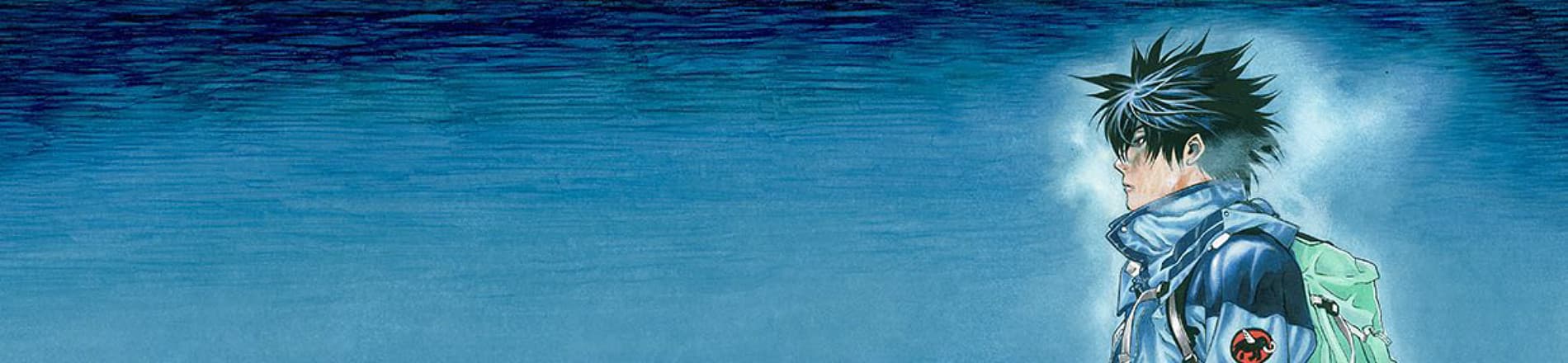
Kokou No Hito

***
#
Introduction
Disclaimer: This is a spoiler-free review. All spoilers will be hidden inside spoiler tags. Based on a true story, Kokou No Hito tells the tale of Mori Buntaro, who transfers to a new school and discovers his love for climbing there. This manga will immerse you into the world of climbing as Mori scales one mountain peak after another. However, this isn't your typical, unoriginal sports manga. Kokou No Hito is so much more than that. This is the story of a lone man's journey through some of life's deepest and darkest times as he learns that the largest mountain standing in his way is actually himself. One of the most masterfully crafted and nuanced characters in all of animanga has a story to tell, and this is his story.

***
#
The Good
Every highly regarded mangaka has a distinguishing characteristic—their "signature touch"—that sets them apart from the others. Some of my favorite mangakas and their distinguishing characteristics are:
- Sako Toshio - There is nothing he cannot accomplish. But he is most well-known for his unbelievable artistic development when Usogui was still in publication.
- Kentaro Miura - The ability to conjure up twisted fantasies with character dynamics that are almost flawless.
- Naoki Urasawa - He has the best character writing in manga I've seen so far. There are no characters that can compete with the writing of some of his antagonists.
- Inio Asano - His potrayal of the darkness within humans and society is unparalleled.
- Sui Ishida - He is the one with mastery over the use of dark shading in manga artwork.
So what separates Sakamoto sensei, the mangaka of Kokou no Hito, from the other mangaka? What defines his style? It's his talent for creating stunning, detailed backgrounds.

This man can draw both the light and the dark with ease; he's an absolute beast. His artistic flair doesn't end there. To depict the feelings that characters are feeling, he also makes extensive use of sophisticated artwork. For instance, the first time the protagonist felt sexually aroused, his legs up to his thighs were shown in the panel as tree roots. The is an entirely unique yet accurate portrayal of that experience, and I don't believe I need to explain why. When the characters are suffering from something like hypothermia or are gradually losing their minds, Sakamoto sensei also does strange things like mirroring objects, particularly text in panels, to help the reader see the world through the characters' eyes. Because Mori is so deeply introverted, it was crucial that the artwork accurately captured all that needed to be said because there isn't much words coming from his mouth.

Now for the reasons why the story is so amazing. The majority of this may be attributed to the fact that this isn't your typical sports manga. It has the kind of plot that prioritizes the characters and their growth rather than the sport aspect. Similar to that of 3-Gatsu No Lion and Ping Pong The Animation, but much darker. Climbing mountains alone is highly risky and impractical. Mori is a protagonist who perfectly complements the story, similar to how plus and minus are drawn to one another. A lonely, introverted man who has trouble relating to others falls in love with a team sport that demands trust and cooperation. Oh, how ironic. Even so, he continues to climb. He progresses alone toward some of the highest peaks and eventually earns the moniker "Immortal Solo Climber." Mori Buntaro is a very complex character. I could go on and on about his psychology for hours, but that would reveal plot details. So I'll make my explanation brief.
Spoiler, click to view
Towards the manga's conclusion, the motivation for his desire to climb becomes more clear. Not just because of his passion for climbing. His passion for climbing has its roots in his loneliness. Although the entire world is trying to get him, he chose to stay by himself. In the later chapters of the manga, it became clear that many people wanted to be near Mori. His need for solitude can be linked to the day his friend (I have a really bad memory so I'm not entirely sure if he was his friend though) committed suicide. Mori likely confided in no one else but him. Mori felt alone when he killed himself since the one person who cared for him had abandoned him. By pushing others away, he earns peace of mind. Perhaps he even holds himself responsible for the suicide. In any case, he gives himself the freedom to do whatever he wants by keeping others at a distance. It does not, however, imply that he gave up on himself. He still has trust in people and hasn't given up on them. Because of this very trust, he was frequently taken advantage of by others. He climbs because, to a lonely person like him, achieving a summit gives him a sense of accomplishment. He began judging success by achieving peaks because there were many things he never imagined achieving, such as a family. This was the reason he chose to stop climbing as soon as he started a family. Finally, everything in his life was complete. But eventually, he also developed a passion for mountains in addition to his thirst for success. So he starts up the mountain of his dreams. Only at the end did he understand that some things and ambitions are more worthwhile to fight for, such as his daughter's life and dreams. He had reached the pinnacle of his character growth with this revelation.
His passion of climbing and his thirst for success intertwine to provide one of the best character development arcs ever written. Yes, I would rate this manga's last arc 10 out of 10.

Speaking of arcs, almost all of the arcs were good. The latter parts of the manga were a step above the rest of the manga. Additionally, there were a number of supporting characters that made an impact on me as a reader and changed the way I saw the world. Not to mention the fact that Mori was impacted by each character in some manner, regardless of their screen-time. In order to fully immerse the reader in this manga's environment, the mangaka also used a great deal of personification. For instance, he gave the mountains a personality that made them punish any non-loner who attempted to climb them. It was intriguing to discover the many motivations behind the characters' climbing aspirations as well as how they perceived Mori and the mountains. You don't need to know how to climb to read this manga. This manga does a wonderful job in its initial arcs of teaching how climbing works before progressively introducing more complex ideas in the later ones. Also, as I already mentioned, the technical aspects of the sport are not thoroughly explored in this manga. Which brings up the fact that, although starting out a little slowly, this manga was actually extremely engaging from beginning to end.

***
#
The Bad
The consistency of this manga is one of its key issues. This is referring to the first six or so volumes. The backgrounds, which were once one of this manga's great strengths, unfortunately became one of its weaknesses at one point. Overall, the backgrounds were still stunning. I'm specifically referring to the artwork for the snowy landscapes. The mangaka's illustration of Mori's journey through the snow made it difficult for me to comprehend anything that is happening.

It's hard to understand what is happening because the characters aren't very visible in the snow. However, it's possible that this was done on purpose. Snow and chilly temperatures make it hard to see. Perhaps the mangaka drew it that way to further immerse the reader in the experience; I highly doubt that (I will explain why later on). There were other issues as well. Some spreads simply have too much information to read. On several panels, the mangaka crammed in a ton of text. He was trying to explain climbing as if it was the nen power system. The mangaka occasionally jammed in text because he was too lazy to deal with it. Every three pages or so, he proceeded to include dates and times, which is cool, but keeping track of them was difficult. Due to a sudden time skip, this was quite essential to the plot. The reader will undoubtedly become confused if they don't pay attention to the time and date stamp. Which is what I experienced. I didn't know there had been a time skip, and I got lost. To grasp the full picture, I had to go back and read those minor things again. Did I mention he also threw in an entire newspaper article, forcing me to read it all to find out what happened? The reading experience was hindered by these two problems for a while, but not long enough to cause a significant issue. Most likely, the mangaka switchup is what caused these issues to arise in the first place. Nabeta sensei completed the first two volumes, while Takano sensei completed the next two (according to AniList). Beginning with the fifth volume, Sakamoto sensei assumed control. He did spend some time perfecting the artwork of the snowy landscapes and gaining a clear understanding of the course he wanted the plot to go. However, it was all worthwhile in the end since he exceeded all expectations. Not only the backgrounds, but the overall artwork, was exquisite after Sakomoto sensei found his groove. He then prepared Mori for the near perfect conclusion.

Whilst on the topic of flaws; there are several timeskips, maybe too many. Although it detracts from the overall pacing, the mangaka does a fantastic job of explaining how things got to that point. This is going to sound ridiculous, but I believe the arcs are incredibly well-paced, even though the manga as a whole is not.I also detest how some of the early chapters' most important side characters just vanished without a trace. I believe Sakamoto sensei was unable to think of a way to include them in the story. Kokou No Hito doesn't have a proper manga wikipedia; it's incomplete. Therefore, the only resources available to you if you become lost are Reddit and Twitter. Now, this might not sound like a big deal, but believe me when I say that the numerous timeskips that occur and go back and forth without warning make it easy to become disoriented.
***
#
The ConclusionKokou No Hito is not flawless, but it is a masterpiece. The landscapes and scenery will draw you into the world within the manga and the characters and the story will help you grow as a person. It is one of the best air quotes sports manga of all time, maybe even the best. The protagonist had one of the best character developments I've ever seen. Should you read this? Heck yeah! What's stopping you? Add it to your lists right now folks. It's totally worth it. And a word of advice, read it while listening to soul lifting music like Porter Robinson or Frank Ocean for greater effect. If you stuck till the end of the review, thank you for reading! I will end this review with a panel of when Mori did unspeakable acts to a mountain (he didn't, I'm just playing)

As an added bonus, you can read some of my thoughts on the ending below. Please note that the part below is for everyone that has already read this manga thus contains spoilers:
Spoiler, click to view
So, let's talk about the finale, or perhaps the last arc. I simply want to make clear that even while there is some evidence to back them, my opinions on the ending are very subjective, so please take them with a grain of salt. Two things are clear from the story up to this point. First, everyone wants to take advantage of Mori, with the exception of his family. He sincerely loves his wife. What if this love is only a façade and nothing more? What if the subject of the last arc was even more sinister? The mangaka's portrayal of women is the second piece of evidence that lead me to this assumption. Women had only ever affected Mori negatively in the manga until he found his wife. They were presented in such an offensive manner that, if a snowflake were to read this, I have no doubt that he or she would take to Twitter to complain about how sexist Sakomoto sensei is. Do you all recall what Mori did for his wife? He prevented her from dying from the cold. Transference is a psychological term that describes how people might fall in love with important figures in their lives, such as someone who saved their life. What if she fell in love with Mori because of this. I make this statement for two reasons. The baby started crying when the wife received a call from the foreign ministry of affairs informing her that Mori might not be coming home, and she then abruptly told the baby to shut up. The fact that babies cry a lot shouldn't bother a kind mother like her (kind is how Sakamoto sensei portrayed her thus far). You may now argue that she yelled "shut up" out of a fit of rage and didn't give it much thought. But my second reason refutes that claim. In the last chapter, where was the family? They were shown in only one little panel without Mori. What would be the ending that we as fans want? Him getting back to his family right? So why did Sakomoto sensei never show them together? To show that at the end of the day Mori is still the same loneliness seeking guy who prioritizes mountains over everything? I doubt this is the case because then the story loses its merit. In the panel, the wife is pregnant, so perhaps she's with someone else and Mori is alone once again? The last chapters takes place one year after Mori returned. So unless Mori had sex with her 3 or 4 months after almost dying, there's no way she's pregnant. It would fit Sakamoto sensei's theme of women if she immediately lost her love for Mori when she got the call saying he might be dead. She probably went and found another man. This is a heavily controversial theory with lots of plot holes. What do you guys think? Did she really love Mori, or was it all a psychological condition like Stockholm syndrome? Drop me a DM with your thoughts if you want, and I'd be happy to discuss.I also have a request to everyone that has read this manga. What say we team up and write up that wiki to help fellow and future readers? If we can form a group of like at least 4 people, we could probably do something.